SAT MATH PRACTICE
Subscribe to our ▶️ YouTube channel 🔴 for the latest videos, updates, and tips.
The best way to do well on any test is to be experienced with the content. The purpose of the content given here is teach the students the concepts and battle-tested approaches they need to know to answer all types of questions in SAT math.
The goal is for every SAT question to be a simple reflex, something the students know how to handle instinctively because they have seen it so many times.
Format of the Test :
Two-stage adaptive test design : one Math section administered via two separately timed modules
1st module : 22 questions (20 operational questions and 2 pretest questions)
2nd module : 22 questions (20 operational questions and 2 pretest questions
The time limit for each module is 35 minutes and the build-in Desmos calculator is allowed for all the questions in both the modules.
Questions on the Math section represent one of four content domains :
• Algebra : Measures the ability to analyze, fluently solve, and create linear equations and inequalities as well as analyze and fluently solve equations and systems of equations using multiple techniques.
• Advanced Math : Measures skills and knowledge central for progression to more advanced math courses, including demonstrating an understanding of absolute value, quadratic, exponential, polynomial, rational, radical, and other nonlinear equations.
• Problem-Solving and Data Analysis : Measures the ability to apply quantitative reasoning about ratios, rates, and proportional relationships; understand and apply unit rate; and analyze and interpret one- and two-variable data•
• Geometry and Trigonometry (SAT, PSAT/NMSQT, PSAT 10)/Geometry (PSAT 8/9) : Measures the ability to solve problems that focus on area and volume; angles, triangles, and trigonometry; and circles (NOTE: PSAT 8/9 doesn’t include trigonometry questions.)
Questions from all four content domains appear in each test module. Across each module, questions are arranged from easiest to hardest, allowing each test taker the best opportunity to demonstrate what they know and can do. Table 3 provides an overview of the question distribution by content domain.
Table of Contents
2. Evaluating Expressions with Exponents
3.Solving Equations with Exponents
5. Rationalizing the Denominator
7. Simple Interest and Compound Interest
9. Exponential Growth and Decay
10. Doubling Time Growth Formula
15. Manipulating and Solving Equations
16. Algebraic Manipulation Problems
20. Interpreting Linear Models
24. Equation Solving Strategies
30. Exponential vs Linear Growth - Concept
31. Exponential vs Linear Growth - Questions
34. The Language and Tools of Algebra
39. Solving Problems on Triangles
SAT Math Video Lesson 1

SAT Math Video Lesson 2
SAT Math Video Lesson 3

SAT Math Video Lesson 4

Hardest SAT Math Questions
To get more Digital SAT Math Content, click here.
Sample SAT Math Questions
Question 1 :
If f(x) = x/2 - 1, what is f(-2x + 1) equal to?
A) -x - 1/2
B) -x + 1/2
C) x - 1/2
D) x + 1/2
Answer :
f(x) = x/2 - 1
Replace x by -2x + 1.
f(-2x + 1) = (-2x + 1)/2 - 1
= -2x/2 + 1/2 - 1
= -x - 1/2
The correct answer choice is (D).
Question 2 :
If x = 1 - a/b, which of the following is equivalent to 1/x?
A) b/(1 + a)
B) b/(1 - a)
C) (b - 1)/a
D) b/(b - a)
Answer :
x = 1 - a/b
x = b/b - a/b
x = (b - a)/b
Take reciprocal on both sides.
1/x = b/(b - a)
The correct answer choice is (A).
Question 3 :
(16 - 4x)/2 = nx + 8 + 3x
If the linear equation above is an identity, what is the value of n?
A) -5
B) -3
C) -1
D) 3
Answer :
(16 - 4x)/2 = nx + 8 + 3x
16/2 - 4x/2 = 8 + nx + 3x
8 - 2x = 8 + (n + 3)x
Since the equation is identity, each side is the same.
Equate the coefficients of x.
-2 = n + 3
Subtract 3 from both sides.
-5 = n
The correct answer choice is (A).
Question 4 :
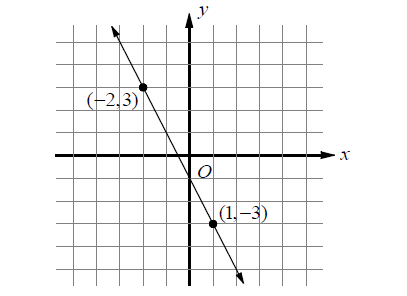
Which of the following equations represents a line that contains the point (1/2, 3) and it is parallel to the line shown above?
A) y = x + 5/2
B) y = -x + 7/2
C) y = -2x + 4
D) y = -2x + 6
Answer :
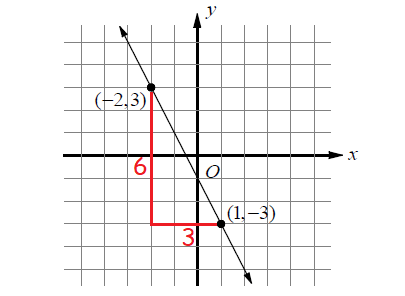
For the above line,
rise = 6
run = 3
Since the line is a falling line, the slope has to be negative.
slope = rise/run
= -6/3
= -2
Equation of the line which is parallel to the above line is
y = -2x + b ----(1)
(since the lines are parallel, the slopes must be equal)
Since (1) contains the point (1/2, 3), substitute x = 1/2 and y = 3.
3 = -2(1/2) + b
3 = -1 + b
4 = b
Therefore, equation of the required line is
(1)----> y = -2x + 4
The correct answer choice is (C).
Question 5 :
If 2√p + 3√q = 7√q, where p > 0 and q > 0, what is p in terms of q?
Answer :
2√p + 3√q = 7√q
Subtract 3√q from both sides.
2√p = 4√q
Divide both sides by 2.
√p = 2√q
Squaring both sides.
(√p)2 = (2√q)2
p = 22(√q)2
p = 4y
Question 6 :
6x + my = 3
2x + y = n
For what values of m and n of will the system of equations above have infinitely many solutions?
Answer :
Write the given two linear equations in slope-intercept form :
6x + my = 3 :
6x + my = 3
my = -6x + 3
y = (-6/m)x + 3/m
2x + y = n :
2x + y = n
y = -2x + n
If a system of linear equations has infinitely many solutions, the two equations must be equivalent.
That is, both the equations must have the same slope and same y-intercept.
Equate the slopes.
-6/m = -2
6/m = 2
m/6 = 1/2
m = 3
Equate the y-intercepts.
3/m = n
Substitute m = 3.
3/3 = n
1 = n
Therefore, m = 3 and n = 1.
Question 7 :
William is playing a board game in which he has to collect as many cards as possible. On his first turn, he loses 18 percent of his cards. On the second turn, he increases his card count by 36 percent. If his final card count after these two turns is n, which of the following represents his starting card count in terms of n?
A) n/[(1.18)(0.64)]
B) (1.18)(0.64)n
C) n/[(1.36)(0.82)]
D) (0.82)(1.36)n
Answer :
Let x be the starting card count.
Number of cards after losing 18% of cards on the first turn :
= (100 - 18)% ⋅ x
= 82% ⋅ x
= 0.82x
Number of cards after increasing 36% of cards on the second turn :
= (100 + 36)% ⋅ 0.82x
= 136% ⋅ 0.82x
= 1.36 ⋅ 0.82x
= (1.36)(0.82)x
Given : Final card count after these two turns is n.
Then, we have
(1.36)(0.82)x = n
Divide each side by (1.36)(0.82).
x = n/[(1.36)(0.82)]
So, the starting card count in terms of n is
n/[(1.36)(0.82)]
Therefore, option C is correct.
Question 8 :
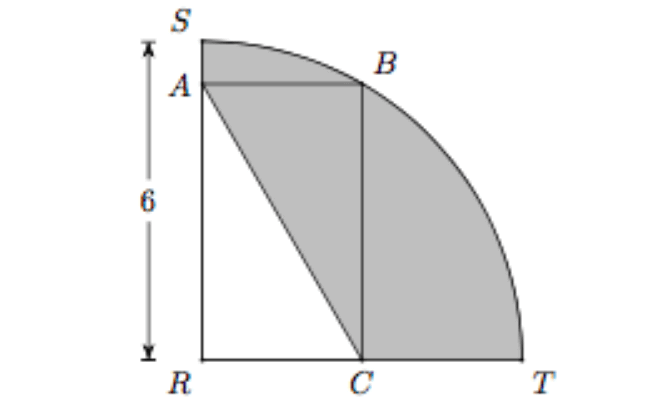
In the figure above, arc SBT is one quarter of a circle with center R and radius 6. If the length plus the width of rectangle ABCR is 8, Then the perimeter of the shaded region is
(A) 8 + π (B) 10 + 3π
(C) 14 + 3π (D) 8 + π
Answer :
Idea to solve this problem :
Find the perimeter of one quarter of the circle STR. Subtract the length (AR) and width (RC) of the rectangle ABCR from the above perimeter. Then, add the the length of the diagonal (AC).
Step 1 :
Perimeter of one quarter of the circle STR is
= 2πr/4 + 2r
= πr/2 + 2r
Substitute 6 for r.
= 6π/2 + 2(6)
= 3π + 12
Step 2 :
Given : The length plus width of rectangle ABCR is 8.
Then,
AR + RC = 8
Subtract 8 from the perimeter found in step 1.
= 3π + 12 - 8
= 3π + 4
Step 3 :
The two diagonals of the rectangle ABCR are AC and RB in which RB is being as radius of the circle.
So, RB = 6.
In any rectangle, the lengths of two diagonals are always congruent.
Then, AC = 6.
Add the length of the diagonal AC (= 6) to the result of step 2.
= 3π + 4 + 6
= 3π + 10
Perimeter of the shaded region is (10 + 3π).
The correct answer choice is (B).
Question 9 :
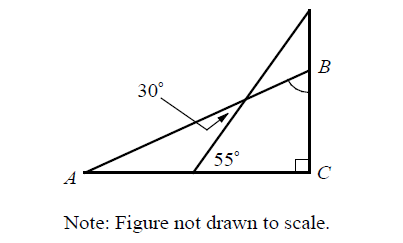
In the figure above AC is perpendicular to BC. What is the measure of m∠ABC?
Answer :
By Exterior Angle Theorem,
m∠A + 30° = 55°
m∠A = 25°
In triangle ABC,
m∠BAC + m∠ACB + m∠ABC = 180
25° + 90° + m∠ABC = 180°
115° + m∠ABC = 180°
Subtract 115° from both sides.
m∠ABC = 65°
Question 10 :
n, n - 3, 2n - 1, 3n - 4 and 5n + 12
The average (arithmetic mean) of five numbers given above is 8. Which of of the following is true?
A) median = 5, mode = 7
B) median = 5, mode = 5
C) median = 7, mode = 7
D) median = 7, mode = 5
Answer :
Average of five numbers = 8
(n + n - 3 + 2n - 1 + 3n - 4 + 5n + 12)/5 = 8
(12n + 4)/5 = 8
Multiply both sides by 5.
12n + 4 = 40
Subtract 4 from both sides.
12n = 36
Divide both sides by 12.
n = 3
Then,
n - 3 = 0
2n - 1 = 5
3n - 4 = 5
5n + 12 = 27
The given five numbers are 3, 0, 5, 5 and 27.
Arrange the numbers from least to greatest.
0, 3, 5, 5, 27
median = 5
mode = 5
The correct answer choice is (B).
Subscribe to our ▶️ YouTube channel 🔴 for the latest videos, updates, and tips.
Kindly mail your feedback to v4formath@gmail.com
We always appreciate your feedback.
About Us | Contact Us | Privacy Policy
©All rights reserved. onlinemath4all.com

Recent Articles


-
Digital SAT Math Questions and Answers (Part - 13)
May 10, 26 05:50 PM
 Digital SAT Math Questions and Answers (Part - 13)
 -
Problems on Solving Logarithmic Equations
Apr 24, 26 09:30 PM
Problems on Solving Logarithmic Equations -
Solving Logarithmic Equations Worksheet
Apr 24, 26 09:05 PM
 Solving Logarithmic Equations Worksheet