The Hidden Patterns in Hard SAT Math Questions
Subscribe to our ▶️ YouTube channel 🔴 for the latest videos, updates, and tips.
Some math questions in SAT may require super advanced calculus and they are designed to test ability of the students to structure, simplify, and spot traps under time pressure. The hidden patterns are consistent, recurring logical structures that College Board uses to increase difficulty. Let's see, how the hidden patterns can be used to solve some hard SAT math questions.
Question 1 :
The function N gives the estimated number of bacteria in a growth medium t hours after a study begun. According to the function, the number of bacteria is estimated to increase by 20% every k minutes. What is the value of k?
A) 45
B) 60
C) 80
D) 100
Answer :
Question 2 :
Circle A has a radius of 3n and circle B has a radius of 129n, where n is a positive constant. The area of circle B is how many times the area of circle A?
A) 43
B) 86
C) 129
D) 1,849
Answer :
Question 3 :
The measure of angle R is 2π/3 radians. The measure of angle T is 5π/12 radians greater than the measure of angle R. What is the measure of angle T, in degrees?
A) 75
B) 120
C) 195
D) 390
Answer :
Question 4 :
The number of bacteria in a growth medium is expected to increase by 140% every 1/5 hours during a period of observation. The number of bacteria in the growth medium is during a period of observation. The number of bacteria in the growth medium is estimated to be 12,000 when the period of observation begun. Which function P gives the expected number of bacteria in this growth medium t hours after the period of observation begun?
A) P(t) = 12000(1.40)t/5
B) P(t) = 12000(1.40)5t
C) P(t) = 12000(1.40)t/5
D) P(t) = 12000(1.40)5t
Answer :
Question 5 :
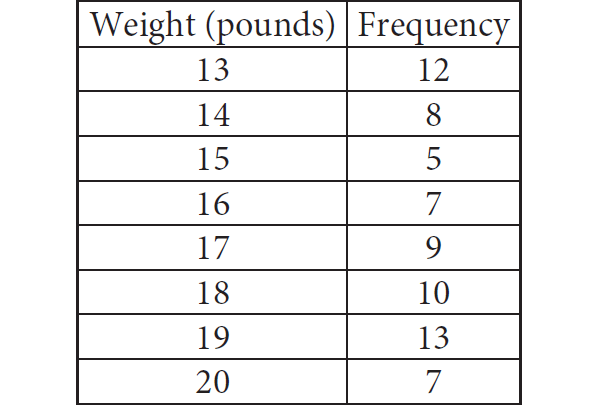
The frequency table summarizes a data set of the weights, rounded to the nearest pound, of 71 tortoises. A weight of 39 pounds is added to the original data set, creating a new data set of the weights, rounded to the nearest pound, of 72 tortoises. Which statement best compares the mean and median of the new data set to the mean and median of the original data set?
A) The mean of the new data set is greater than the mean of the original data set, and the median of the new data set is greater than the median of the original data set.
B) The mean of the new data set is greater than the mean of the original data set, and the medians of the two data sets are equal.
C) The mean of the new data set is less than the mean of the original data set, and the median of the new data set is less than the median of the original data set.
D) The mean of the new data set is less than the mean of the original data set, and the medians of the two data sets are equal.
Answer :
Question 6 :
x - 29 = (x - a)(x - 29)
Which of the following are solutions to the given equation, where a is a constant and a > 30 ?
I. a
II. a + 1
III. 29
A) I and II only
B) I and III only
C) II and III only
D) I, II, and III
Answer :
Question 7 :
The functions f and g are defined by the given equations, where x ≥ 0. Which of the following equations displays, as a constant or coefficient, the maximum value of the function it defines, where x ≥ 0 ?
I. f(x) = 18(1.25)x + 41
II. g(x) = 9(0.73)x
A) I only
B) II only
C) I and II
D) Neither I nor II
Answer :
Question 8 :
The perimeter of an equilateral triangle is 852 centimeters. The three vertices of the triangle lie on a circle. The radius of the circle is w√3 centimeters. What is the value of w?
Answer :
Question 9 :
One gallon of stain will cover 170 square feet of a surface. A yard has a total fence area of w square feet. Which equation represents the total amount of stain S, in gallons, needed to stain the fence in this yard twice?
A) S = w/170
B) S = 170w
C) S = 340w
D) S = w/85
Answer :
Question 10 :
Triangles PQR and LMN are graphed in the xy-plane. Triangle PQR has vertices P, Q, and R at (4, 5), (4, 7), and (6, 5), respectively. Triangle LMN has vertices L, M, and N at (4, 5), (4, 7 + k), and (6 + k, 5), respectively, where k is a positive constant. If the measure of ∠Q is t°, what is the measure of ∠N?
A) (90 - (t - k))°
B) (90 - (t + k))°
C) (90 - t)°
D) (90 + k)°
Answer :
Question 11 :
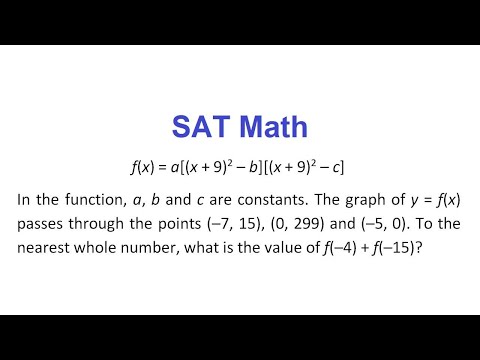
f(x) = a[(x + 9)2 – b][(x + 9)2 – c]
In the function, a, b and c are constants. The graph of y = f(x) passes through the points (–7, 15), (0, 299) and (–5, 0). To the nearest whole number, what is the value of f(–4) + f(–15)?
Answer :
Question 12 :
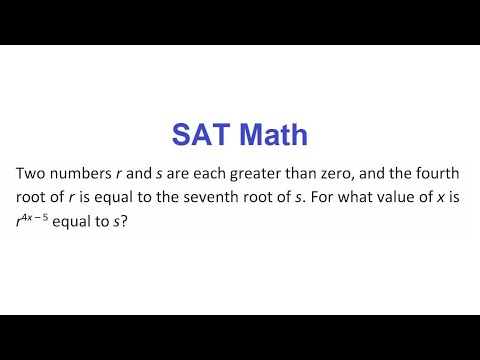
Two numbers r and s are each greater than zero, and the fourth root of r is equal to the seventh root of s. For what value of x is r4x – 5 equal to s?
Answer :
Question 13 :
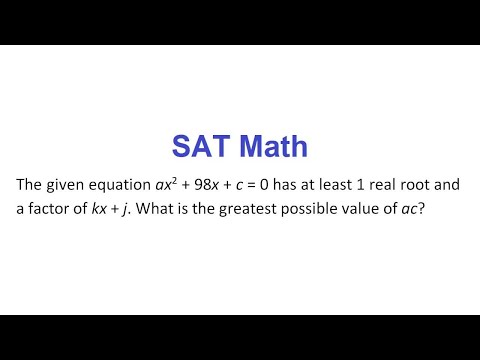
The given equation ax2 + 98x + c = 0 has at least 1 real root and a factor of kx + j. What is the greatest possible value of ac?
Answer :
Question 14 :

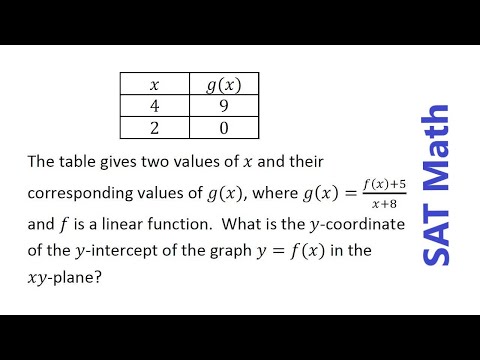
The table gives two values of x and their corresponding values of g(x), where
and f is a linear function. What is the y-coordinate of the y-intercept of the graph y = f(x) in the xy-plane?
Answer :
Question 15 :
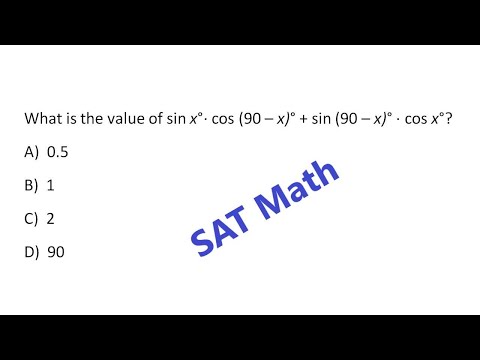
What is the value of sin x°⋅ cos (90 – x)° + sin (90 – x)° ⋅ cos x°?
A) 0.5
B) 1
C) 2
D) 90
Answer :
Question 16 :
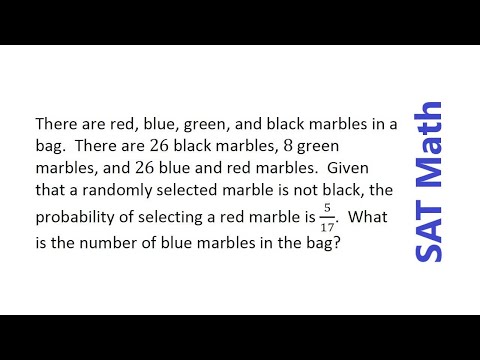
There are red, blue, green, and black marbles in a bag. There are 26 black marbles, 8 green marbles, and 26 blue and red marbles. Given that a randomly selected marble is not black, the probability of selecting a red marble is 5/17. What is the number of blue marbles in the bag?
Answer :
Question 17 :
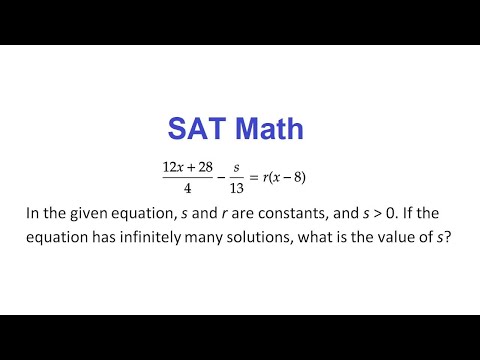
In the given equation, s and r are constants, and s > 0. If the equation has infinitely many solutions, what is the value of s?
Answer :
Question 18 :
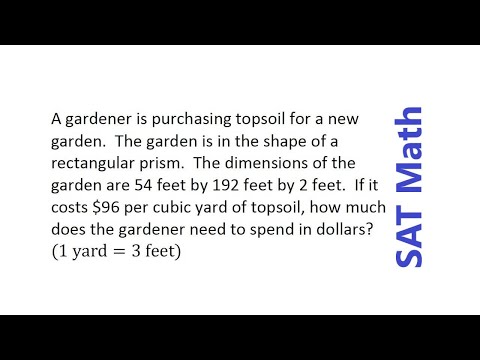
A gardener is purchasing topsoil for a new garden. The garden is in the shape of a rectangular prism. The dimensions of the garden are 54 feet by 192 feet by 2 feet. If it costs $96 per cubic yard of topsoil, how much does the gardener need to spend in dollars?
(1 yard = 3 feet)
Answer :
Question 19 :
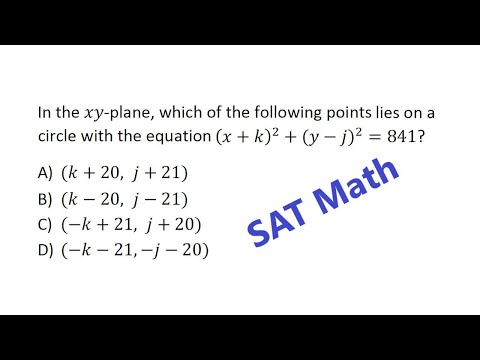
In the xy-plane, which of the following points lies on a circle with the equation (x + k)2 + (y - j)2 = 841 ?
A) (k + 20, j + 21)
B) (k - 20, j - 21)
C) (-k + 21, j + 20)
D) (-k - 21, -j - 20)
Answer :
Question 20 :
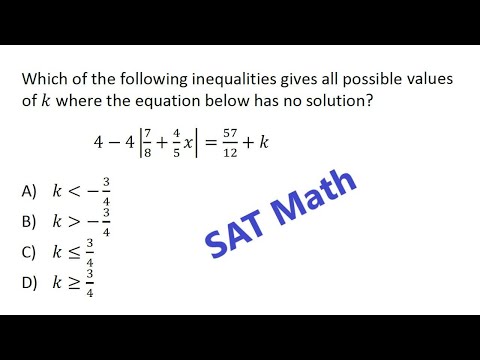
Which of the following inequalities gives all possible values of k where the equation below has no solution?
A) k < -3/4
B) k > -3/4
C) k ≤ 3/4
D) k ≥ 3/4
Answer :
You might like these
Solving the HARDEST SAT Math Questions ONLY using Desmos
Tricky SAT Math Problems Solved Easily
Challenging SAT Math Questions
How to Solve the Hardest SAT Math Problems
Hard SAT Math Questions with Video Solutions
SAT Math Practice Test with Answers
SAT Math Practice Questions with Answers
SAT Math Problems and Solutions
SAT Math Practice Problems with Answers
25 of the Hardest SAT Math Questions
The 15 Hardest SAT Math Questions Ever
The 10 Most Difficult SAT Math Questions
The 10 Hardest SAT Math Questions
10 Tricky SAT Math Questions with Answers
SAT Math Preparation with Hard Questions
SAT Math Practice Hard Questions
SAT Math Practice Problems Hard
The Hidden Patterns in Hard SAT Math Questions
How to Solve Challenging Math Problems in SAT
How to Master the SAT Math Section
Problem Solving Strategies for SAT Math
Conquering the Hardest SAT Math Questions
SAT Math Problems on Exponents and Radicals
Subscribe to our ▶️ YouTube channel 🔴 for the latest videos, updates, and tips.
Kindly mail your feedback to v4formath@gmail.com
We always appreciate your feedback.
About Us | Contact Us | Privacy Policy
©All rights reserved. onlinemath4all.com

Recent Articles


-
Digital SAT Math Practice Test with Answers (Part - 18)
Oct 22, 26 07:55 PM
 Digital SAT Math Practice Test with Answers (Part - 18)
 -
AP Calculus BC Problems with Solutions
Sep 30, 26 01:08 PM
 AP Calculus BC Problems with Solutions
 -
Digital SAT Math Practice Test with Answers (Part - 17)
Sep 30, 26 01:00 PM
 Digital SAT Math Practice Test with Answers (Part - 17)