VERTICAL ANGLES THEOREM WORKSHEET
Subscribe to our ▶️ YouTube channel 🔴 for the latest videos, updates, and tips.
Problem 1 :
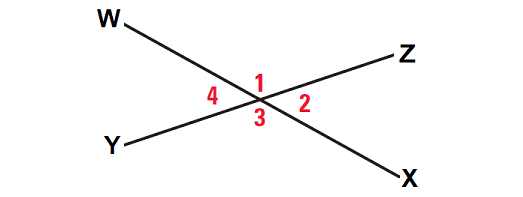
In the diagram shown below, WX and YZ are two straight lines intersecting. If m∠1 = 140°, find the measures of the other three angles.
Problem 2 :
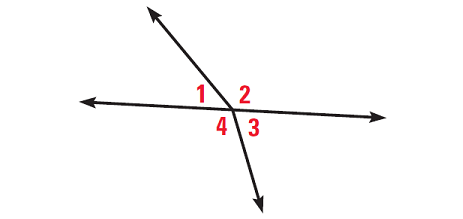
Look at the picture shown below and answer the following questions.
(i) Are 1 and 3 vertical angles ?
(i) Are 2 and 4 vertical angles ?
Problem 3 :
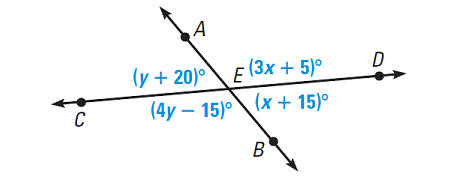
In the diagram shown below, using Linear Pair Postulate, solve for x and y. Then, find the angle measures and analyze your results with Vertical Angles Theorem.
Problem 4 :
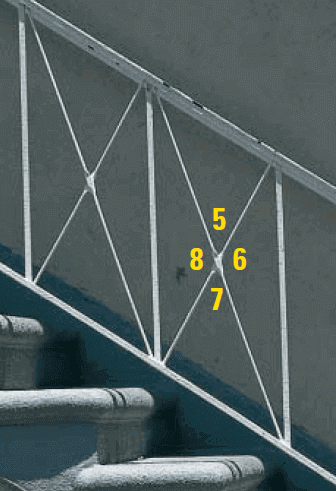
In the stair railing shown at the right, if ∠6 has a measure of 130°, find the measures of the other three angles.
Problem 5 :
Problem 6 :

Problem 7 :

Problem 8 :

Problem 9 :
Use the diagram below.

a. Use the Vertical Angles Theorem to write an equation.
b. Solve your equation to find the value of x.
c. Find the measures of the acute angles formed by the lines.
d. Find the measures of the obtuse angles formed by the lines.
1. Answer :
∠1 and ∠2 form a linear pair, they are supplementary.
m∠1 + m∠2 = 180°
Substitute m∠1 = 140°.
140° + m∠2 = 180°
Subtract 140° from each side.
m∠2 = 40°
∠1 and ∠3 are vertical angles, they are equal.
m∠3 = m∠1
m∠3 = 140°
∠2 and ∠4 are vertical angles, they are equal.
m∠4 = m∠2
m∠4 = 40°
Therefore,
m∠2 = 40°
m∠3 = 140°
m∠4 = 40°
2. Answer :
(i) Are ∠1 and ∠3 vertical angles ?
(iI) Are ∠2 and ∠4 vertical angles ?
Solution (i) :
No. The sides of the angles do not form two pairs of opposite rays.
Solution (ii) :
No. The sides of the angles do not form two pairs of opposite rays.
3. Answer :
Use the fact that the sum of the measures of angles that form a linear pair is 180°.
Solving for x :
∠AED and ∠DEB form a linear pair.
m∠AED + m∠DEB = 180°
Substitute m∠AED = (3x + 5)° and m∠DEB = (x + 15)°.
(3x + 5)° + (x + 15)° = 180°
Simplify.
4x + 20 = 180
Subtract 20 from each side.
4x = 160
Divide each side by 4.
x = 40
Solving for y :
∠AEC and ∠CEB form a linear pair.
m∠AEC + m∠CEB = 180°
Substitute m∠AEC = (y + 20)° and m∠CEB = (4y - 15)°.
(y + 20)° + (4y - 15)° = 180°
Simplify.
5y + 5 = 180
Subtract 5 from each side.
5y = 175
Divide each side by 5.
y = 35
Use substitution to find the angle measures :
m∠AED = (3x + 5)° = (3 • 40 + 5)° = 125°
m∠DEB = (x + 15)° = (40 + 15)° = 55°
m∠AEC = ( y + 20)° = (35 + 20)° = 55°
m∠CEB = (4y - 15)° = (4 • 35 - 15)° = 125°
So, the angle measures are 125°, 55°, 55°, and 125°. Because the vertical angles are congruent, the result is reasonable.
4. Answer :
∠5 and ∠6 form a linear pair.
m∠5 + m∠6 = 180°
Substitute m∠6 = 130°
m∠5 + 130° = 180°
Subtract 130° from both sides.
m∠5 = 50°
∠5 and ∠7 are vertical angles, they are equal.
m∠7 = m∠5 = 50°
∠6 and ∠8 are vertical angles, they are equal.
m∠8 = m∠6 = 130°
Therefore,
m∠5 = 50°
m∠7 = 50°
m∠8 = 130°
5. Answer :
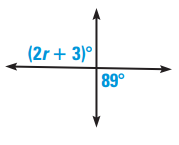
Vertical angles are equal,
2r + 3 = 89
2r = 89 - 3
2r = 86
r = 86/2
r = 43
6. Answer :
Vertical angles are equal,
3x = 2x + 16
3x - 2x = 16
x = 16
7. Answer :
Sum of adjacent angles = 180
15t + 20t + 5 = 180
35t + 5 = 180
35t = 180 - 5
35t = 175
t = 175/35
t = 5
So, the value of t is 5.
8. Answer :
Find the values of x and y in the diagram below.
Vertical angles are equal.
7x - 2 = 11x - 34
7x - 11x = -34 + 2
-4x = -32
x = 32/4
x = 8
Sum of adjacent angles = 180
7x - 2 + 18y = 180
Applying the value of x, we get
7(8) - 2 + 18y = 180
56 - 2 + 18y = 180
54 + 18y = 180
18y = 180 - 54
18y = 126
y = 126/18
y = 7
9. Answer :
a) 6x = 4x + 8
b) Solving for x,
6x - 4x = 8
2x = 8
x = 8/2
x = 4
c) Finding acute angle :
Applying the value of x, we get
= 6(4)
= 24
So, the required acute angle is 24 degree.
d) Finding obtuse angle :
= 180 - 24
= 156
So, the required obtuse angle is 156 degree.
Subscribe to our ▶️ YouTube channel 🔴 for the latest videos, updates, and tips.
Kindly mail your feedback to v4formath@gmail.com
We always appreciate your feedback.
About Us | Contact Us | Privacy Policy
©All rights reserved. onlinemath4all.com

Recent Articles


-
Digital SAT Math Practice Test with Answers (Part - 18)
Oct 06, 26 07:23 PM
Digital SAT Math Practice Test with Answers (Part - 18) -
AP Calculus BC Problems with Solutions
Sep 30, 26 01:08 PM
 AP Calculus BC Problems with Solutions
 -
Digital SAT Math Practice Test with Answers (Part - 17)
Sep 30, 26 01:00 PM
 Digital SAT Math Practice Test with Answers (Part - 17)