USE THE EUCLIDEAN ALGORITHM TO FIND GCD OF THE GIVEN POLYNOMIALS
Subscribe to our ▶️ YouTube channel 🔴 for the latest videos, updates, and tips.
Step 1 :
First, divide f(x) by g(x) to obtain
f(x) = g(x)q(x)+ r(x)
where q(x) is the quotient and r(x) is remainder,
so, deg (g(x)) > deg (r(x))
If the remainder r(x) is 0, then g(x) is the GCD of f(x) and g(x).
Step 2 :
If the remainder r(x) is non-zero, divide g(x) by r(x) to obtain
g(x) = r(x) q(x)+ r1(x)
where r1(x) is the remainder.
So, deg r(x) > deg r1(x)
If the remainder r1(x) is 0, then r(x) is the required GCD.
Step 3 :
If r1(x) is non-zero, then continue the process until we get zero as remainder.
The remainder in the last but one step is the GCD of f(x) and g(x).
We write GCD(f(x), g(x)) to denote the GCD of the polynomials f(x) and g(x).
Find the GCD of the following pairs of polynomials using division algorithm
(i) x3-9x2+23x-15 and 4x2-16x+12
(ii) 3x3+18x2+33x+18, 3x2+13x+10
(iii) 2x3+2x2+2x+2, 6x3+12x2+6x+12
(iv) x3-3x2+4x-12, x4+x3+4x2+4x
(i) Answer :
x3-9x2+23x-15 and 4x2-16x+12
Let f(x) = x3-9x2+23x-15 and
g(x) = 4x2-16x+12
g(x) = 4(x2-4x+3)
Here, deg(f(x)) > deg (g(x))
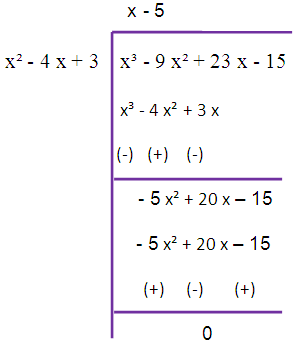
By dividing f(x) by g(x), we get 0 as remainder. So, the required GCD is x-5.
(ii) Answer :
3x3+18x2+33x+18, 3x2+13x+10
Let f(x) = 3x3+18x2+33x+18 and g(x) = 3x2+13x+10
Here, deg f(x) > deg g(x)
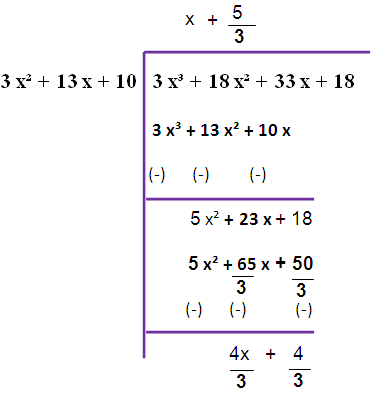
By dividing f(x) by g(x) we are not getting zero. So, we have to do this long division once again.
Now we are taking 4/3 as common from the remainder. So that we are getting (4/3)(x+1)
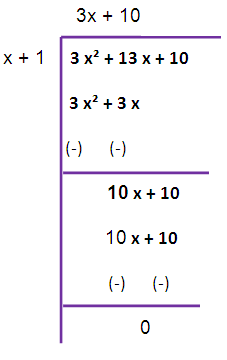
So, the greatest common divisor is x+1.
(iii) Answer :
2x3+2x2+2x+2, 6x3+12x2+6x+12
Let f(x) = 2x3+2x2+2x+2 and g(x) = 6x3+12x2+6x+12
f(x) = 2(x3+x2+x+1)
g(x) = 6(x3+2x2+x+2)
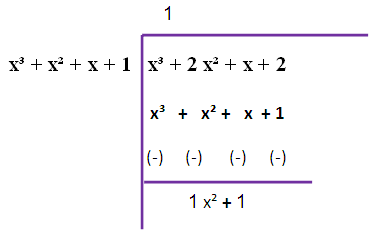
Since we are not getting zero, we have to do this long division once again
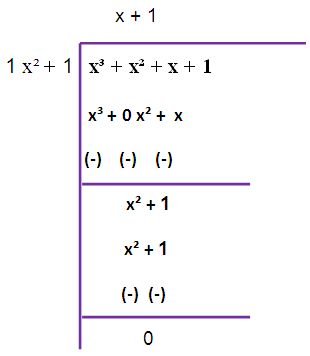
So, the required GCD is 2 (x2+1).
(iv) Answer :
x3-3x2+4x-12, x4+x3+4x2+4x
Let f(x) = x3-3x2+4x-12 and g(x) = x4+x3+4x2+4x
f(x) = x3-3x2+4x-12
g (x) = x(x3+x2+4x+4)
Here, deg (f(x)) = deg (g(x))
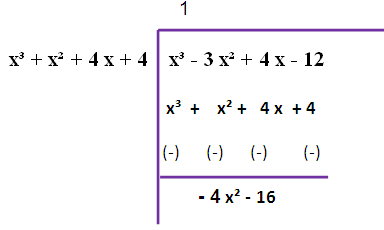
Since we are not getting zero, we have to do this long division once again
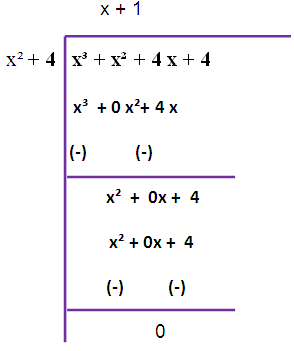
So, the required GCD is (x2+4).
Subscribe to our ▶️ YouTube channel 🔴 for the latest videos, updates, and tips.
Kindly mail your feedback to v4formath@gmail.com
We always appreciate your feedback.
About Us | Contact Us | Privacy Policy
©All rights reserved. onlinemath4all.com

Recent Articles


-
AP Calculus AB Problems with Solutions (Part - 1)
May 29, 26 09:41 PM
 AP Calculus AB Problems with Solutions (Part - 1)
 -
SAT Math Practice Problems with Answers
May 21, 26 01:17 AM
 SAT Math Practice Problems with Answers
 -
Digital SAT Math Questions and Answers (Part - 13)
May 17, 26 09:03 AM
 Digital SAT Math Questions and Answers (Part - 13)