UNION AND INTERSECTION OF SETS
Subscribe to our ▶️ YouTube channel 🔴 for the latest videos, updates, and tips.
Union of Two Sets :
The union of two sets contains all the elements contained in the both sets without repetition of elements.
The union is notated A⋃B.
Intersection of Two Sets :
The intersection of two sets contains the element which are common to both the sets.
The intersection is notated A ⋂ B.
Example 1 :
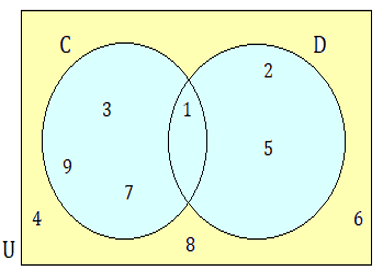
List :
(i) set C
(ii) set D
(iii) set U
(iv) set CnD
(v) set CUD
Solution :
(i) set C
The elements in set C = {1, 3, 7, 9}
(ii) set D
The elements in set D = {1, 2, 5}
(iii) set U
The universal set with all the elements in set
U = {1, 2, 3, 4, 5, 6, 7, 8, 9}
(iv) set CnD
The common elements in sets C and D is
C n D = {1}
(v) set C U D
All the elements in sets C and D is
CUD = {1, 2, 3, 5, 7, 9}
Example 2 :
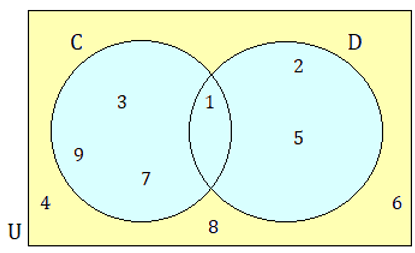
Find :
(i) n(C)
(ii) n(D)
(iii) n(U)
(iv) n(CnD)
(v) n(CUD)
Solution :
(i) n(C)
The number of elements in set C is 4.
So, n(C) = 4
(ii) n(D)
The number of elements in set D is 3
So, n(D) = 3
(iii) n(U)
The number of elements in universal set U is 9
n(U) = 9
(iv) n (CnD)
The number of common elements in sets C and D is 1.
n(CnD) = 1
(v) n (CUD)
The number of all elements in sets C and D is 6.
n(CUD) = 6
Example 3 :
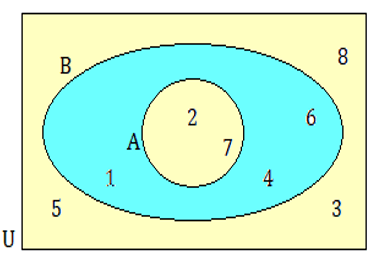
List :
(i) set A
(ii) set B
(iii) set U
(iv) set AnB
(v) set AUB
Solution :
(i) A = {2, 7}
(ii) B = {1, 4, 6, 2, 7}
(iii) U = {1, 2, 3, 4, 5, 6, 7, 8}
(iv) AnB = {2,7}
(v) AUB = {1, 2, 4, 6, 7}
Example 4 :
Find :
(i) n(A)
(ii) n(B)
(iii) n(U)
(iv) n(AnB)
(v) n(AUB)
Solution :
(i) n(A)
The number of elements in set A = 2
(ii) n(B)
The number of elements in set B = 5
(iii) n(U)
The number of elements in universal set U = 8
(iv) n(AnB)
The number of common elements in sets A and B is 2
n(AnB) = 2
(v) n(AUB)
The number of all elements in sets A and B is 5.
So, n(AUB) = 5
Example 5 :
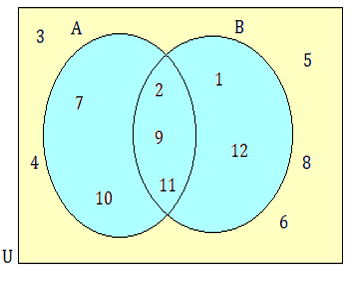
Consider U = {x | x ≤ 12, x Є Z+}
A = {2, 7, 9, 10, 11} and B = {1, 2, 9, 11, 12}
Show these sets on a Venn diagram.
Solution :
Example 6 :
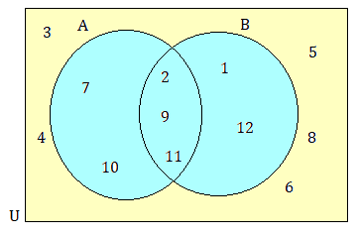
List the elements of :
(i) AnB
(ii) AUB
(iii) B’
Solution :
(i) AnB = {2, 9, 11}
(ii) AUB = {1, 2, 7, 9, 10, 11, 12}
(iii) B’
The elements which do not belong to set B is
B’ = {3, 4, 5, 6, 7, 8, 10}
Example 7 :
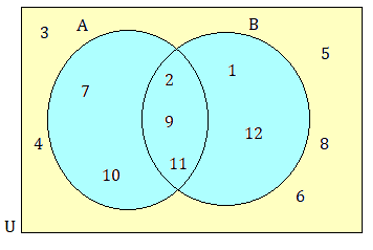
Find :
(i) n(A)
(ii) n(B’)
(iii) n(AnB)
(iv) n(AUB)
Solution :
(i) n(A) = 5
(ii) The number of elements which do not belong to set B is B’ = 7
(iii) n(AnB) = 3
(iv) n(AUB) = 7
Example 8 :
If A is the set of all factors of 36 and B is the set of all factors of 63,
Find : (a) AnB (b) AUB
Solution :
Given, A is the set of all factors of 36
So, set A = {1, 2, 3, 4, 6, 9, 12, 18, 36}
B is the set of all factors of 63
So, set B = {1, 3, 7, 9, 21, 63}
(a) AnB = {1, 3, 9}
(b) AUB = {1, 2, 3, 4, 6, 7, 9, 12, 18, 21, 36, 63}
Example 9 :
If X = {A, B, D, M, N, P, R, T, Z} and
Y = {B, C, M, T, W, Z}
Find : (a) XnY (b) XUY
Solution :
Given, X = {A, B, D, M, N, P, R, T, Z} and
Y = {B,
C, M, T, W, Z}
(a) XnY = {B, M, T, Z}
(b) XUY = {A, B, C, D, M, N, P, R, T, W, Z}
Example 10 :
If U = {x| x ≤ 30, x Є Z+}
A = {factors of 30} and B = {prime numbers ≤ 30}
Find :
(a) (i) n (A) (ii) n (B) (iii) n (A n B) (iv) n (A U B)
(b) Verify that n(AUB) = n(A) + n(B) – n(AnB)
Solution :
Given, A = {1, 2, 3, 5, 6, 10, 15, 30}
B = {2, 3, 5, 7, 11, 13, 17, 19, 23, 29}
(i) n(A) = 8
(ii) n(B) = 10
(iii) n (AnB) = 3
(iv) n (AUB) = 15
(b) n(AUB) = n(A) + n(B) – n(AnB)
15 = 8 + 10 – 3
15 = 18-3
15
= 15
Hence it is verified.
Example 11 :
Of 75 people with cell phones, 42 take pictures with their cell phone and 36 use their cell phone to take pictures and send text messages. How many use their phones to send text messages ?
Solution :
Let A and B be the number of people who take pictures and sending messages.
n(A) = 42
n(A n B) = 36
Total number of people = n(AUB) = 75
n(AUB) = n(A) + n(B) - n(A n B)
75 = 42 + n(B) - 36
75 = 6 + n(B)
n(B) = 75 - 6
n(B) = 69
Number of people who use phones and send text messages is 69.
Example 12 :
Find two sets A and B such that A U B = {1, 2, 3, 4, 5 } and A n B = {2}
Solution :
A U B = {1, 2, 3, 4, 5 }
A n B = {2}
A = {1, 3, 4}
B = {5}
Subscribe to our ▶️ YouTube channel 🔴 for the latest videos, updates, and tips.
Kindly mail your feedback to v4formath@gmail.com
We always appreciate your feedback.
About Us | Contact Us | Privacy Policy
©All rights reserved. onlinemath4all.com

Recent Articles


-
Digital SAT Math Practice Test with Answers (Part - 18)
Oct 22, 26 07:55 PM
 Digital SAT Math Practice Test with Answers (Part - 18)
-
AP Calculus BC Problems with Solutions
Sep 30, 26 01:08 PM
 AP Calculus BC Problems with Solutions
-
Digital SAT Math Practice Test with Answers (Part - 17)
Sep 30, 26 01:00 PM
 Digital SAT Math Practice Test with Answers (Part - 17)