SOLVING QUADRATIC EQUATIONS USING SQUARE ROOTS
Subscribe to our ▶️ YouTube channel 🔴 for the latest videos, updates, and tips.
Taking square root is the inverse operation of taking the square. For example, if you have x2 and you want to get rid of the square, take square root.
x2 = 9
To solve for x in the above quadratic equation, we have to get rid of the square we have for x. To get rid of the square, take square root on both sides.
√x2 = ±√9
x = ±3
Why do we have ± in front of square root?
Square root of any positive number will result a number with ±. If you square '3' or '-3', both of them will result the same value '9'.
32 = 3 ⋅ 3 = 9
(-3)2 = (-3) ⋅ (-3) = 9
So, the square root of '9' will be ±3.
Solve the following quadratic equations using square root :
Example 1 :
x2 - 2 = 23
Solution :
x2 - 2 = 23
Add 2 to each side.
x2 = 25
Take square root on both sides.
√x2 = ±√25
x = ±5
Therefore, the solutions are
x = 5 and x = -5
Example 2 :
(x - 2)2 = 36
Solution :
(x - 2)2 = 36
Take square root on both sides.
√(x - 2)2 = ±√36
x - 2 = ±6
|
x - 2 = 6 x = 8 |
x - 2 = -6 x = -4 |
Therefore, the solutions are
x = 8 and x = -4
Example 3 :
3x2 + 8 = 56
Solution :
3x2 + 8 = 56
Subtract 8 from both sides.
3x2 = 48
Divide both sides by 3.
x2 = 16
Take square root on both sides.
√x2 = ±√16
x = ±4
Therefore, the solutions are
x = 4 and x = -4
Example 4 :
-5x2 + 15 = -2x2 - 12
Solution :
-5x2 + 15 = -2x2 - 12
Add 2x2 to both sides.
-3x2 + 15 = -12
Subtract 15 from both sides.
-3x2 = -27
Divide both sides by -3.
x2 = 9
Take square root on both sides.
√x2 = ±√9
x = ±3
Therefore, the solutions are
x = 3 and x = -3
Example 5 :
6(x2 - 1) + 7(1 - x2) = -11
Solution :
6(x2 - 1) + 7(1 - x2) = -11
Use Distributive Property.
6x2 - 6 + 7 - 7x2 = -11
Group the like terms.
(6x2 - 7x2) + (-6 + 7) = -11
Combine the like terms.
-x2 + 1 = -11
Subtract 1 from both sides.
-x2 = -12
Multiply both sides by -1.
x2 = 12
Take square root on both sides.
√x2 = ±√12
x = ±√(2 ⋅ 2 ⋅ 3)
x = ±2√3
Therefore, the solutions are
x = 2√3 and x = -2√3
Example 6 :
-6(x2 - 10)2 - 5 = -221
Solution :
-6(x2 - 10)2 - 5 = -221
Add 6 to both sides.
-6(x2 - 10)2 = -216
Divide both sides by -6.
(x2 - 10)2 = 36
Take square root on both sides.
√(x2 - 10)2 = ±√36
x2 - 10 = ±6
|
x2 - 10 = 6 x2 = 16 √x2 = ±√16 x = ±4 |
x2 - 10 = -6 x2 = 4 √x2 = ±√4 x = ±2 |
Therefore, the solutions are
x = 4, x = -4, x = 2 and x = -2
Example 7 :
x2 + 6x + 8 = 0
Solution :
x2 + 6x + 8 = 0
Write the trinomial on the left side of the above equation in terms of square of a binomial.
x2 + 2(x)(3) + 8 = 0
x2 + 2(x)(3) + 32 - 32 + 8 = 0
Using the identity (a + b)2 = a2 + 2ab + b2,
(x + 3)2 - 32 + 8 = 0
(x + 3)2 - 9 + 8 = 0
(x + 3)2 - 1 = 0
Add 1 to both sides.
(x + 3)2 = 1
Take square root on both sides.
√(x + 3)2 = ±√1
x + 3 = ±1
|
x + 3 = 1 x = -2 |
x + 3 = -1 x = -4 |
Therefore, the solutions are
x = -2 and x = -4
Example 8 :
x2 - 5x + 6 = 0
Solution :
x2 - 5x + 6 = 0
Write the trinomial on the left side of the above equation in terms of square of a binomial.
x2 - 2(x)(5/2) + 6 = 0
x2 - 2(x)(5/2) + (5/2)2 - (5/2)2 + 6 = 0
Using the identity (a - b)2 = a2 - 2ab + b2,
(x - 5/2)2 - (5/2)2 + 6 = 0
(x - 5/2)2 - 25/4 + 6 = 0
(x - 5/2)2 - 1/4 = 0
Add 1/4 to both sides.
(x - 5/2)2 = 1/4
Take square root on both sides.
√(x - 5/2)2 = ±√1/4
x - 5/2 = ±1/2
|
x -5/2 = 1/2 x = 1/2 + 5/2 x = (1 + 5)/2 x = 6/2 x = 3 |
x -5/2 = -1/2 x = -1/2 + 5/2 x = (-1 + 5)/2 x = 4/2 x = 2 |
Therefore, the solutions are
x = 3 and x = 2
Example 9 :
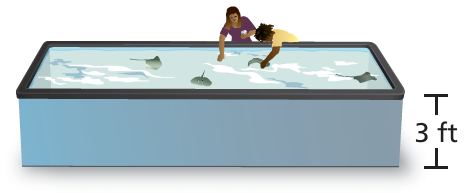
A touch tank has a height of 3 feet. Its length is three times its width. The volume of the tank is 270 cubic feet. Find the length and width of the tank.
Solution :
Volume of the tank = 270 cubic feet
height = 3 feet
Let w be the width.
length = 3w
length x width x height = 270
3(w)(3w) = 270
9w2 = 270
w2 = 270/9
w = ±√30
Example 10 :
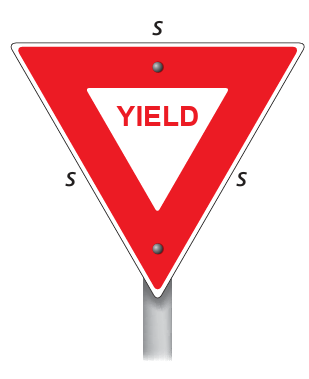
The area A of an equilateral triangle with side length s is given by the formula A = (√3/4) s2. Solve the formula for s. Then approximate the side length of the traffic sign that has an area of 390 square inches.
A = (√3/4) s2
Area of equilateral triangle = 390 square inches
390 = (√3/4) s2
390(4/√3) = s2
s2 = 390(4/√3) x (√3/√3)
= 390 x 4 x (√3/3)
= 130 x 4 √3
s2 = 520√3
The side length of the traffic sign is about 30 inches.
Subscribe to our ▶️ YouTube channel 🔴 for the latest videos, updates, and tips.
Kindly mail your feedback to v4formath@gmail.com
We always appreciate your feedback.
About Us | Contact Us | Privacy Policy
©All rights reserved. onlinemath4all.com

Recent Articles


-
Digital SAT Math Practice Test with Answers (Part - 18)
Oct 16, 26 11:02 AM
 Digital SAT Math Practice Test with Answers (Part - 18)
 -
AP Calculus BC Problems with Solutions
Sep 30, 26 01:08 PM
 AP Calculus BC Problems with Solutions
 -
Digital SAT Math Practice Test with Answers (Part - 17)
Sep 30, 26 01:00 PM
 Digital SAT Math Practice Test with Answers (Part - 17)