SOLVING AND INTERPRETING SOLUTIONS OF INEQUALITIES
Subscribe to our ▶️ YouTube channel 🔴 for the latest videos, updates, and tips.
In math, we solve inequalities and give solution in different ways like interval notation and graphing.
To have a clear understanding of the problem, we may have to interpret the part of the solution or sometimes the whole.
Let us see, how solution of an inequality can be interpreted through the following examples.
Examples
Example 1 :
Serena wants to complete the first 3 miles of a 10-mile run in 45 minutes or less running at a steady pace. The inequality 10 - 0.75p ≤ 7 can be used to find p, the pace, in miles per hour, she can run to reach her goal. Solve the inequality. Then graph and interpret the solution.
Solution :
Step 1 :
Use inverse operations to solve the inequality.
10 - 0.75p ≤ 7
Subtract 10 from both sides.
(10 - 0.75p) - 10 ≤ (7) - 10
-0.75p ≤ -3
Divide both sides by -0.75.
(-0.75p) / (-0.75) ≥ (-3) / (-0.75)
p ≥ 4
Step 2 :
Graph the inequality and interpret the circle and the arrow.
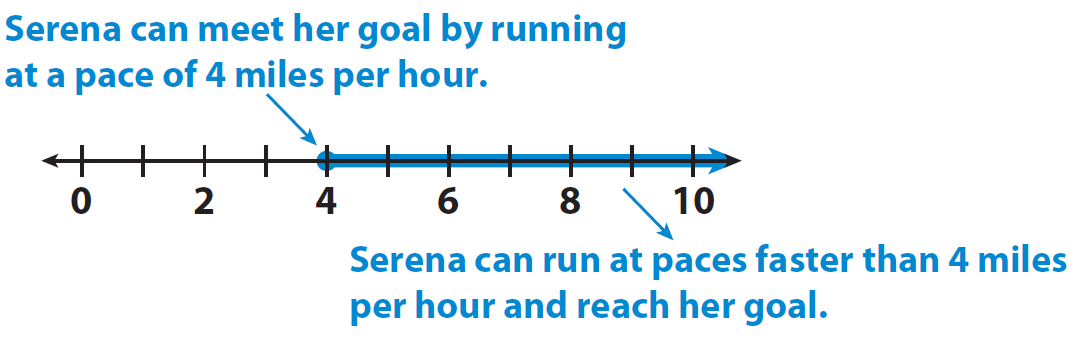
So, Serena has to run at a steady pace of at least 4 miles per hour.
Example 2 :
Joshua wants to complete the first mile of a 5-mile run in 10 minutes or less running at a steady pace. The inequality 5 - p/6 ≤ 4 can be used to find p, the pace, in miles per hour, he can run to reach his goal. Solve the inequality. Then graph and interpret the solution.
Solution :
Step 1 :
Use inverse operations to solve the inequality.
5 - p/6 ≤ 4
Subtract 5 from both sides.
(5 - p/6) - 5 ≤ (4) - 5
- p/6 ≤ -1
Multiply both sides by -6.
(-p/6).(-6) ≥ (-1).(-6)
p ≥ 6
Step 2 :
Graph the inequality and interpret the solution.

So, Joshua has to run at a steady pace of at least 6 mi/h.
Subscribe to our ▶️ YouTube channel 🔴 for the latest videos, updates, and tips.
Kindly mail your feedback to v4formath@gmail.com
We always appreciate your feedback.
About Us | Contact Us | Privacy Policy
©All rights reserved. onlinemath4all.com

Recent Articles


-
Digital SAT Math Practice Test with Answers (Part - 18)
Oct 22, 26 07:55 PM
 Digital SAT Math Practice Test with Answers (Part - 18)
 -
AP Calculus BC Problems with Solutions
Sep 30, 26 01:08 PM
 AP Calculus BC Problems with Solutions
 -
Digital SAT Math Practice Test with Answers (Part - 17)
Sep 30, 26 01:00 PM
 Digital SAT Math Practice Test with Answers (Part - 17)