POSTULATES AND THEOREMS
Subscribe to our ▶️ YouTube channel 🔴 for the latest videos, updates, and tips.
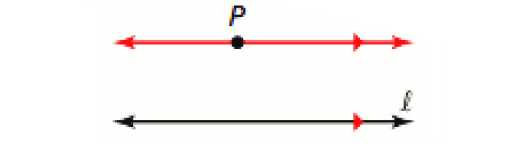
Parallel Postulate :
If there is a line and a point not on the line, then there is exactly one line through the point parallel to the given line.
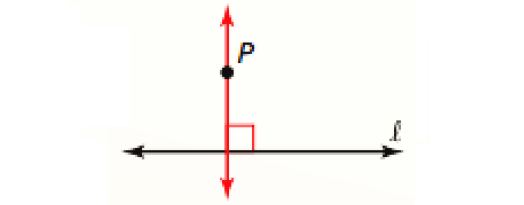
Perpendicular Postulate :
If there is a line and a point not on the line, then there is exactly one line through the point perpendicular to the given line.
Corresponding Angles Theorem :
If two parallel lines are cut by a transversal, then the pairs of corresponding angles are congruent.
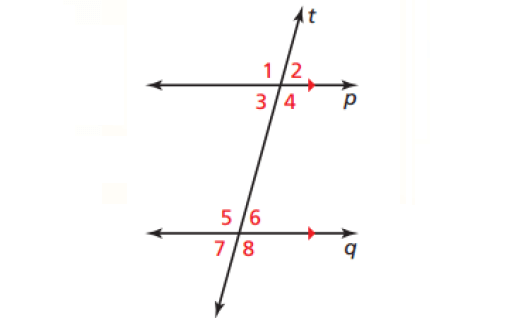
In the above diagram,
m∠1 ≅ m∠5
m∠2 ≅ m∠6
m∠3 ≅ m∠7
m∠4 ≅ m∠8
Alternate Interior Angles Theorem :
If two parallel lines are cut by a transversal, then the pairs of alternate interior angles are congruent.
In the above diagram,
m∠3 ≅ m∠6
m∠4 ≅ m∠5
Alternate Exterior Angles Theorem :
If two parallel lines are cut by a transversal, then the pairs of alternate exterior angles are congruent.
In the above diagram,
m∠1 ≅ m∠8
m∠2 ≅ m∠7
Consecutive Interior Angles Theorem :
If two parallel lines are cut by a transversal, then the pairs of consecutive interior angles are supplementary.
In the above diagram,
m∠3 + m∠5 = 180°
m∠4 + m∠6 = 180°
Corresponding Angles Converse :
If two lines are cut by a transversal so the corresponding angles are congruent, then the lines are parallel.
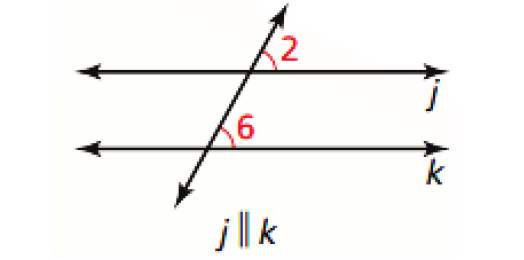
Alternate Interior Angles Converse :
If two lines are cut by a transversal so the alternate interior angles are congruent, then the lines are parallel.
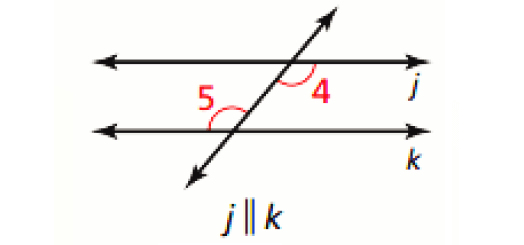
Alternate Exterior Angles Converse :
If two lines are cut by a transversal so the alternate exterior angles are congruent, then the lines are parallel.
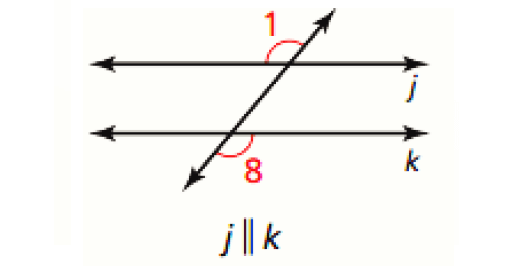
Consecutive Interior Angles Converse :
If two lines are cut by a transversal so the consecutive interior angles are supplementary, then the lines are parallel.
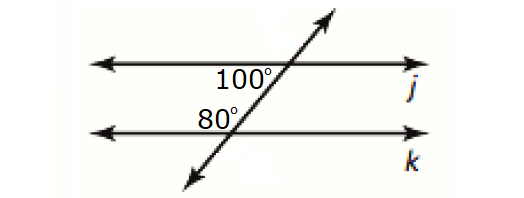
In the diagram above, the lines j and k are parallel.
j ∥ k
Transitive Property of Parallel Lines :
If two lines are parallel to the same line, then they are parallel to each other.
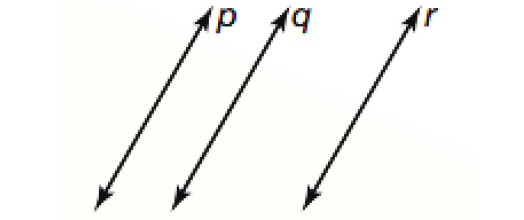
In the diagram above, if p ∥ q and q ∥ r, then p ∥ r.
Linear Pair Perpendicular Theorem :
If two lines intersect to form a linear pair of congruent angles, then the lines are perpendicular.
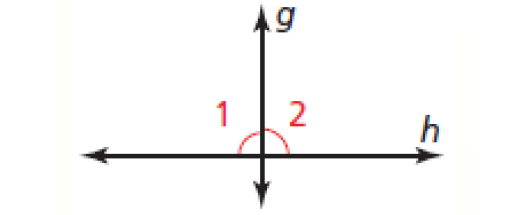
Perpendicular Transversal Theorem :
In a plane, if a transversal is perpendicular to one of two parallel lines, then it is perpendicular to the other line.
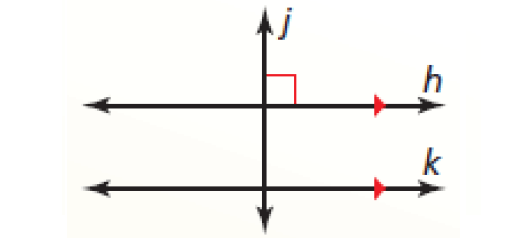
In the diagram above, line j is perpendicular to line k.
j ⊥ k
Lines Perpendicular to a Transversal Theorem :
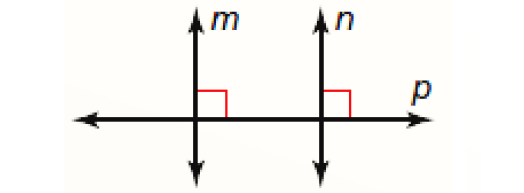
In a plane, if two lines are perpendicular to the same line, then they are parallel to each other.
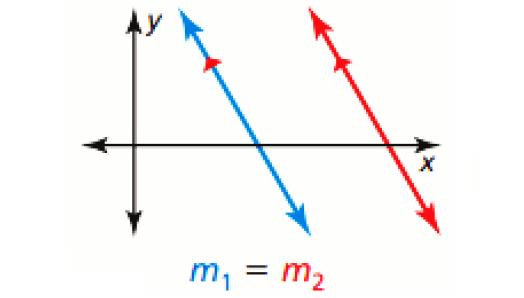
Slopes of Parallel Lines :
In a coordinate plane, two distinct nonvertical lines are parallel if and only if they have the same slope. Any two vertical lines are parallel.
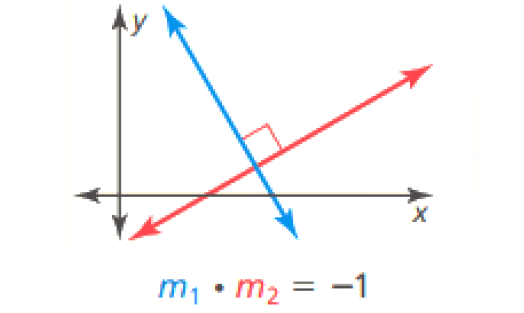
Slopes of Perpendicular Lines :
In a coordinate plane, two nonvertical lines are perpendicular if and only if the product of their slopes is -1. Horizontal lines are perpendicular to vertical lines.
Note :
A postulate is a statement that is assumed true without proof. A theorem is a true statement that can be proven.
Subscribe to our ▶️ YouTube channel 🔴 for the latest videos, updates, and tips.
Kindly mail your feedback to v4formath@gmail.com
We always appreciate your feedback.
About Us | Contact Us | Privacy Policy
©All rights reserved. onlinemath4all.com

Recent Articles


-
SAT Math Practice Problems with Answers
May 21, 26 01:17 AM
 SAT Math Practice Problems with Answers
 -
Digital SAT Math Questions and Answers (Part - 13)
May 17, 26 09:03 AM
 Digital SAT Math Questions and Answers (Part - 13)
 -
Problems on Solving Logarithmic Equations
Apr 24, 26 09:30 PM
Problems on Solving Logarithmic Equations