LINEAR EQUATIONS WITH UNKNOWN COEFFICIENTS
Subscribe to our ▶️ YouTube channel 🔴 for the latest videos, updates, and tips.
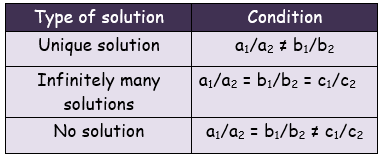
When we solve problems of linear equations with unknown coefficients, we should be aware of number of solutions the system of equations have.
The general form of a pair of linear equations is
a1x + b1y + c1 = 0
a2x + b2y + c2 = 0
(where a1, a2, b1, b2, c1, and c2 are real numbers)
Example 1 :
For what value of c will system of equations below have no solution ?
cx – 2y = 6
3x + 4y = 4
Solution :
By writing the given equations a1x + b1y + c1 = 0 and a2x + b2y + c2 = 0 in the form, we get
cx – 2y – 6 = 0
3x + 4y – 4 = 0
Since the given equations have no solution,
a1/a2 = b1/b2 ≠ c1/c2
Here a1 = c, a2 = 3, b1 = -2, and b2 = 4
c/3 = -2/4
c = 3(-1/2)
c = -3/2
So, the value of c is -3/2
Example 2 :
For what value of b will system of equations below have infinitely many solutions ?
-2x + y = 4
5x - by = -10
Solution :
-2x + y – 4 = 0
5x – by + 10 = 0
Since the given equations have infinitely many solutions,
a1/a2 = b1/b2 = c1/c2
Here a1 = -2, a2 = 5, and b1 = 1, b2 = -b
-2/5 = 1/-b
2b = 5
b = 5/2
So, the value of b is 5/2
Example 3 :
ax - y = 0
x - by = 1
In the system of equations above, a and b are constants and x and y are variables. If the system of equation above has no solution, what is the value of a . b ?
Solution :
ax - y + 0 = 0
x – by - 1 = 0
Since the given equations have no solution,
a1/a2 = b1/b2 ≠ c1/c2
Here a1 = a, a2 = 1, b1 = -1, and b2 = -b
a/1 = -1/-b
-ab = -1
a.b = 1
So, the value of a.b is 1
Example 4 :
2x - ky = 14
5x - 2y = 5
In the system of equations above, k is a constants and x and y are variables. For what value of k will the system of equations have no solution ?
Solution :
2x - ky - 14 = 0
5x – 2y - 5 = 0
Since the given equations have no solution,
a1/a2 = b1/b2 ≠ c1/c2
Here a1 = 2, a2 = 5, b1 = -k, and b2 = -2
2/5 = -k/-2
-4 = -5k
k = 4/5
So, the value of k is 4/5
Example 5 :
2x – 1/2y = 15
ax – 1/3y = 10
In the system of equations above, a is a constants and x and y are variables. For what value of a will the system of equations infinitely many solutions ?
Solution :
2x – 1/2y - 15 = 0
ax – 1/3y - 10 = 0
Since the given equations have infinitely many solutions,
a1/a2 = b1/b2 = c1/c2
Here a1 = 2, a2 = a, b1 = -1/2, and b2 = -1/3
2/a = (-1/2)/(-1/3)
-2/3 = -a/2
4 = 3a
a = 4/3
So, the value of a is 4/3
Example 6 :
ax + 4y = 14
5x + 7y = 8
In the system of equations above, a is a constants and x and y are variables. If the system no solution, what is the value of a ?
Solution :
ax + 4y - 14 = 0
5x + 7y - 8 = 0
Since the given equations have no solution,
a1/a2 = b1/b2 ≠ c1/c2
Here a1 = a, a2 = 5, b1 = 4, and b2 = 7
a/5 = 4/7
7a = 20
a = 20/7
So, the value of a is 20/7
Example 7 :
ax + 1/2y = 16
4x + 3y = 8
In the system of equations above, a is a constants and x and y are variables. If the system no solution, what is the value of a ?
Solution :
ax + 1/2y - 16 = 0
4x + 3y - 8 = 0
Since the given equations have no solution,
a1/a2 = b1/b2 ≠ c1/c2
Here a1 = a, a2 = 4, b1 = 1/2, and b2 = 3
a/4 = (1/2)/3
3a = 2
a = 2/3
So, the value of a is 2/3
Example 8 :
3x + ky = 8
x + 4y = -1
If(x, y) is a solution to the system of equations above and k is a constant, what is y in terms of k ?
Solution :
3x + ky = 8 -----(1)
x + 4y = -1 -----(2)
Since the given equations (x, y) is a solution,
We are using the elimination method.
Subtract (1) – 3(2), we get
3x + ky – 3x - 12y = 8 – 3
ky - 12y = 5
(k - 12)y = 5
y = 5/(k – 12)
So, the answer is 5/(k – 12)
Example 9 :
5x + 16y = 36
cx + dy = 9
The system of equations above, where c and d are constants, has infinitely many solutions. what is the value of cd ?
Solution :
5x + 16y – 36 = 0
cx + dy – 9 = 0
Since the given equations have infinitely many solutions,
a1/a2 = b1/b2 = c1/c2
Here a1 = 5, a2 = c, b1 = 16, b2 = d, c1 = -36 and c2 = -9
5/c = 16/d = -36/-9
5d = 16c = 4
5d = 4 and 16c = 4
d = 4/5 and c = 1/4
So, the value of c and d is 1/4 and 4/5
Example 10 :
0.3x – 0.7y = 1
kx – 2.8y = 3
In the system of equations above, k is a constant. If the system no solution, what is the value of k ?
Solution :
0.3x – 0.7y – 1 = 0
kx – 2.8y – 3 = 0
Since the given equations have no solution,
a1/a2 = b1/b2 ≠ c1/c2
Here a1 = 0.3, a2 = k, b1 = -0.7, and b2 = -2.8
0.3/k = -0.7/-2.8
(0.3 × -2.8) = -0.7k
-0.84 = -0.7k
k = 1.2
So, the value of k is 1.2.
Subscribe to our ▶️ YouTube channel 🔴 for the latest videos, updates, and tips.
Kindly mail your feedback to v4formath@gmail.com
We always appreciate your feedback.
About Us | Contact Us | Privacy Policy
©All rights reserved. onlinemath4all.com

Recent Articles


-
Digital SAT Math Practice Test with Answers (Part - 17)
Sep 24, 26 12:05 PM
 Digital SAT Math Practice Test with Answers (Part - 17)
 -
Digital SAT Math Practice Test with Answers (Part - 16)
Sep 07, 26 11:23 AM
Digital SAT Math Practice Test with Answers (Part - 16) -
Digital SAT Math Practice Test with Answers (Part - 15)
Aug 23, 26 12:24 PM
 Digital SAT Math Practice Test with Answers (Part - 15)