IDENTIFY EXPONENTIAL BEHAVIOR WORKSHEET
Subscribe to our ▶️ YouTube channel 🔴 for the latest videos, updates, and tips.
Problem 1 :
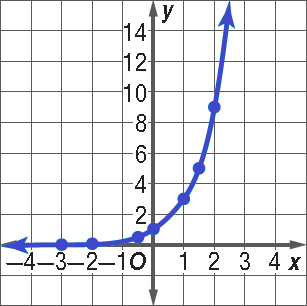
Determine whether the graph shown below displays exponential behavior.
Problem 2 :
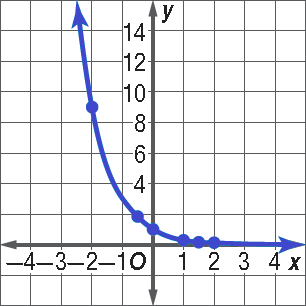
Determine whether the graph shown below displays exponential behavior.
Problem 3 :
Determine whether the data set shown below displays exponential behavior.

Problem 4 :
Determine whether the data set shown below displays exponential behavior.

Problem 5 :
Determine whether the data set shown below displays exponential behavior.

Problem 6 :
Determine whether the data set shown below displays exponential behavior.

Problem 7 :
Determine whether the data set shown below displays exponential behavior.

Problem 8 :
Determine whether the data set shown below displays exponential behavior.


Problem 1 :
Determine whether the graph shown below displays exponential behavior.
Solution :
The graph shows rapidly increasing values of y as x increases. This is characteristic of exponential behavior.
Problem 2 :
Determine whether the graph shown below displays exponential behavior.
Solution :
The graph shows rapidly decreasing values of y as x increases. This is characteristic of exponential behavior.
Problem 3 :
Determine whether the data set shown below displays exponential behavior.
Solution :
The domain values are at regular intervals of 10. Let’s see if there is a common factor among the range values
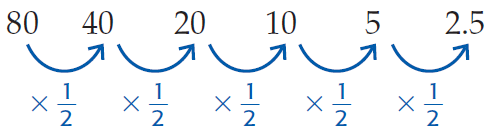
Since the domain values are at regular intervals and the range values have a common factor, the data are probably exponential.
Exponential function for the above data is
f(x) = (1/2)x
Problem 4 :
Determine whether the data set shown below displays exponential behavior.
Solution :
The domain values are at regular intervals of 10. The range values have a common difference 6.
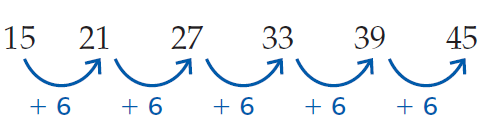
The data do not display exponential behavior, but rather linear behavior.
Problem 5 :
Determine whether the data set shown below displays exponential behavior.
Solution :
The domain values are at regular intervals of 1. Let’s see if there is a common factor among the range values
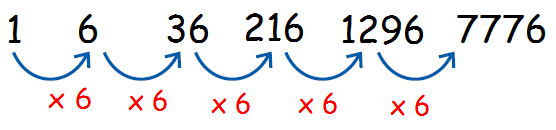
Since the domain values are at regular intervals and the range values have a common factor, the data are probably exponential.
Exponential function for the above data is
f(x) = 6x
Problem 6 :
Determine whether the data set shown below displays exponential behavior.
Solution :
The domain values are at regular intervals of 2. The range values have a common difference 4.
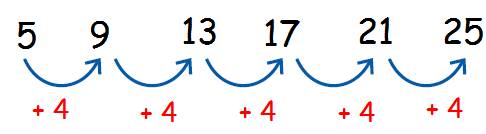
The data do not display exponential behavior, but rather linear behavior.
Problem 7 :
Determine whether the data set shown below displays exponential behavior.
Solution :
The domain values are at regular intervals of 1. The range values have a common difference 3.
The data do not display exponential behavior, but rather linear behavior.
Problem 8 :
Determine whether the data set shown below displays exponential behavior.
Solution :
The domain values are at regular intervals of 1. Let’s see if there is a common factor among the range values
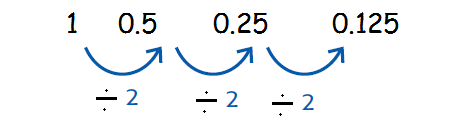
Since the domain values are at regular intervals and the range values have a common factor, the data are probably exponential.
Exponential function for the above data is
f(x) = 1/2x
Subscribe to our ▶️ YouTube channel 🔴 for the latest videos, updates, and tips.
Kindly mail your feedback to v4formath@gmail.com
We always appreciate your feedback.
About Us | Contact Us | Privacy Policy
©All rights reserved. onlinemath4all.com

Recent Articles


-
Digital SAT Math Questions and Answers (Part - 13)
May 10, 26 05:50 PM
 Digital SAT Math Questions and Answers (Part - 13)
 -
Problems on Solving Logarithmic Equations
Apr 24, 26 09:30 PM
Problems on Solving Logarithmic Equations -
Solving Logarithmic Equations Worksheet
Apr 24, 26 09:05 PM
 Solving Logarithmic Equations Worksheet