HOW TO FIND DOMAIN AND RANGE OF A FUNCTION
Subscribe to our ▶️ YouTube channel 🔴 for the latest videos, updates, and tips.
Domain :
Let y = f(x) be a function.
Domain is all real values of x for which y is defined.
If there is any value of x for which y is undefined, we have to exclude that particular value from the set of domain.
Range :
Let y = f(x) be a function.
Range is all real values of y for the given domain (real values of x).
Let us look at some practice questions to understand how to find domain and range of a function.
Question 1 :
Find the domain of 1 / (1 − 2sinx)
Solution :
1 − 2sin x = 0
- 2sin x = - 1
sin x = 1/2
sin x = sin π/6
Since it sin function, the domain will be R - {nπ + (-1)n π/6}, n ∈ Z
Question 2 :
Find the largest possible domain of the real valued function f(x) = √(4 - x2)/ √(x2 - 9)
Solution :
Let us equate numerator and denominator equal to 0.
|
(4 - x2) = 0 x2 = 4 x = √4 x = ± 2 |
(x2 - 9) = 0 x2 = 9 x = √9 x = ± 3 |
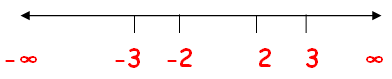
(-∞, -3) (-3, -2) (-2, 2) (2, 3) (3, ∞)
If x ∈ (-∞, -3)
f(-3.5) = √(4 - (-3.5)2)/ √((-3.5)2 - 9)
= √(4 -12.25)/ √(12.25 - 9)
= √(-8.25)/ √3.25
= Not defined
Hence x ∉ (-∞, -3)
If x ∈ (-3, -2)
f(-2.5) = √(4 - (-2.5)2)/ √((-2.5)2 - 9)
= √(4 -6.25)/ √(6.25- 9)
= Not defined
Hence x ∉ (-3, -2)
If x ∈ (-2, 2)
f(0) = √(4 - 02)/ √((0)2 - 9)
= √4/ √(-9)
= Not defined
Hence x ∉ (-2, 2)
If x ∈ (2, 3)
f(2.5) = √(4 - (2.5)2)/ √((2.5)2 - 9)
= √(4 - 6.25)/ √(6.25-9)
= Not defined
Hence x ∉ (2, 3)
If x ∈ (3, ∞)
f(4) = √(4 - 42)/ √(4)2 - 9)
= √(4 - 16)/ √(16-9
= Not defined
Hence x ∉ (3, ∞).
Hence the answer is null set.
Question 3 :
Find the range of the function
1 / (2 cos x − 1)
Solution :
Range for cos function is between -1 and 1
-1 ≤ cos x ≤ 1
-2 ≤ 2cos x ≤ 2
-2 - 1 ≤ 2cos x - 1 ≤ 2 - 1
-3 ≤ 2cos x - 1 ≤ 1
Take reciprocal through out the equation, we get
-1/3 ≤ 1/(2cos x - 1) ≤ 1/1
-1/3 ≤ 1/(2cos x - 1) ≤ 1
(-∞, -1/3] U [1, ∞) is the required range.
Question 4 :
Show that the relation xy = −2 is a function for a suitable domain. Find the domain and the range of the function.
Solution :
xy = −2
y = -2/x
Domain means set of possible values of x.
Domain is all real values expect 0.
Domain = R - {0}
x = -2/y
Range means set of possible values of y.
Range is all real values expect 0.
Range = R - {0}
Question 5 :
Find domain and range of the following real valued functions:
i) f(x) = |𝑥| + 1
ii) f(x) = √(27 − x2)
iii) f (x) = 𝑥2 / (𝑥2 + 1)
iv) –|x + 2|
Solution :
i) f(x) = |𝑥| + 1
Domain :
For all positive and negative values of x, the function is defined. Then the domain is all real values.
Domain is (-∞, ∞)
Range :
The value of f(x) = |𝑥| is always greater than or equal to 0. The required outputs starts from 1 and it is always greater than or equal to 1. Then the range is y ≥ 1
Range is [1, ∞)
ii) f(x) = √(27 − x2)
Domain :
(27 − x2) ≥ 0
- x2 ≥ - 27
- x2 ≥ -27
Dividing by negative on both sides, we get
x2 ≤ 27
x ≤ √27
Domain is [-3√3, 3√3]
Range :
Applying x = -√27
f(√26) = √(27 − √272))
= √0
To find the maximize √(27 − x2), we have to give the minimum value of x, which is 0
= √(27 − 02)
= √27
= 3√3
Range is [0, 3√3].
iii) f (x) = 𝑥2 / (𝑥2 + 1)
Domain :
Since we have even power for all positive and negative values of x, we will get only positive values as result. Hence the denominator will never become 0.
So, domain is (-∞, ∞).
Range :
Finding inverse function of the given function
Let y = 𝑥2 / (𝑥2 + 1)
y(𝑥2 + 1) = 𝑥2
y𝑥2 + y = 𝑥2
y𝑥2 - 𝑥2 = y
𝑥2(y - 1) = y
𝑥2 = y / (y - 1)
x = √[y / (y - 1)]
Domain of the inverse function will be equal to the range of original function.
0 ≤ y < 1
iv) –|x + 2|
Domain :
For any absolute value function, the domain is all real values. So, the domain is (-∞, ∞).
Range :
The absolute value function opens down, then its range will be (-∞, 0].
Question 6 :
Find the domain and range of
(x2 + 5x - 6) / (x2 - 3x + 2)
Solution :
Let f(x) = (x2 + 5x - 6) / (x2 - 3x + 2)
Factoring the denominator,
= (x + 6)(x - 1) / (x - 2)(x - 1)
x - 2 = 0 and x - 1 = 0
x = 2 and x = 1
So, these are the two values will make the function f(x) as undefined. Domain is (-∞, 1) (1, 2) and (2, ∞).
To find range, after cancelling common factors,
f(x) = (x + 6) / (x + 2)
y (x + 2) = x + 6
xy + 2y = x + 6
xy - x = -2y + 6
x(y - 1) = 6 - 2y
x = (6 - 2y) / (y - 1)
Inverse function is f-1(x) = (6 - 2x) / (x - 1)
Domain of the inverse function = range of original function
So, range is all real numbers except 1.
Subscribe to our ▶️ YouTube channel 🔴 for the latest videos, updates, and tips.
Kindly mail your feedback to v4formath@gmail.com
We always appreciate your feedback.
About Us | Contact Us | Privacy Policy
©All rights reserved. onlinemath4all.com

Recent Articles


-
Digital SAT Math Practice Test with Answers (Part - 18)
Oct 16, 26 11:02 AM
 Digital SAT Math Practice Test with Answers (Part - 18)
 -
AP Calculus BC Problems with Solutions
Sep 30, 26 01:08 PM
 AP Calculus BC Problems with Solutions
 -
Digital SAT Math Practice Test with Answers (Part - 17)
Sep 30, 26 01:00 PM
 Digital SAT Math Practice Test with Answers (Part - 17)