GRAPHING REDUCTIONS
Subscribe to our ▶️ YouTube channel 🔴 for the latest videos, updates, and tips.
When a dilation in the coordinate plane has the origin as the center of dilation, we can find points on the dilated image by multiplying the x and y coordinates of the original figure by the scale factor.
For example, if the scale factor is 'k', the algebraic representation of the dilation is
(x, y) → (kx, ky)
For reductions, k < 1.
Example 1 :
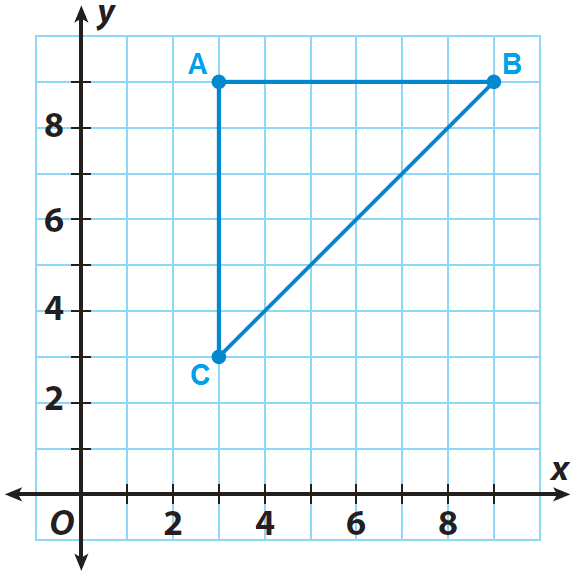
The triangle ABC shown on the grid is the pre-image. If the center of dilation is the origin and the scale factor is 1/3, graph the dilated image A'B'C'.
Solution :
Step 1 :
List the coordinates of the vertices of the pre image.
A(3, 9), B(9, 9) and C(3, 3)
Step 2 :
Since the scale factor is 1/3, the rule to get the coordinates of the vertices of the image is
(x, y) → [(1/3)x, (1/3)y]
Step 3 :
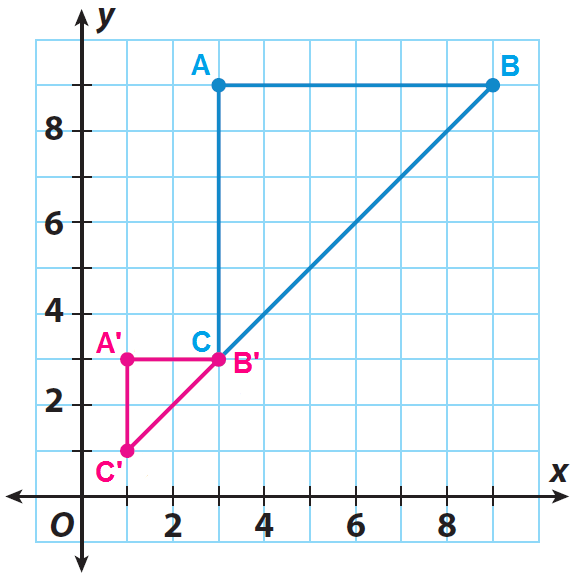
List the coordinates of the vertices of the image.
A(3, 9) ---> A'(1, 3)
B(9, 9) ---> B'(3, 3)
C(3, 3) ---> C'(1, 1)
Step 4 :
Graph the image A'B'C'.
Example 2 :
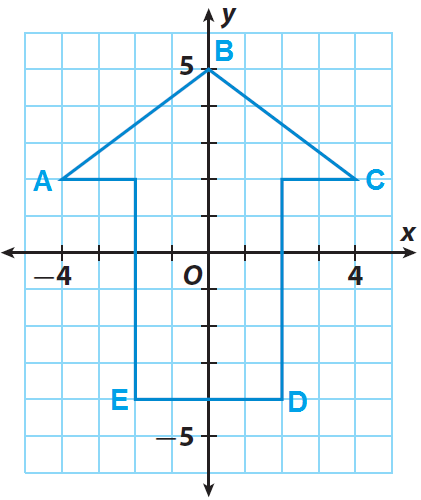
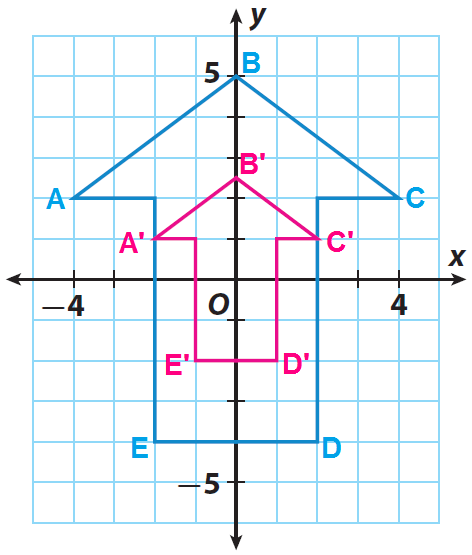
The arrow ABCDE shown on the grid is the pre-image. If the center of dilation is the origin and the scale factor is 0.5, graph the dilated image A'B'C'D'E'.
Solution :
Step 1 :
List the coordinates of the vertices of the pre image.
A(1, 1), B(3, 1), C(3, 4), D(1, 4) and E(2, 3)
Step 2 :
Since the scale factor is 1/2, the rule to get the coordinates of the vertices of the image is
(x, y) → [0.5x, 0.5y]
Step 3 :
List the coordinates of the vertices of the image.
A(-4, 2) ---> A'(-2, 1)
B(0, 5) ---> B'(0, 2.5)
C(4, 2) ---> C'(2, 1)
D(2, -4) ---> D'(1, -2)
E(-2, -4) ---> E'(-1, -2)
Step 4 :
Graph the image A'B'C'D'E'.
Example 3 :
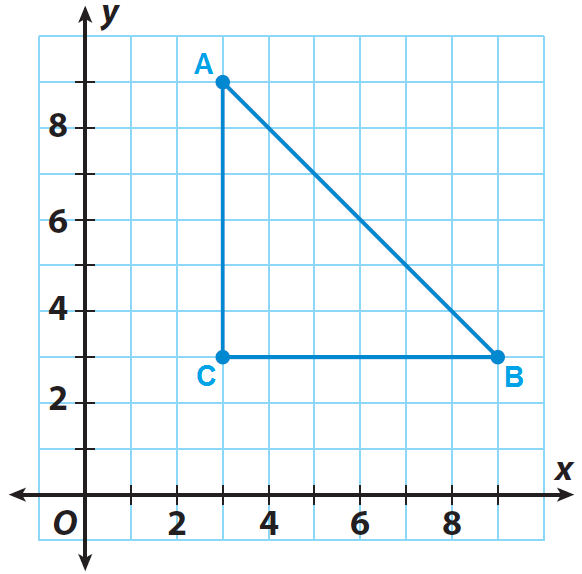
The triangle ABC shown on the grid is the pre-image. If the center of dilation is the origin and the scale factor is 3, graph the dilated image A'B'C'.
Solution :
Step 1 :
List the coordinates of the vertices of the pre image.
A(3, 9), B(9, 3) and C(3, 3)
Step 2 :
Since the scale factor is 1/3, the rule to get the coordinates of the vertices of the image is
(x, y) → [(1/3)x, (1/3)y]
Step 3 :
List the coordinates of the vertices of the image.
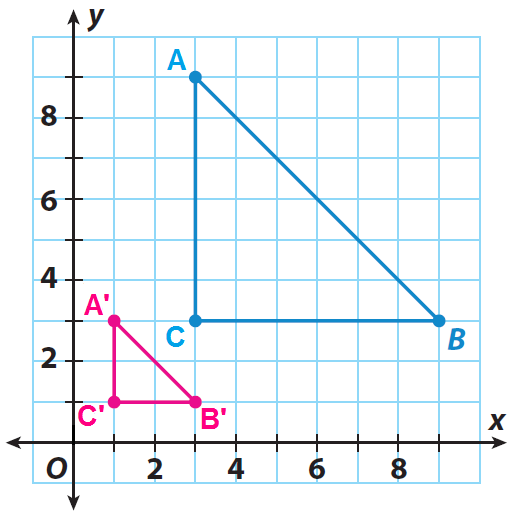
A(3, 9) ---> A'(1, 3)
B(9, 3) ---> B'(3, 1)
C(3, 3) ---> C'(1, 1)
Step 4 :
Graph the image A'B'C'.
Subscribe to our ▶️ YouTube channel 🔴 for the latest videos, updates, and tips.
Kindly mail your feedback to v4formath@gmail.com
We always appreciate your feedback.
About Us | Contact Us | Privacy Policy
©All rights reserved. onlinemath4all.com

Recent Articles


-
Digital SAT Math Questions and Answers (Part - 13)
May 10, 26 05:50 PM
 Digital SAT Math Questions and Answers (Part - 13)
 -
Problems on Solving Logarithmic Equations
Apr 24, 26 09:30 PM
Problems on Solving Logarithmic Equations -
Solving Logarithmic Equations Worksheet
Apr 24, 26 09:05 PM
 Solving Logarithmic Equations Worksheet