USING DOT PLOTS TO MAKE INFERENCES
Subscribe to our ▶️ YouTube channel 🔴 for the latest videos, updates, and tips.
After obtaining a random sample of a population, you can make inferences about the population. Random samples are usually representative and support valid inferences.
Let us see some examples to understand how dot plots can be used to make inferences.
Example 1 :
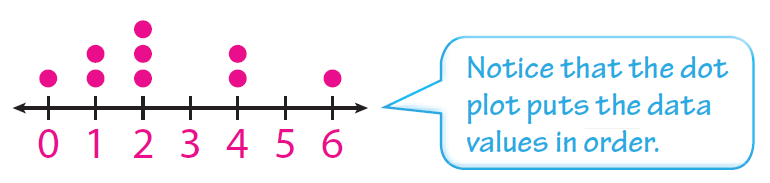
Rosee asked students on the lunch line how many books they had in their backpacks. She recorded the data as a list: 2, 6, 1, 0, 4, 1, 4, 2, 2.
(i) Make a dot plot for the books carried by this sample of students.
Step 1 :
Make a real number line.
In the given data, we have values range from from 0 to 6.
So we have to use a scale from 0 to 6.
Step 2 :
Place a dot above each number on the number line for each time it appears in the data set.
(ii) How are the number of dots you plotted related to the number of data values ?
They are the same. Each dot represents one data value.
(iii) What could Rosee do to improve the quality of her data ?
Rosee could increase the size of her sample.
Example 2 :
A baseball team manager records the number of runs scored by the team in each game for several weeks.
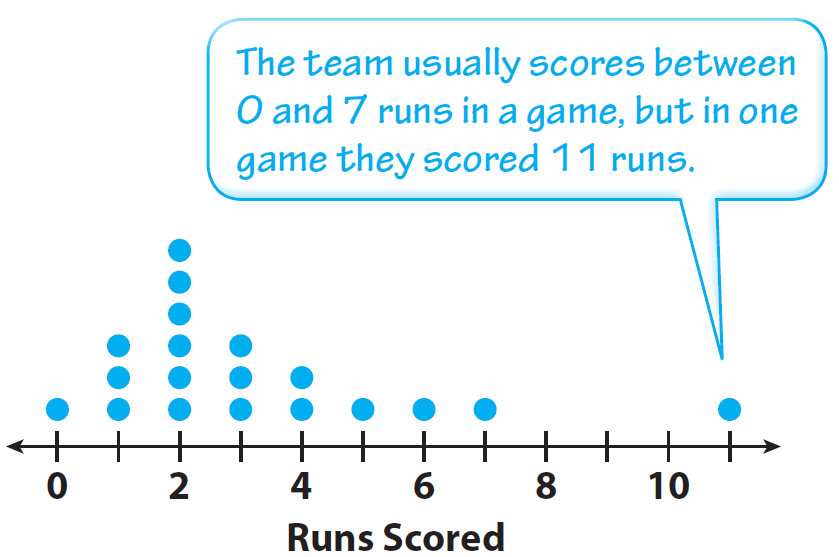
1, 3, 1, 7, 2, 0, 11, 2, 2, 3, 1, 3, 4, 2, 2, 4, 5, 2, 6
(i) Make a dot plot to know how the data is distributed.
Step 1 :
Make a real number line.
In the given data, we have values range from from 0 to 11.
So we have to use a scale from 0 to 11.
Step 2 :
Place a dot above each number on the number line for each time it appears in the data set.
(ii) How many games did the team play during the season? How can you tell from looking at the dot plot?
There are 19 dots in total above the numbers where each dot represents a game. So, the team played 19 games during the season.
(iii) At how many games did the team score 2 runs or fewer? How do you know?
In 10 games the team scored 2 runs or fewer; I counted the number of dots for the values less than or equal to 2.
Example 3 :
A different baseball team scores the following numbers of runs in its games for several weeks:
4, 4, 6, 1, 2, 4, 1, 2, 5, 3, 3, 5, 4, 2
(i) Make a dot plot to know how the data is distributed.
Step 1 :
Make a real number line.
In the given data, we have values range from from 0 to 6.
So we have to use a scale from 0 to 6.
Step 2 :
Place a dot above each number on the number line for each time it appears in the data set.

(ii) Tell how many games the team played, and identify the data value with the greatest frequency.
There
are 14 dots in total above the numbers where each dot represents a
game. So the team played 14 games.
And the value with the greatest frequency is 4. So there were 4 games in which the team scored 4 runs.
Subscribe to our ▶️ YouTube channel 🔴 for the latest videos, updates, and tips.
Kindly mail your feedback to v4formath@gmail.com
We always appreciate your feedback.
About Us | Contact Us | Privacy Policy
©All rights reserved. onlinemath4all.com

Recent Articles


-
SAT Math Practice Problems with Answers
May 21, 26 01:17 AM
 SAT Math Practice Problems with Answers
 -
Digital SAT Math Questions and Answers (Part - 13)
May 17, 26 09:03 AM
 Digital SAT Math Questions and Answers (Part - 13)
 -
Problems on Solving Logarithmic Equations
Apr 24, 26 09:30 PM
Problems on Solving Logarithmic Equations