USING DISTRIBUTIVE PROPERTY INVOLVING RADICALS WORKSHEET
Subscribe to our ▶️ YouTube channel 🔴 for the latest videos, updates, and tips.
Expand and simplify
Problem 1 :
√2 (√5+√2)
(A) √5+2 (B) √10+2 (C) √2+2 (D) √5
Problem 2 :
√3 (1-√3)
(A) √3-3 (B) √3+1 (C) 1-√3 (D) √3
Problem 3 :
√11 (2√11-1)
(A) √11-2 (B) 22-√11 (C) 22 (D) √11
Problem 4 :
2√3 (√3-√5)
(A) √3+√5 (B) √5 (C) 2√3 (D) 6-2√15
Problem 5 :
(1+√2) (2+√2)
(A) 2√2 (B) 4+3√2 (C) 6 (D) √2
Problem 6 :
(√3+2) (√3-1)
(A) 1+√3 (B) 1 (C) √3 (D) 2
Problem 7 :
(√5+2) (√5-3)
(A) √5 (B) 3 (C) -1-√5 (D) 1
Problem 8 :
(2√2+√3) (2√2-√3)
(A) 5 (B) 8 (C) 11 (D) 3
Problem 9 :
(2+√3) (2+√3)
(A) 2 (B) √3 (C) 7+4√3 (D) 4
Problem 10 :
(4-√2) (3+√2)
(A) √2 (B) 10+√2 (C) 7 (D) 10
Problem 11 :
(√7-√3) (√7+√3)
(A) 3 (B) 4 (C) 7 (D) 10
Problem 12 :
(4-√2) (3-√2)
(A) 7√2 (B) √2 (C) 14-7√2 (D) 3
Problem 13 :
Shown below is a rectangle
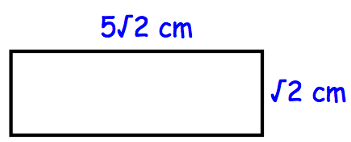
Problem 14 :
Expand and simplify
(√3 + √5)2
Problem 15 :
Expand and simplify
√3(√27 - √3)
Problem 16 :
Given that a = √2, b = √15 and c = √30
work out the value of
b/ac
Write your answer in simplest form.
Problem 17 :
Given that a = √3 and b = √48
a) work out the value of a2
b) Show that (a+b)2 = 75
Problem 18 :
Expand and simplify (3 + √8)(4 + √2) Give your answer in the form a + b √2 where a and b are integers
Problem 19 :
The midpoints of the sides of a square of side 10 cm are joined to form another square. This process is then repeated to create the shaded square.
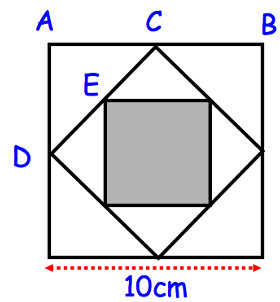
Find the area of the shaded square.
Problem 20 :
Given that (10 - √32)/√2 = a + b√2
Write a and b as integers, find the values of a and b.
1.Solution :
Given, √2 (√5+√2)
By distribution, we get
√2 (√5+√2) = √2×√5 + √2×√2
= √10+2
So, the answer is √10+2.
2.Solution :
Given, √3 (1-√3)
By distribution, we get
√3 (1-√3) = √3×1 - √3×√3
= √3-3
3.Solution :
Given, √11 (2√11-1)
By distribution, we get
√11 (2√11-1) = √11×2√11 - √11×1
= 2×11 - √11
= 22-√11
4.Solution :
Given, 2√3 (√3-√5)
By distribution, we get
2√3 (√3-√5) = (2√3×√3)-(2√3×√5)
= (2x3) - 2√15
= 6-2√15
5.Solution :
Given, (1+√2) (2+√2)
By distribution, we get
(1+√2) (2+√2) = 2+√2+2√2+2
= 4+3√2
6.Solution :
Given, (√3+2) (√3-1)
By distribution, we get
(√3+2) (√3-1) = (√3×√3)-(√3×1)+(2×√3)-(2×1)
= 3-√3+2√3-2
= 1+√3
7.Solution :
Given, (√5+2) (√5-3)
By distribution, we get
(√5+2) (√5-3) = (√5×√5)-(√5×3)+(2×√5)-(2×3)
= 5-3√5+2√5-6
= -1-√5
8.Solution :
Given, (2√2+√3) (2√2-√3)
By algebraic identity, we get
(2√2+√3) (2√2-√3) = (2√2)2-(√3)2
= 4×2 - 3
= 5
9.Solution :
Given, (2+√3) (2+√3)
By distribution, we get
(2+√3) (2+√3) = 2×2+(2×√3)+(√3×2)+(√3×√3)
= 4+2√3+2√3+3
= 7+4√3
10.Solution :
Given, (4-√2) (3+√2)
By distribution, we get
(4-√2) (3+√2) = (4×3)+(4×√2)-(√2×3)-(√2×√2)
= 12+4√2-3√2-2
= 10+√2
11.Solution :
Given, (√7-√3) (√7+√3)
By using algebraic identity
(a+b)(a-b) = a2-b2
(√7-√3) (√7+√3) = (√7)2-( √3 )2
= 7-3
= 4
12.Solution :
Given, (4-√2) (3-√2)
By distribution, we get
(4-√2) (3-√2) = 4×3 - (4×√2) - (√2×3) + (√2×√2)
= 12-4√2-3√2+2
= 14-7√2
13.Solution :
a) Perimeter of the rectangle = 2(length + width)
Length of the rectangle = 5√2
width of the rectangle = √2
= 2(5√2 + √2)
= 2(6√2)
= 12√2 cm
b) Area of the rectangle = length x width
= 5√2 (√2)
= 5(2)
= 10 cm2
14. Solution :
(√3 + √5)2
Using the formula for (a + b)2 = a2 + 2ab+ b2
Here a = √3 and b = √5
Expanding this using the formula above,
(√3 + √5)2 = (√3)2 + 2(√3)(√5) + (√5)2
= 3 + 2√15 + 5
= 8 + 2√15
15. Solution :
= √3(√27 - √3)
By distributing √3, we get
= √3(√27) - √3(√3)
= √(3 x 27) - 3
decomposing 27, we get
= √(3 x 3 x 3 x 3) - 3
= 9 - 3
= 6
So, the answer is 6.
16. Solution :
Given that, a = √2, b = √15 and c = √30
b/ac
Applying the given values, we get
= √15 / √2 √30
= √15 / √(2x30)
= √15 / √(2x2x3x5)
= √15 / 2√15
= 1/2
17. Solution :
Given that a = √3 and b = √48
a) a2 = √32
= 3
b) (a+b)2 = (√3 + √48) 2
= (√3 + √(4 x 4 x 3))2
= (√3 + 4√3)2
Before expanding this using algebraic identity, we know that both are like terms. So, we can combine.
= (5√3)2
= 25(3)
= 75
18. Solution :
(3 + √8)(4 + √2)
Using distributive property, we get
(3 + √8)(4 + √2) = 12 + 3√2 + 4√8 + √2(√8)
= 12 + 3√2 + 4√(2x2x2) + √(2x8)
= 12 + 3√2 + (4x2)√2 + √16
= 12 + 3√2 + 8√2 + 4
= 16 + 11√2
By comparing this with a + b√2, we get
a = 16 and b = 11
19. Solution :
Length of the square = 10 cm
Finding the measure of DC :
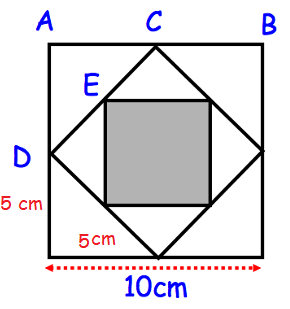
DC2 = 52 + 52
DC = √(25+25)
= √50
= √(5 x 5 x 2)
= 5√2
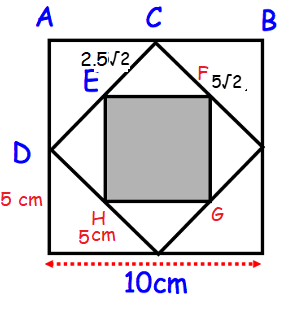
Area of shaded square
= Area of square EFGH - 4(Area of triangle CEF)
= (5√2)2 - 4(1/2) x 2.5√2 x 2.5√2
= 25(2) - 2 x 6.25(2)
= 50 - 25
= 25 cm2
20. Solution :
Given that (10 - √32)/√2 = a + b√2
Multiplying both numerator and denominator by √2.
= [(10 - √32)/√2] [√2/√2]
= √2(10-√32)/2
√32 = √(2 x 2 x 2 x 2 x 2)
= 4√2
= √2(10-4√2)/2
= 2√2(5-2√2)
= 10√2 - 4√2√2
= 10 √2 - 8
= -8 + 10√2
Comparing with a + b√2
a = -8 and b = 10
Subscribe to our ▶️ YouTube channel 🔴 for the latest videos, updates, and tips.
Kindly mail your feedback to v4formath@gmail.com
We always appreciate your feedback.
About Us | Contact Us | Privacy Policy
©All rights reserved. onlinemath4all.com

Recent Articles


-
US Common Core K-12 Curricum Algebra Solving Simple Equations
Jan 07, 26 01:53 PM
US Common Core K-12 Curricum Algebra Solving Simple Equations -
10 Hard SAT Math Questions (Part - 4)
Jan 05, 26 06:56 PM
 10 Hard SAT Math Questions (Part - 4)
 -
10 Hard SAT Math Questions (Part - 3)
Jan 05, 26 06:34 PM
 10 Hard SAT Math Questions (Part - 3)