USING A SIMULATION TO MAKE A PREDICTION
Subscribe to our ▶️ YouTube channel 🔴 for the latest videos, updates, and tips.
We can use a simulation or model of an experiment to find the experimental probability of compound events.
Example 1 :
At a street intersection, a vehicle is classified either as a car or a truck, and it can turn left, right, or go straight. About an equal number of cars and trucks go through the intersection and turn in each direction. Use a simulation to find the experimental probability that the next vehicle will be a car that turns right.
Solution :
Step 1 :
Choose a model.
Use a coin toss to model the two vehicle types.
Let Heads = Car and Tails = Truck
Use a spinner divided into 3 equal sectors to represent the three directions as shown.

Step 2 :
Find the sample space for the compound event.
There are 6 possible outcomes: CL, CR, CS, TL, TR, TS
Step 3 :
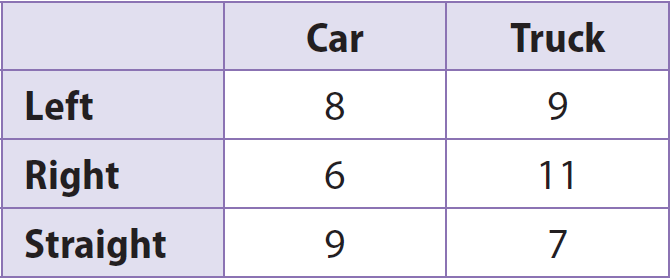
Perform the simulation.
A coin was tossed and a spinner spun 50 times.
The results are shown in the table.
Step 3 :
Find the experimental probability that a car turns right.

Substitute the values.
P (Car turns right) = 6/50
Simplify.
P (Car turns right) = 3/25.
Based on the simulation, the experimental probability is 3/25 that the next vehicle will be a car that turns right.
Example 2 :
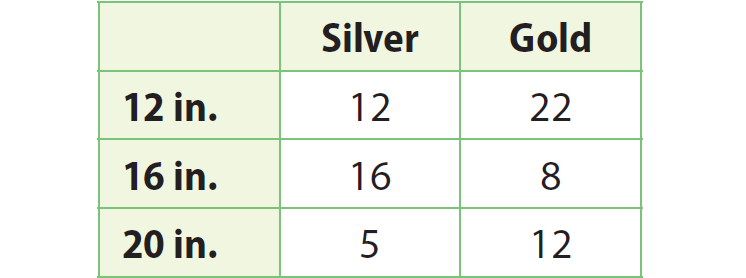
A jeweler sells necklaces made in three sizes and two different metals. Use the data from a simulation to find the experimental probability that the next necklace sold is a 20-inch gold necklace.
Solution :
Step 1 :
Find the total no. of necklaces made.
Total no. of necklaces is
= 12 + 16 + 5 + 22 + 8 + 12
= 75
Step 2 :
Find the no. of 20-inch gold necklaces.
No. of 20-inch gold necklaces = 12.
Step 3 :
Find the probability.

Experimental probability = 12/75
Simplify.
Experimental probability = 4/25
Example 3 :
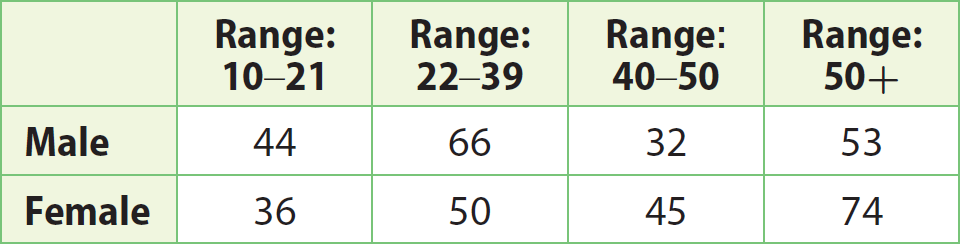
A dentist has 400 male and female patients that range in ages from 10 years old to 50 years old. Use the data from a simulation to find the experimental probability that the next patient will be female and in the age range 22–39.
Solution :
Step 1 :
Find the total no. of patients.
Total no. of patients is
= 44 + 66 + 32 + 53 + 36 + 50 + 45 + 74
= 400
Step 2 :
Find the no. of female patients in the age range 22 - 39.
No. of female patients in the age range 22 - 39 = 50
Step 3 :
Find the probability.
Experimental probability = 50/400
Simplify.
Experimental probability = 1/8
Subscribe to our ▶️ YouTube channel 🔴 for the latest videos, updates, and tips.
Kindly mail your feedback to v4formath@gmail.com
We always appreciate your feedback.
About Us | Contact Us | Privacy Policy
©All rights reserved. onlinemath4all.com

Recent Articles


-
10 Hard SAT Math Questions (Part - 44)
Jan 12, 26 06:35 AM
10 Hard SAT Math Questions (Part - 44) -
US Common Core K-12 Curricum Algebra Solving Simple Equations
Jan 07, 26 01:53 PM
US Common Core K-12 Curricum Algebra Solving Simple Equations -
10 Hard SAT Math Questions (Part - 4)
Jan 05, 26 06:56 PM
 10 Hard SAT Math Questions (Part - 4)