PROBLEMS ON INVERSE TRIGONOMETRIC FUNCTIONS
Subscribe to our ▶️ YouTube channel 🔴 for the latest videos, updates, and tips.
Problem 1 :
Find the principal value of sin-1(-1/2), (in radians and degrees).
Solution :
Let y = sin-1(-1/2).
Then,
sin y = -1/2
The range of the principal value of sin-1(x) is [-π/2, π/2] and hence, let us find y ∈ [-π/2, π/2] such that
sin y = -1/2
Clearly, y = -π/6.
Thus, the principal value of sin-1(x) is -π/6.
This corresponds to -30°.
Problem 2 :
Find the principal value of sin-1(2), if it exists.
Solution :
Let y = sin-1(2).
Since the domain of y = sin-1(x) is [-1, 1] and 2 ∉ [-1, 1], sin-1(2) does not exist.
Problem 3 :
Find the principal value of
(i) sin-1(1/√2), (ii) sin-1[sin(-π/3)], (iii) sin-1[sin(5π/6)]
Solution :
We know that
sin-1 : [-1, 1] -----> [-π/2, π/2] is given by sin-1(x) = y
if and only if x = sin y for -1 ≤ x ≤ 1 and -π/2 ≤ y ≤ π/2.
Thus,
(i) sin-1(1/√2) = π/4
Since π/4 ∈ [-π/2, π/2] and sin (π/4) = 1/√2.
(ii) sin-1[sin(-π/3)] = -π/3, since -π/3 ∈ [-π/2, π/2].
(iii) sin-1[sin(5π/6)] :
= sin-1[sin(π - π/6)]
= sin-1[sin(π/6)]
= sin-1(1/2)
= π/6
Since π/6 ∈ [-π/2, π/2].
Problem 4 :
Find the domain of sin-1(2 - 3x2).
Solution :
We know that the domain of sin-1(x) is [-1, 1].
This leads to -1 ≤ (2 - 3x2) ≤ 1, which implies
-1 ≤ (2 - 3x2) ≤ 1
Subtract 2 from each term.
-3 ≤ -3x2 ≤ -1
Divide each term by -3.
1 ≥ x2 ≥ 1/3
or
1/3 ≤ x2 ≤ 1/3
That is,
1/√3 ≤ |x| ≤ 1
Then,
x ∈ [-1, -1/√3] U [1/√3, 1]
Since a ≤ |x| ≤ b implies, x ∈ [-b, -a] U [a, b].
Problem 5 :
Find the principal value of cos-1(√3/2).
Solution :
Let y = cos-1(√3/2).
Then,
cos y = √3/2
The range of the principal value of y = cos-1(x) is [0, π].
So, let us find y in [0, π] such that cos y = √3/2.
But, cos (π/6) = √3/2 and π/6 ∈ [0, π].
Therefore,
y = π/6
Thus, the principal value of cos-1(√3/2) is π/6.
Problem 6 :
Find the principal value of
(i) cos-1(-1/√2), (ii) cos-1[cos(-π/3)], (iii) cos-1[cos(7π/6)]
Solution :
It is known that
cos-1 : [-1, 1] -----> [0, π] is given by cos-1(x) = y
if and only if x = cos y for -1 ≤ x ≤ 1 and 0 ≤ y ≤ π.
Thus,
(i) cos-1(-1/√2) = 3π/4, since 3π/4 ∈ [0, π] and
cos (3π/4) = cos (π - π/4) = -cos(π/4) = -1/√2
(ii) cos-1[cos(-π/3)] = cos-1[cos(π/3)] = π/3,
since -π/3 ∉ [0, π], but π/3 ∈ [0, π].
(iii) cos-1[cos(7π/6)] = 5π/6,
since cos(7π/6) = cos(π + π/6) = -√3/2 = cos(5π/6) and
5π/6 ∈ [0, π]
Problem 7 :
Find the principal value of tan-1(√3).
Solution :
Let y = tan-1(√3).
Then,
tan y = √3
Thus, y = π/3.
Since π/3 ∈ [-π/2, π/2], the principal value of tan-1(√3) is π/3.
Problem 8 :
Find the principal value of
(i) tan-1(-√3), (ii) tan-1[tan(3π/5)], (iii) tan[tan-1(209)]
Solution :
(i) tan-1(-√3) = tan-1[tan(-π/3)] = -π/3,
since -π/3 ∈ (-π/2, π/2).
(ii) tan-1[tan(3π/5)]
Let us find Ѳ ∈ (-π/2, π/2) such that tan Ѳ = tan(3π/5).
Since the tangent function has period π,
tan(3π/5) = tan(3π/5 - π) = tan (-2π/5)
Therefore,
tan-1[tan(3π/5)] = tan-1[tan(-2π/5)] = -2π/5,
since -2π/5 ∈ (-π/2, π/2).
(iii) since tan-1[tan(x)] = x, x ∈ R, we have
tan-1[tan(2019)] = 2019
Problem 9 :
Find the principal value of csc-1(-1).
Solution :
Let y = csc-1(-1).
Then,
csc y = -1
Since the range of principal value branch of y = csc-1x is
[-π/2, π/2] \ {0} and csc (-π/2) = -1,
we have y = -π/2.
Note that -π/2 ∈ [-π/2, π/2] \ {0}.
Thus the principal value of csc-1(-1) is -π/2.
Problem 10 :
Find the principal value of sec-1(-2).
Solution :
Let y = sec-1(-2).
Then,
sec y = -2
The range of principal value branch of y = sec-1x is
[0, π] \ {π/2}
Let us find y in [0, π] - {π/2} such that sec y = -2.
But, sec y = -2 -----> cos y = -1/2.
Now,
cos y = -1/2 = -cos(π/3) = cos(π - π/3) = cos(2π/3)
Therefore,
y = 2π/3
Since 2π/3 ∈ [0, π] \ {π/2}, the principal value of sec-1(-2) is 2π/3.
Problem 11 :
Find the value of sec-1(-2√3/3).
Solution :
Let Ѳ = sec-1(-2√3/3).
Then,
sec Ѳ = -2/√3 where Ѳ ∈ [0, π] \ {π/2}
Thus, cos Ѳ = -√3/2.
Now,
cos(5π/6) = cos(π - π/6) = -cos(π/6) = -√3/2
Hence,
sec-1(-2√3/3) = 5π/6
Problem 12 :
If cot-1(1/7) = θ, find the value of cos θ.
Solution :
By definition, cot-1(x) ∈ (0, π).
Therefore, cot-1(1/7) = θ implies θ ∈ (0, π).
But, cot-1(1/7) = θ implies cot θ = 1/7 and hence tan θ = 7 and θ is acute.
Using tan θ = 7/1, we construct a right triangle as shown below.
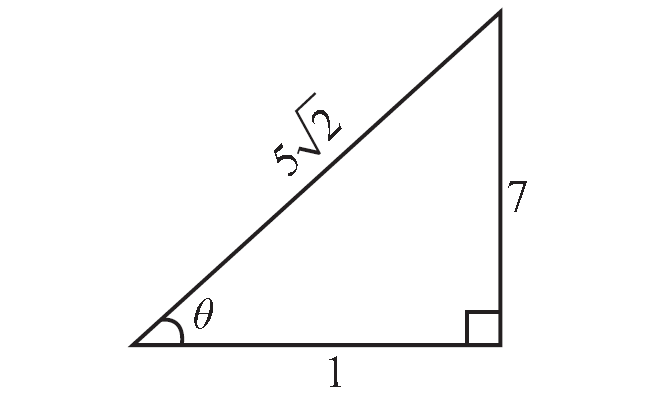
Then, we have,
cos θ = 1/5√2
Subscribe to our ▶️ YouTube channel 🔴 for the latest videos, updates, and tips.
Kindly mail your feedback to v4formath@gmail.com
We always appreciate your feedback.
About Us | Contact Us | Privacy Policy
©All rights reserved. onlinemath4all.com

Recent Articles


-
AP Calculus AB Problems with Solutions (Part - 1)
May 29, 26 09:41 PM
 AP Calculus AB Problems with Solutions (Part - 1)
 -
SAT Math Practice Problems with Answers
May 21, 26 01:17 AM
 SAT Math Practice Problems with Answers
 -
Digital SAT Math Questions and Answers (Part - 13)
May 17, 26 09:03 AM
 Digital SAT Math Questions and Answers (Part - 13)