PRIME FACTORIZATION BY DIVISION METHOD
Subscribe to our ▶️ YouTube channel 🔴 for the latest videos, updates, and tips.
Expressing a number as a product of factors that are all prime numbers is called the prime factorization of a number.
For example, 36 can be written as product of factors as shown below.
36 = 1 x 36
36 = 2 x 18
36 = 3 x 12
36 = 4 x 9
36 = 6 x 6
The factors of 36 can be found easily as 1, 2, 3, 4, 6, 9, 12, 18 and 36.
Note that not all the factors of 36 are prime numbers. One of the ways to find the prime factorization of a number is division method .
Using Division Method, we can find the prime factorization of 36 as follows :
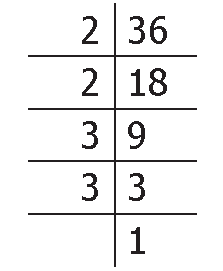 36 = 2 x 2 x 3 x 3 |
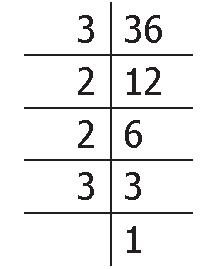 36 = 3 x 2 x 2 x 3 |
In the above method, why do we start with 2 or 3 ? why not with 5 ?
Because, we know that 36 is not a multiple of 5 and hence not divisible by 5. So, to find the prime factors of a number, it will be useful to check for divisibility by smaller numbers like 2, 3 and 5 first and not take numbers at random.
Examples :
Find the prime factors of the following numbers.
1) 56
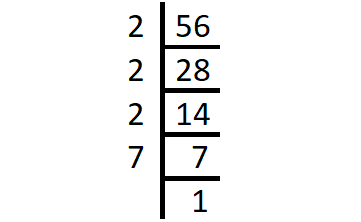
Prime factorization of 56 :
56 = 2 x 2 x 2 x 7
2) 24
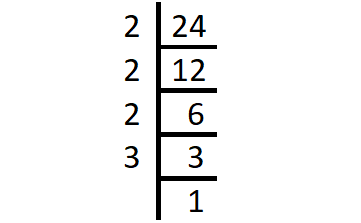
Prime factorization of 24 :
24 = 2 x 2 x 2 x 3
3) 50

Prime factorization of 50 :
50 = 2 x 5 x 5
4) 108
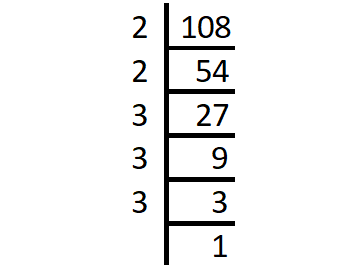
Prime factorization of 108 :
108 = 2 x 2 x 3 x 3 x 3
5) 80
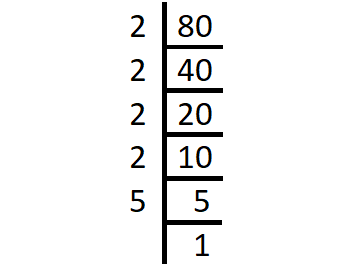
Prime factorization of 80 :
80 = 2 x 2 x 2 x 2 x 5
6) 54
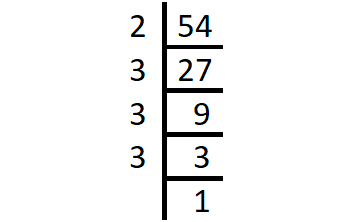
Prime factorization of 54 :
54 = 2 x 3 x 3 x 3
Subscribe to our ▶️ YouTube channel 🔴 for the latest videos, updates, and tips.
Kindly mail your feedback to v4formath@gmail.com
We always appreciate your feedback.
About Us | Contact Us | Privacy Policy
©All rights reserved. onlinemath4all.com

Recent Articles


-
AP Calculus AB Problems with Solutions (Part - 1)
May 29, 26 09:41 PM
 AP Calculus AB Problems with Solutions (Part - 1)
 -
SAT Math Practice Problems with Answers
May 21, 26 01:17 AM
 SAT Math Practice Problems with Answers
 -
Digital SAT Math Questions and Answers (Part - 13)
May 17, 26 09:03 AM
 Digital SAT Math Questions and Answers (Part - 13)