ORDERING RATIONAL AND IRRATIONAL NUMBERS WORKSHEET
Subscribe to our ▶️ YouTube channel 🔴 for the latest videos, updates, and tips.
Problem 1 :
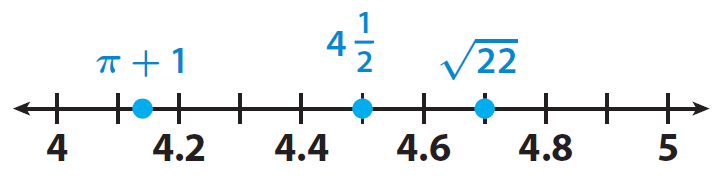
Order √22, π+1 and 4 1/2 from least to greatest. Then graph them on the number line.
Problem 2 :
Order 4√2, 2√3, 3√2, √17, 3√3 and 5 from least to greatest.
Problem 3 :
Order 2, √5, 61/3 and 42/3 from least to greatest.

Answers
Problem 1 :
Order √22, π+1 and 4 1/2 from least to greatest. Then graph them on the number line.
Answer :
Step 1 :
First approximate √22.
√22 is between 4 and 5. Since we don’t know where it falls between 4 and 5, we need to find a better estimate for √22.
So that we can compare it to 4 1/2.
Since 22 is closer to 25 than 16, use squares of numbers between 4.5 and 5 to find a better estimate of √22.
4.52 = 20.25
4.62 = 21.16
4.72 = 22.09
4.82 = 23.04
Since 4.72 = 22.09, an approximate value for √22 is 4.7.
That is,
√22 ≈ 4.7 -------- (1)
Step 2 :
An approximate value of π is 3.14. So an approximate value of π+1 is 4.14.
That is,
π+1 ≈ 4.14 -------- (2)
Step 3 :
The value of 4 1/2 is 4.5.
That is,
4 1/2 = 4.5 -------- (3)
Step 4 :
Comparing (1), (2) and (3), we can order the numbers from least to greatest as given below.
π+1, 4 1/2 and √22
Step 5 :
Read the numbers from left to right to place them on a number line in order from least to greatest.
Problem 2 :
Order 4√2, 2√3, 3√2, √17, 3√3 and 5 from least to greatest.
Answer :
Key Concept :
Most of the given real numbers are irrational numbers.
So, square the given real numbers and order them from least to greatest.
Step 1 :
Take square to the number 4√2.
(4√2)2 = (4)2(√2)2
(4√2)2 = (16)(2)
(4√2)2 = 32 --------> (1)
Step 2 :
Take square to the number 2√3.
(2√3)2 = (2)2(√3)2
(2√3)2 = (4)(3)
(2√3)2 = 12 --------> (2)
Step 3 :
Take square to the number 3√2.
(3√2)2 = (3)2(√2)2
(3√2)2 = (9)(2)
(3√2)2 = 18 --------> (3)
Step 4 :
Take square to the number √17.
(√17)2 = 17 --------> (4)
Step 5 :
Take square to the number 3√3.
(3√3)2 = (3)2(√3)2
(3√3)2 = (9)(3)
(3√3)2 = 27 --------> (5)
Step 6 :
Take square to the number 5.
(5)2 = 25 --------> (6)
Step 7 :
Comparing (1), (2), (3), (4), and (6), we can write the squares of the given irrational numbers from least to greatest as given below.
12, 17, 18, 25, 27, 32
In the above order, write the corresponding real number to its square to write the given real numbers in the order from least to greatest.
2√3, √17, 3√2, 5, 3√3, 4√2
Problem 3 :
Order 2, √5, 61/3, 42/3 from least to greatest
Answer :
Step 1 :
First convert the radical in √5 as exponent.
Then, we have
√5 = 51/2
Step 2 :
Now, the given numbers are
2, 51/2, 61/3, 42/3
In the numbers listed above, we find the exponents 1/2, 1/3 and 2/3.
All the exponents are fractions and the denominators of the fractions are 2 and 3.
The least common multiple of the denominators 2 and 3 is 6
Step 3 :
Now take exponent 6 to all of the numbers in step 2.
26, (51/2)6, (61/3)6, (42/3)6
Simplify.
26, 53, 62, 44
64, 125, 36, 256
Step 4 :
Order the numbers from least to greatest.
36, 64, 125, 256
Step 5 :
Using the order of numbers in step 4, write the given rational and irrational numbers in the order from least to greatest.
61/3, 2, √5, 42/3
Subscribe to our ▶️ YouTube channel 🔴 for the latest videos, updates, and tips.
Kindly mail your feedback to v4formath@gmail.com
We always appreciate your feedback.
About Us | Contact Us | Privacy Policy
©All rights reserved. onlinemath4all.com

Recent Articles


-
Digital SAT Math Practice Test with Answers (Part - 17)
Sep 29, 26 12:20 PM
 Digital SAT Math Practice Test with Answers (Part - 17)
 -
Digital SAT Math Practice Test with Answers (Part - 16)
Sep 07, 26 11:23 AM
Digital SAT Math Practice Test with Answers (Part - 16) -
Digital SAT Math Practice Test with Answers (Part - 15)
Aug 23, 26 12:24 PM
 Digital SAT Math Practice Test with Answers (Part - 15)