MAXIMUM OR MINIMUM VALUE OF A QUADRATIC FUNCTION
Subscribe to our ▶️ YouTube channel 🔴 for the latest videos, updates, and tips.
We can determine the maxim or minimum value of the quadratic function using the vertex of the parabola (graph the quadratic function).
The general form of a quadratic function is
f(x) = ax2 + bx + c
Here, if the leading coefficient or the sign of "a" is positive, then the graph of the quadratic function will be a parabola which opens up.
If the leading coefficient or the sign of "a" is negative, then the graph of the quadratic function will be a parabola which opens down.
Maximum Value of a Quadratic Function
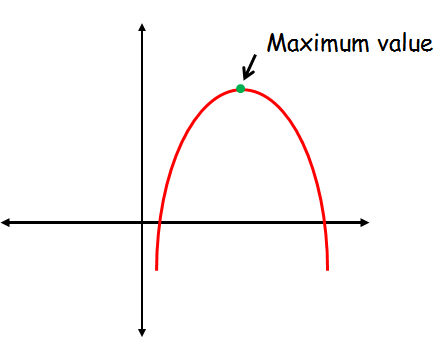
The quadratic function f(x) = ax2 + bx + c will have only the maximum value when the the leading coefficient or the sign of "a" is negative.
When "a" is negative the graph of the quadratic function will be a parabola which opens down.
The maximum value is "y" coordinate at the vertex of the parabola.
Note :
There is no minimum value for the parabola which opens down.
Minimum Value of a Quadratic Function
The quadratic function f(x) = ax2 + bx + c will have only the minimum value when the the leading coefficient or the sign of "a" is positive.
When "a" is positive, the graph of the quadratic function will be a parabola which opens up.
The minimum value is "y" coordinate at the vertex of the parabola.
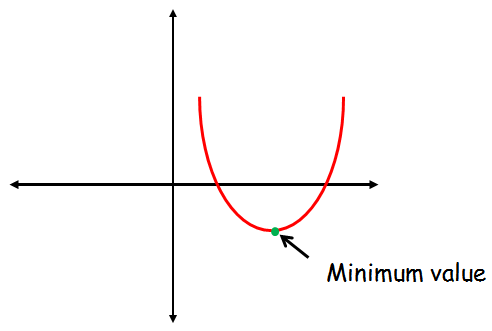
Note :
There is no maximum value for the parabola which opens up.
Vertex of a Parabola
To find the vertex of the parabola which is given by the quadratic function
f(x) = ax2 + bx + c,
we have to substitute
x = -b/2a
And the vertex is
[-b/2a, f(-b/2a)]
So, the maximum or minimum value of the quadratic function is,
"y" coordinate = f(-b/2a)
Examples
Example 1 :
Find the minimum or maximum value of the quadratic equation given below.
f(x) = 2x2 + 7x + 5
Solution :
In the given quadratic function, since the leading coefficient (2x2) is positive, the function will have only the minimum value.
When we compare the given quadratic function with
f(x) = ax2 + bx + c,
we get
a = 2
b = 7
c = 5
"x" coordinate of the vertex = -b/2a
"x" coordinate of the vertex = -7/2(2)
"x" coordinate of the vertex = -7/4
"x" coordinate of the vertex = -1.75
Minimum value is
= f(-1.75)
= 2(-1.75)2 + 7(-1.75) + 5
= 2(3.0625) - 12.25 + 5
= 6.125 - 12.25 + 5
= -1.125
So, the minimum value of the given quadratic function is -1.125.
Example 2 :
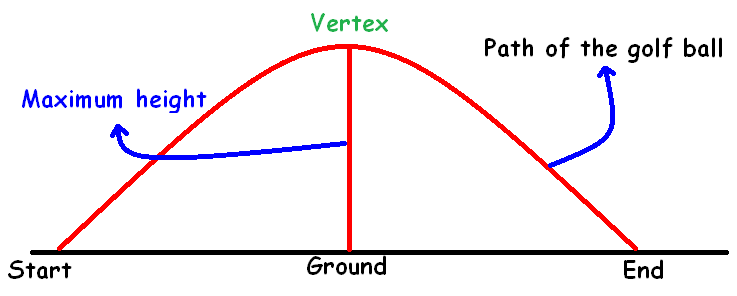
A golfer attempts to hit a golf ball over a gorge from a platform above the ground. The function that models the height of the ball is
h(t) = -5t2 + 40t + 100
where 'h' is the height in meters 't' is time in seconds after contact. Find the maximum height reached by the golf ball.
Solution :
It is clear that the path of the golf ball is a parabola which opens up.
It has been illustrated in the picture given below.
When we compare the given quadratic function with
f(x) = ax2 + bx + c,
we get
a = -5
b = 40
c = 100
"x" coordinate of the vertex = -b / 2a
"x" coordinate of the vertex = -40 / 2x(-5)
"x" coordinate of the vertex = -40 / (-10)
"x" coordinate of the vertex = 4
Maximum height is
= h(4)
= -5(4)2 + 40(4) + 100
= -5(16) + 160 + 100
= -80 + 160 + 100
= 180
So, the maximum height reached by the golf ball is 180 meters.
Subscribe to our ▶️ YouTube channel 🔴 for the latest videos, updates, and tips.
Kindly mail your feedback to v4formath@gmail.com
We always appreciate your feedback.
About Us | Contact Us | Privacy Policy
©All rights reserved. onlinemath4all.com

Recent Articles


-
AP Calculus AB Problems with Solutions (Part - 1)
May 29, 26 09:41 PM
 AP Calculus AB Problems with Solutions (Part - 1)
 -
SAT Math Practice Problems with Answers
May 21, 26 01:17 AM
 SAT Math Practice Problems with Answers
 -
Digital SAT Math Questions and Answers (Part - 13)
May 17, 26 09:03 AM
 Digital SAT Math Questions and Answers (Part - 13)