HORIZONTAL AND VERTICAL SHIFTS WORKSHEET
Subscribe to our ▶️ YouTube channel 🔴 for the latest videos, updates, and tips.
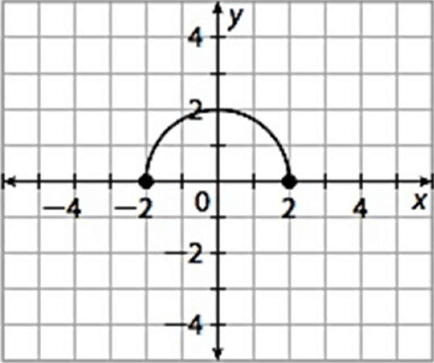
Problems 1-3 : Refer the graph of f(x) given below.
Problem 1 :
Sketch the graph of g(x) such that
g(x) = f(x) + 2
Problem 2 :
Sketch the graph of h(x) such that
h(x) = f(x + 2)
Problem 3 :
Sketch the graph of j(x) such that
j(x) = f(x - 2) - 3
Problems 4-6 : State the transformations on f(x) that woul create the graph of the new function described.
Problem 4 :
g(x) = f(x + 3) + 5
Problem 5 :
Problem 6 :
j(x) = -3 + f(x)
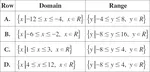
Problems 7-9 : The function f(x) has a domain of [-13, 4) and a range of [0, +∞). Find the domain and range for the functions.
Problem 7 :
g(x) = f(x + 4)
Problem 8 :
h(x) = f(x) + 25
Problem 9 :
h(x) = f(x - 3) - 7.5
Problems 10-12 : The point (8, -5) is on the graph of f(x). Find a point on the graph of the function.
Problem 10 :
g(x) = f(x - 13)
Problem 11 :
h(x) = f(x) - 17
Problem 12 :
h(x) = f(x + 3) + 5

Answers
1. Answer :
g(x) = f(x) + 2
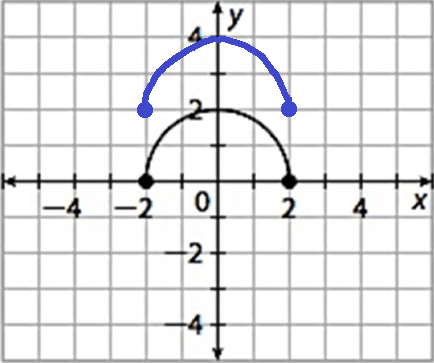
In f(x) + 2, 2 is added to f. So, there is a vertical shift of 2 units up.
To get the graph of g(x), the graph of f(x) has to be shifted 2 units up.
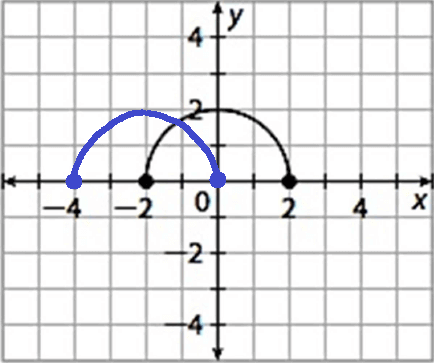
2. Answer :
h(x) = f(x + 2)
In f(x + 2), 2 is added to x. So, there is an horizontal shift of 2 units to the left.
To get the graph of h(x), the graph of f(x) has to be shifted 2 units to the left.
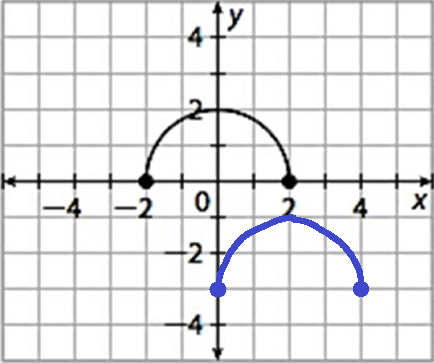
3. Answer :
j(x) = f(x - 2) - 3
In f(x - 2), 2 is subtracted from x. So, there is an horizontal shift of 2 units to the right.
In f(x - 2) - 3, 3 is subtracted from f. So, there is a vertical shift of 3 unit down.
To get the graph of j(x), the graph of f(x) has to be shifted 2 units to the right and 3 units down.
4. Answer :
g(x) = f(x + 3) + 5
Horizontal Shift : 3 units to the left
Vertical Shift : 5 units up
5. Answer :
6. Answer :
j(x) = -3 + f(x)
j(x) = f(x) - 3
NO horizontal shift
Vertical Shift : 3 units down
7. Answer :
g(x) = f(x + 4)
Horizontal Shift :
4 units to the left
Since there is an horizontal shift of 4 units to the left, subtract 4 from the boundary values of the domain of f(x) to get the domain of g(x).
Domain of g(x) = [-13 - 4, 4 - 4)
= [-17, 0)
Vertical Shift :
NO vertical shift
Since there is NO vertical shift, there no change in range.
Range g(x) = [0, +∞)
8. Answer :
h(x) = f(x) + 25
Horizontal Shift :
NO horizontal shift
Since there is NO horizontal shift, there no change in range.
Domain of h(x) = [-13, 4)
Vertical Shift :
25 units up
Since there is a vertical shift of 25 units up, add 25 to the boundary values of the range of f(x) to get the range of h(x).
Range of h(x) = [0 + 25, +∞ + 25)
= [25, +∞)
Problem 9 :
h(x) = f(x - 3) - 7.5
9. Answer :
h(x) = f(x - 3) - 7.5
Horizontal Shift :
3 units to the right
Since there is an horizontal shift of 3 units to the right, add 3 to the boundary values of the domain.
Domain of j(x) = [-13 + 3, 4 + 3)
= [-10, 7)
Vertical Shift :
7.5 units down
Since there is a vertical shift of 7.5 units down, subtract 25 from the boundary values of the range.
Range of j(x) = [0 -7.5, +∞ - 7.5)
= [-.75, +∞)
Problems 10-12 : The point (8, -5) is on the graph of f(x). Find a point on the graph of the function.
Problem 10 :
g(x) = f(x - 13)
10. Answer :
g(x) = f(x - 13)
Horizontal Shift :
13 units to the right
Since there is an horizontal shift of 13 units to the right, add 13 to the x-coordinate of the point (8, -5).
Vertical Shift :
NO vertical shift
Since there is NO vertical shift, there no change in y-coodinate.
Therefore, the point on the graph of g(x) :
(21, -5)
Problem 11 :
h(x) = f(x) - 17
11. Answer :
h(x) = f(x) - 17
Horizontal Shift :
NO horizontal shift
Since there is NO horizontal shift, there no change in x-coordinate.
Vertical Shift :
17 units down
Since there is a vertical shift of 17 units down, subtract 25 from the y-coordinate of the point (8, -5).
Therefore, the point on the graph of h(x) :
(8, -22)
Problem 12 :
h(x) = f(x + 3) + 5
12. Answer :
h(x) = f(x + 3) + 5
Horizontal Shift :
3 units to the left
Since there is an horizontal shift of 3 units to the left, subtract 3 from the x-coordinate from the point (8, -5).
Vertical Shift :
5 units up
Since there is a vertical shift of 5 units up, add 5 to the y-coordinate of the point (8, -5).
Therefore, the point on the graph of j(x) :
(5, 0)
Subscribe to our ▶️ YouTube channel 🔴 for the latest videos, updates, and tips.
Kindly mail your feedback to v4formath@gmail.com
We always appreciate your feedback.
About Us | Contact Us | Privacy Policy
©All rights reserved. onlinemath4all.com

Recent Articles


-
Digital SAT Math Problems and Solutions (Part - 1)
Feb 05, 26 09:37 AM
 Digital SAT Math Problems and Solutions (Part - 1)
 -
AP Precalculus Problems and Solutions
Feb 05, 26 06:41 AM
 AP Precalculus Problems and Solutions
 -
SAT Math Preparation with Hard Questions
Feb 05, 26 05:30 AM
SAT Math Preparation with Hard Questions