EXPLORING TRANSLATIONS
Subscribe to our ▶️ YouTube channel 🔴 for the latest videos, updates, and tips.
Function is a rule that assigns exactly one output to each input.
A transformation is a function that describes a change in the position, size, or shape of a figure. The input of a transformation is the pre-image, and the output of a transformation is the image.
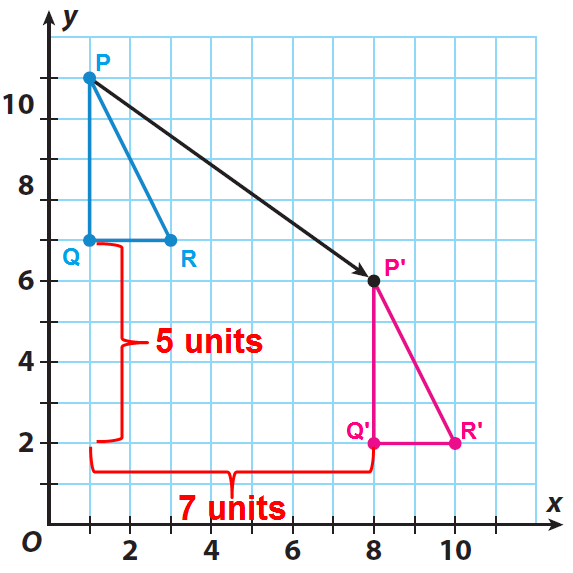
The triangle PQR has the following vertices.
P(1, 11), Q(1, 7) and R(3, 7)
(i) Trace triangle PQR and line PP′ onto a piece of paper as given below.
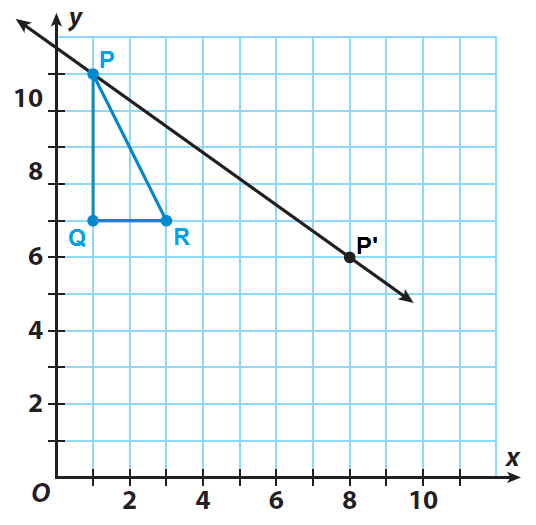
(ii) Slide your triangle along the line to model the translation that maps point P to point P′.
(iii) The image of the translation is the triangle produced by the translation.
Sketch the image of the translation.
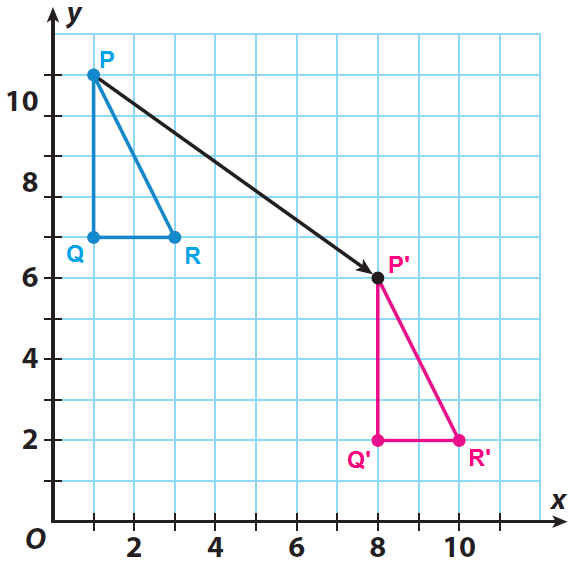
(iv) The vertices of the image are labeled using prime notation. For example, the image of P is P′. Label the images of points Q and R.
(v) Describe the motion modeled by the translation.
Move 7 units to the right and 5 units down.
(vi) Check that the motion we described in part (v) is the same motion that maps point Q onto Q′.
Reflect
Is the orientation of the triangle affected by the translation ?
No
The orientation of the triangle is not affected and it stays the same.
Practice Problems
Problem 1 :
A triangle has the vertices P (-6, 2), Q(-7, -5) and R(-2, -3). P', Q'and R' are the vertices of the triangle after a translation of 7 units to the right and 2 units up. Find the vertices P', Q' and R'
Solution :
Since there is a translation of 7 units to the right and 2 units up, we have to add 7 to x-coordinate and add 2 to y-coordinate of each vertex.
P' ------> (-6+7, 2+2) = (1, 4)
Q' ------> (-7+7, -5+2) = (0, -3)
R' ------> (-2+7, -3+2) = (5, -1)
Problem 2 :
A trapezoid has the vertices A (1, 0), B(4, 0), C(4, -4) and D(0, -4). A', B', C'and D' are the vertices of the trapezoid after a translation of 5 units to the left and 3 units up. Find the vertices A', B', C' and D'
Solution :
Since there is a translation of 5 units to the left and 3 units up , we have to subtract 5 from x-coordinate and add 3 to y-coordinate of each vertex.
A' ------> (1-5, 0+3) = (-4, 3)
B' ------> (4-5, 0+3) = (-1, 3)
C' ------> (4-5, -4+3) = (-1, -1)
D' ------> (0-5, -4+3) = (-5, -1)
Subscribe to our ▶️ YouTube channel 🔴 for the latest videos, updates, and tips.
Kindly mail your feedback to v4formath@gmail.com
We always appreciate your feedback.
About Us | Contact Us | Privacy Policy
©All rights reserved. onlinemath4all.com

Recent Articles


-
SAT Math Practice Problems with Answers
May 21, 26 01:17 AM
 SAT Math Practice Problems with Answers
 -
Digital SAT Math Questions and Answers (Part - 13)
May 17, 26 09:03 AM
 Digital SAT Math Questions and Answers (Part - 13)
 -
Problems on Solving Logarithmic Equations
Apr 24, 26 09:30 PM
Problems on Solving Logarithmic Equations