DESCRIBING TRANSFORMATIONS OF TRIGONOMETRIC FUNCTIONS
Subscribe to our ▶️ YouTube channel 🔴 for the latest videos, updates, and tips.
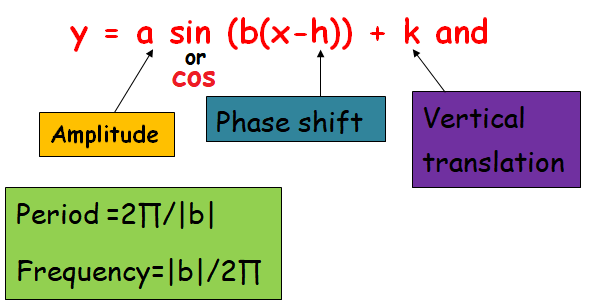
The graphs of the six basic trigonometric functions can be transformed by adjusting their amplitude, period, phase shift, and vertical shift.
The transformations are given below.
What is amplitude ?
Graphically, the amplitude is half the height of the wave.
What is period ?
Graphically, the period is the length of one full cycle of the wave.
What is phase shift ?
In mathematics, a horizontal shift of a trigonometric function may be referred to as a phase shift.
For example :
- (x - 2) where 2 is a positive value being subtracted the shift is to the right.
- (x + 2) where 2 is a negative value being added the shift is to the left.
What is vertical translation ?
- When we have +k, we have to move the graph k units up.
- When we have -k, we have to move the graph k units down.
Example 1 :
Graph one period function. Use your understanding of transformations, not your graphing calculators. Be sure to show the scale on both axes.
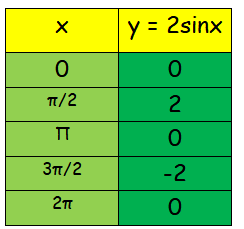
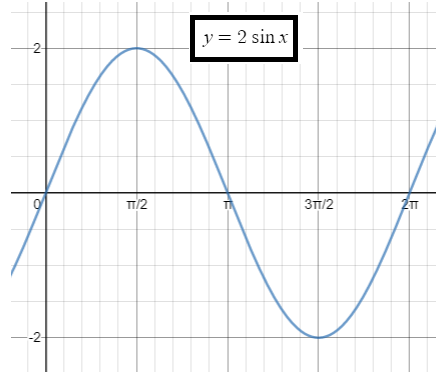
y = 2 sinx
Solution :
We can compare the given function with y = A sin Bx
Amplitude = 2
Period = 2π/|B| ==> 2π/|1| ==> 2π
Frequency = 1/2π
There is no phase shift and and vertical shift.
Example 2 :
Graph one period function. Use your understanding of transformations, not your graphing calculators. Be sure to show the scale on both axes.
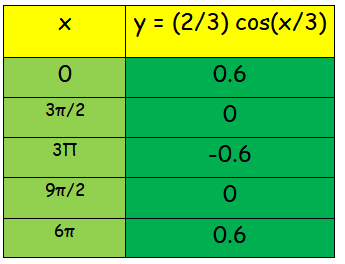
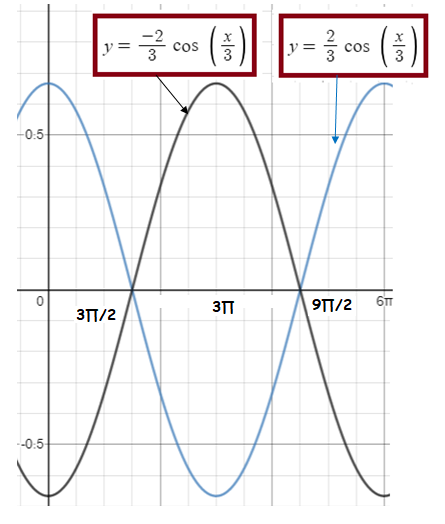
y = (-2/3) cos (x/3)
Solution :
We can compare the given function with y = A cos Bx
Amplitude = 2/3
Period = 2π/|B| ==> 2π/|1/3| ==> 6π
Frequency = 1/6π
Since we have negative in front, there is a reflection.
There is no phase shift and and vertical shift.
Subscribe to our ▶️ YouTube channel 🔴 for the latest videos, updates, and tips.
Kindly mail your feedback to v4formath@gmail.com
We always appreciate your feedback.
About Us | Contact Us | Privacy Policy
©All rights reserved. onlinemath4all.com

Recent Articles


-
SAT Math Practice Problems with Answers
May 21, 26 01:17 AM
 SAT Math Practice Problems with Answers
 -
Digital SAT Math Questions and Answers (Part - 13)
May 17, 26 09:03 AM
 Digital SAT Math Questions and Answers (Part - 13)
 -
Problems on Solving Logarithmic Equations
Apr 24, 26 09:30 PM
Problems on Solving Logarithmic Equations