CO INTERIOR ANGLES PRACTICE WORKSHEET
Subscribe to our ▶️ YouTube channel 🔴 for the latest videos, updates, and tips.
Find the values of the variables in the following :
Problem 1 :

Problem 2 :

Problem 3 :

Problem 4 :

Problem 5 :

Problem 6 :

Problem 7 :

Problem 8 :
a) Name a pair of complementary angles, a pair of supplementary angles, and a pair of adjacent angles.
b) Are ∠KGH and ∠LKG adjacent angles? Are ∠FGK and ∠FGH adjacent angles? Explain.
c) ∠1 is a complement of ∠2, and m∠2 = 5°. Find m∠1.
d) ∠3 is a supplement of ∠4, and m∠3 = 148°. Find m∠4.

Problem 9 :
a. ∠1 is a complement of ∠2, and m∠1 = 62°. Find m∠2.
b. ∠3 is a supplement of ∠4, and m∠4 = 47°. Find m∠3.
Problem 10 :
What is the value of x?

Problem 11 :
Find the values of x and y.

Problem 12 :
Find FG and m∠G.

Problem 13 :
Find the values of x and y.

Problem 14 :
Find the values of x and y.

Problem 15 :
You shoot a pool ball, and it rolls back to where it started, as shown in the diagram. The ball bounces off each wall at the same angle at which it hits the wall.

a. The ball hits the first wall at an angle of 63°. So m∠AEF = m∠BEH = 63°. What is m∠AFE? Explain your reasoning.
b. Explain why m∠FGD = 63°.
c. What is m∠GHC? m∠EHB?
d. Is quadrilateral EFGH a parallelogram? Explain your reasoning.
Answer Key
1) y = 53
2) y = 110
3) g = 123
4) x = 108 and y = 108
5) x = 3
6) x = 6
7) x= 5
8)
a)
- ∠LKG and ∠FGK are complementary angles, because they add upto 90 degree.
- ∠GKL and ∠KGH are supplementary angles, because they add upto 180 degree.
- ∠FGK and ∠KGH are adjacent angles.
b)
- ∠KGH and ∠LKG are not adjacent angles, because they are not next to each other.
- ∠FGK and ∠FGH are not adjacent angles, because they are not next to each other.
c) m∠1 = 85
d) m∠4 = 32
9) a) m∠2 = 28
d) m∠4 = 133
10) x = 55.
11) x = 8 and y = 65
12) m∠G = 60 and FG = 8
13) x = 25 and y = 15
14) x = 32 and y = 29
15)
a) m∠AFE = 27
b. m∠FGD = 63° because the ball bounces at the same angle
c. m∠GHC = 27 and m∠EHB = 27
d. Since opposite angles are equal, then it is parallelogram.
Problem 1 :
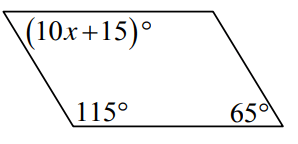
In the parallelogram shown below, find the value of x.

Problem 2 :
Quadrilateral RSTU is a parallelogram. Find the values of x, y, a, and b.

Problem 3 :

Problem 4 :

Problem 5 :

Problem 6 :

Problem 7 :

Problem 8 :

Problem 9 :

Problem 10 :

Problem 11 :
In the diagram of the parking lot shown, m∠JKL = 60°, JK = LM = 21 feet, and KL = JM = 9 feet.

a) Explain how to show that parking space JKLM is a parallelogram.
b) Find m∠JML, m∠KJM, and m∠KLM.
c) LM || NO and NO || PQ . Which theorem could you use to show that JK II PQ ?.
Problem 12 :
Describe how to prove that ABCD is a parallelogram.

Problem 13 :
Quadrilateral JKLM is a parallelogram. Describe how to prove that △MGJ ≅ △KHL.

Problem 14 :
Three interior angle measures of a quadrilateral are 67°, 67°, and 113°. Is this enough information to conclude that the quadrilateral is a parallelogram? Explain your reasoning.
Answer Key
1) x = 4
2) b = 9 and a = 6
3) x = 100
4) x = 2 and y = 3
5) x = 5 and y = 6
6) x = 2
7) x = 2
8) x = 7
9) ∠F = 145
10) x = 5
11)
a) Given that, JK = LM = 21 feet, and KL = JM = 9 feet
Since the opposite sides are equal, it must be a parallelogram.
b) m∠KLM = 120 (since opposite angles are equal)
c) LM || NO and NO || PQ
Using transitive property of parallel line, we say that JK II PQ.
12)
In triangle ADB and triangle DCB,
∠DAB = ∠DBC
AD = BC (opposite sides)
DE = DB (Common)
Triangle ABD and triangle BDC are congruent.
Using CPCTC, AB = DC
13) SAS, then △MGJ ≅ △KHL.
14) Since the opposite angles are equal, then it is parallelogram.
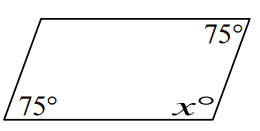
Find the value of x that will make the shape a parallelogram and give a reason to support your answer.
Problem 1 :
Problem 2 :
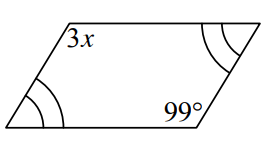
Solve for x in the parallelogram given below.
Problem 3 :
Solve for x in the parallelogram given below.
Problem 4 :
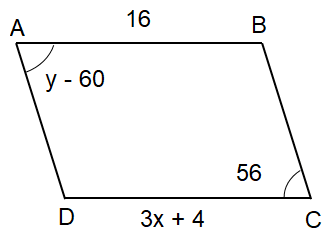
Solve for x and y in the parallelogram given below.
Problem 5 :
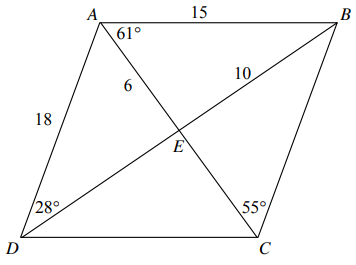
Use the diagram of parallelogram ABCD below to answer the questions.
|
1) Find CD 2) Find m∠ADB 3) Find m ∠BDC |
4) Find AC 5) Find m∠DCB 6) Find BE |
Problem 6 :
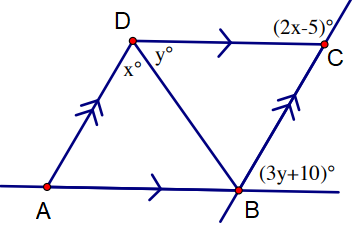
Solve for x and y in the parallelogram given below.
Problem 7 :
Find the missing value in each of the following parallelogram.
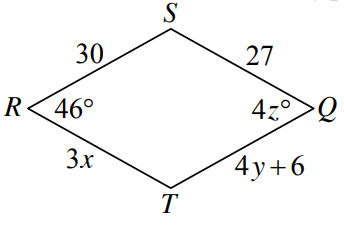
Problem 8 :
Given that quadrilateral ABCD is a parallelogram find the values of x and y.
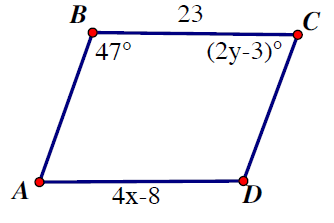
Problem 9 :
Find the length of CF. AB = 12, AD = 10, CE = 8.
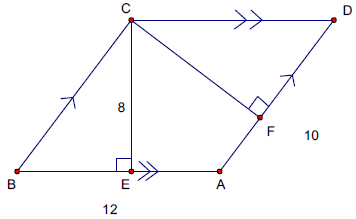
Problem 10 :
Find the value of x that will make the shape a parallelogram and give a reason to support your answer.
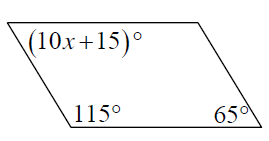
Find the value(s) of the variable(s) in each parallelogram
Problem 11 :
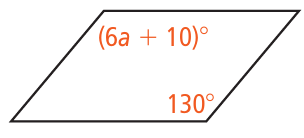
Problem 12 :
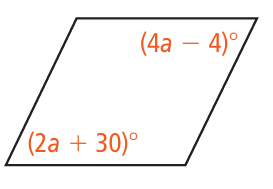
Problem 13 :
What are the values of x and y in the parallelogram?
- How are the angles related?
- Which variable should you solve for first?
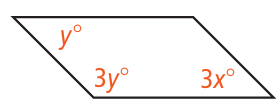
Problem 14 :
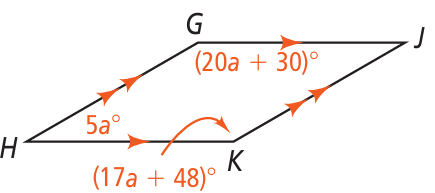
Problem 15 :
Two consecutive angles in a parallelogram have measures x + 5 and 4x - 10. Find the measure of the smaller angle.

Recent Articles


-
Digital SAT Math Practice Test with Answers (Part - 18)
Oct 06, 26 07:23 PM
Digital SAT Math Practice Test with Answers (Part - 18) -
AP Calculus BC Problems with Solutions
Sep 30, 26 01:08 PM
 AP Calculus BC Problems with Solutions
 -
Digital SAT Math Practice Test with Answers (Part - 17)
Sep 30, 26 01:00 PM
 Digital SAT Math Practice Test with Answers (Part - 17)