SLOPE OF A LINE JOINING TWO POINTS WORKSHEET
Subscribe to our ▶️ YouTube channel 🔴 for the latest videos, updates, and tips.
Problem 1 :
Find the slope of a straight joining the two points (3, -2) and (-1, 4).
Problem 2 :
Find the slope of a straight joining the two points (5, -2) and (4, -1).
Problem 3 :
Find the slope of a straight joining the two points (-2, -1) and (4, 0).
Problem 4 :
Find the slope of a straight joining the two points (1, 2) and (-4, 5).
Problem 5 :
If the slope of a line joining the two points (1, -2) and (3, k) is 5, find the value of k.
Problem 6 :
If the line that passes through (4, 3) and (-5, r) has a slope of -1, what is the value of r?
Problem 7 :
If the line that passes through (a, 7) and (1, a) has a slope of -⁵⁄₉, what is the value of a?
Problem 8 :
The graph of the linear function f passes through the points (a, 1) and (1, b) in the xy-plane. If the slope of the graph of f is 1, which of the following is true?
(A) a - b = 1
(B) a + b = 1
(C) a - b = 2
(D) a + b = 2
Problem 9 :
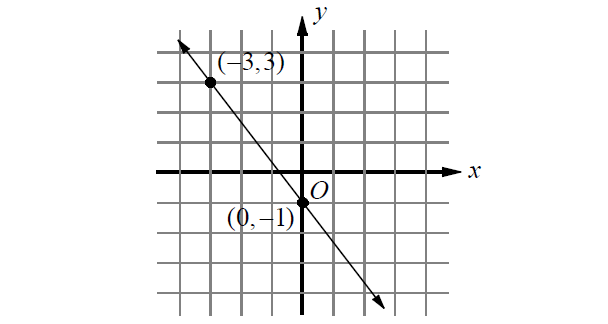
Find the slope of the line in xy-plane shown below.
Problem 10 :
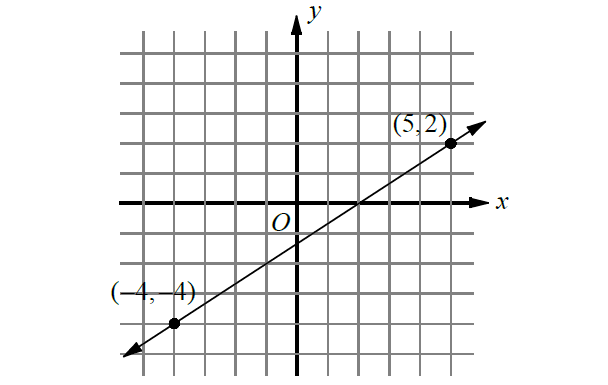
Find the slope of the line in xy-plane shown below.
Question 11 :
If the points A(2, 2), B(–2, –3), C(1, –3) and D(x, y) form a parallelogram then find the value of x and y.
Question 12 :
Let A(3, -4), B(9, -4), C(5, -7) and D(7, -7) . Show that ABCD is a trapezium.

Answers
1. Answer :
(3, -2) and (-1, 4)
Formula to find the slope of a line joining two points :
Substitute (x1, y1) = (3, -2) and (x2, y2) = (-1, 4).
2. Answer :
(5, -2) and (4, -1)
Formula :
Substitute (x1, y1) = (5, -2) and (x2, y2) = (4, -1).
m = -1
3. Answer :
(-2, - 1) and (4, 0)
Formula :
Substitute (x1, y1) = (-2, -1) and (x2, y2) = (4, 0).
4. Answer :
(1, 2) and (-4, 5)
Formula :
Substitute (x1, y1) = (1, 2) and (x2, y2) = (-4, 5).
5. Answer :
slope = 5
Substitute (x1, y1) = (1, -2) and (x2, y2) = (3, k).
Multiply both sides by 2.
k + 2 = 10
Subtract 2 from both sides.
k = 8
6. Answer :
slope = -1
Substitute (x1, y1) = (4, 3) and (x2, y2) = (-5, r).
Multiply both sides by -9.
r - 3 = 9
Add 3 to both sides.
r = 12
7. Answer :
Substitute (x1, y1) = (a, 7) and (x2, y2) = (1, a).
By cross-multiplication,
9(a - 7) = -5(1 - a)
Use the Distributive Property.
9a - 63 = -5 + 5a
Subtract 5a from both sides.
4a - 63 = -5
Add 63 to both sides.
4a = 58
Divide both sides by 4.
a = ⁵⁸⁄₄
a = ²⁹⁄₂
8. Answer :
slope = 1
Substitute (x1, y1) = (a, 1) and (x2, y2) = (1, b).
Multiply both sides by (1 - a).
b - 1 = 1 - a
Add a to both sides.
a + b - 1 = 1
Add 1 to both sides.
a + b = 2
Therefore, the corect answer is option (D).
9. Answer :
Measure the rise and run.
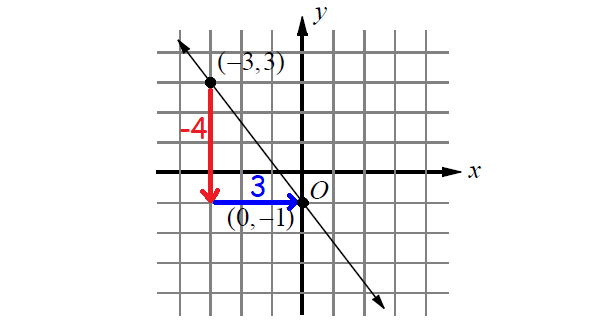
For the above line,
rise = -4
run = 3
Then,
slope = ʳⁱˢᵉ⁄ᵣᵤₙ
= -⁴⁄₃
10. Answer :
Measure the rise and run.
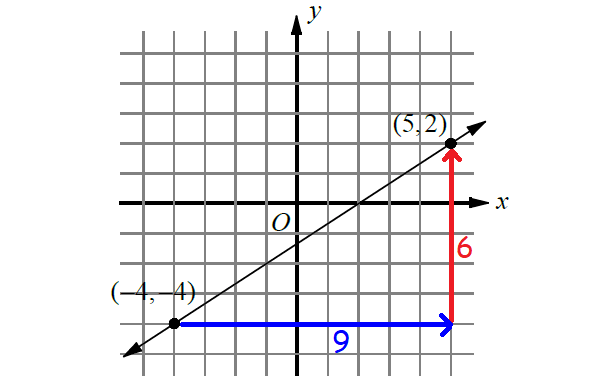
For the above line,
rise = 6
run = 9
Then,
slope = ʳⁱˢᵉ⁄ᵣᵤₙ
= ⁶⁄₉
= ⅔
11. Answer :
Since the given points form a parallelogram,
Slope of AB = Slope of CD
Slope of BC = Slope of DA
A(2, 2), B(–2, –3), C(1, –3) and D(x, y)
|
Slope of AB : = ⁽⁻³ ⁻ ²⁾⁄₍₋₂ ₋ ₂₎ = ⁻⁵⁄₋₄ = ⁵⁄₄ ----(1) |
Slope of CD : = ⁽ʸ ⁺ ³⁾⁄₍ₓ ₋ ₁₎ ----(2) |
|
Slope of BC : = ⁽⁻³ ⁺ ³⁾⁄₍₁ ₊ ₂₎ = ↉ = 0 ----(3) |
Slope of DA : = ⁽ʸ ⁻ ²⁾⁄₍ₓ ₋ ₂₎ ----(4) |
(1) = (2) :
⁵⁄₄ = ⁽ʸ ⁺ ³⁾⁄₍ₓ ₋ ₁₎
5(x - 1) = 4(y + 3)
5x - 5 = 4y + 12
5x - 4y = 12 + 5
5x - 4y = 17 -----(5)
(3) = (4) :
0 = ⁽ʸ ⁻ ²⁾⁄₍ₓ ₋ ₂₎
0 = y - 2
2 = y
Substitute y = 2 into (5).
5x - 4(2) = 17
5x - 8 = 17
5x = 25
x = 5
Therefore,
(x, y) = (5, 2)
12. Answer :
A(3, -4), B(9, -4) , C(5, -7) and D(7, -7)
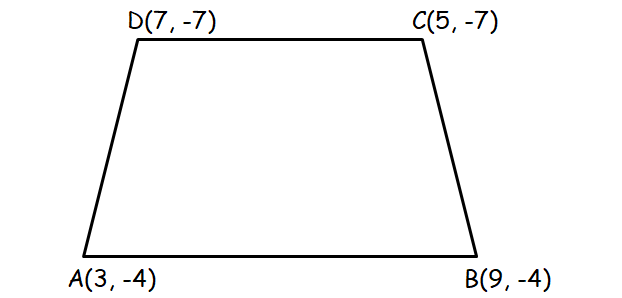
A trapezium always contains two parallel sides and two non parallel sides.
Slope of AB = (-4 + 4)/(9 - 3)
= 0/6
= 0
Slope of BC = (-7 + 4)/(5 - 9)
= -3/-4
= 3/4
Slope of CD = (-7 + 7)/(7 - 5)
= 0/2
= 0
Slope of DA = (-7 + 4)/(7 - 3)
= -3/4
From the above working, we have
Slope of AB = Slope of CD ----> AB and CD are parallel
Slope of BC ≠ Slope of DA ----> BC and DA are not parallel
Therefore, ABCD is a trapezium.
Subscribe to our ▶️ YouTube channel 🔴 for the latest videos, updates, and tips.
Kindly mail your feedback to v4formath@gmail.com
We always appreciate your feedback.
About Us | Contact Us | Privacy Policy
©All rights reserved. onlinemath4all.com

Recent Articles


-
AP Calculus BC Problems with Solutions
Sep 30, 26 01:08 PM
 AP Calculus BC Problems with Solutions
 -
Digital SAT Math Practice Test with Answers (Part - 17)
Sep 30, 26 01:00 PM
 Digital SAT Math Practice Test with Answers (Part - 17)
 -
Digital SAT Math Practice Test with Answers (Part - 16)
Sep 07, 26 11:23 AM
Digital SAT Math Practice Test with Answers (Part - 16)