PROBLEMS ON PROPERTIES OF SQUARE
Subscribe to our ▶️ YouTube channel 🔴 for the latest videos, updates, and tips.
What is square ?
A square is a rhombus with four equal angles of 90.
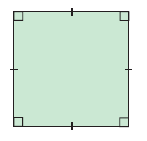
Properties :
- Opposite sides are parallel.
- All sides are equal in length.
- Diagonals bisect each other at right angles.
- Diagonals bisect the angles at each vertex.
- Diagonals are equal in length.
Problem 1 :
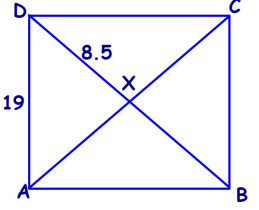
The square ABCD, find each length or angle measure.
|
1) BX 2) AX 3) DB 4) AC |
5) AB 6) BC 7) ∠AXB 8) ∠XAB |
Solution :
1) In square, the diagonal will bisect each other. So, BX = 8.5
2) Diagonals are equal, AX = 8.5
3) DB = 2DX, DB = 2(8.5) ==> 17
4) Diagonals are equal. So AC = 17
5) AB = 19
6) BC = 19
7) Diagonals will bisect each other at right angle, ∠AXB = 90
8) Diagonals will bisect the vertex angle, ∠XAB = 45
Problem 2 :
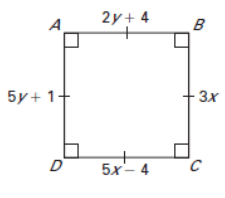
Classify the special quadrilateral. Then find the values of x and y.
Solution :
Since all sides are equal and angles at vertex is 90 degree. The given shape is square.
|
AB = DC 5x - 4 = 2y + 4 5x - 2y = 4 + 4 5x - 2y = 8 ------(1) |
AD = BC 5y + 1 = 3x 3x - 5y = 1 3x - 5y = 1 ------(2) |
(1) ⋅ 5 ==> 25x - 10y = 40
(2) ⋅ 2 ==> 6x - 10y = 2
(1) - (2)
19x = 38
x = 38/19
x = 2
By applying x = 1 in (1), we get
5(2) - 2y = 8
10 - 2y = 8
-2y = 8 - 10
-2y = -2
y = 1
Problem 3 :
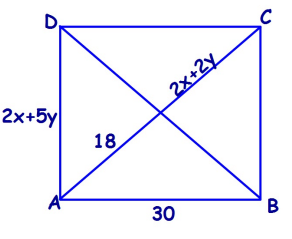
For the square ABCD, find the missing values.
|
1) x 2) y |
3) AD 4) DB |
Solution :
Diagonals will bisect each other.
18 = 2x + 2y
Dividing by 2 on both sides.
9 = x + y
x + y = 9 ----(1)
All sides will be equal.
AB = AD
30 = 2x + 5y
2x + 5y = 30 ----(2)
(1) ⋅ 2 - (2) ==> (2x + 2y) - (2x + 5y) = 9 - 30
2y - 5y = -21
-3y = -21
y = 7
Applying the value of y in (1), we get x = 9 - 7
x = 2
AD = 2x + 5y
= 2(2) + 5(7)
= 4 + 35
AD = 39
DB = 18 + 2x + 2y
= 18 + 2(2) + 2(7)
= 18 + 4 + 14
DB = 36
Problem 4 :
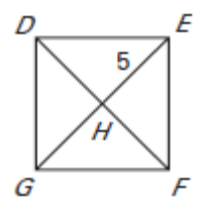
The diagonals of square DEFG intersect at H. Given that EH = 5, find the indicated measure.
|
1) ∠GHF 2) HF |
3) ∠DGH 4) DE |
Solution :
1) ∠GHF = 90 degree
2) HF = 5
3) ∠DGH = 45 degree
4) In triangle DHE,
(DE)2 = DH2 + HE2
DE2 = 52 + 52
DE2 = 25 + 25
DE = √50
DE = 5√2
Problem 5 :
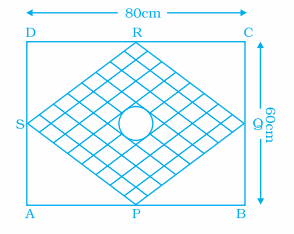
ABCD is a given rectangle with length as 80 cm and breadth as 60 cm. P, Q, R, S are the mid points of sides AB, BC, CD, DA respectively. A circular rangoli of radius 10 cm is drawn at the center as shown in figure given below. Find the area of shaded portion.
Solution :
DC = 80 cm, DR = 40 cm
DA = 60 cm, DS = 30 cm
In triangle DRS,
RS2 = DR2 + DS2
RS2 = 402 + 302
RS2 = 1600 + 900
RS2 = 2500
RS = 50
RS = PQ = SP = RQ
Area of square PQRS = 2500
Area of circle = πr2
radius = 5 cm
= 3.14 (5)2
= 3.14(25)
= 78.5
Area of shaded portion = 2500 - 78.5
= 1921.5 cm2
Problem 6 :
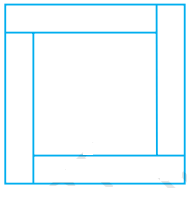
A large square is made by arranging a small square surrounded by four congruent rectangles as shown in figure given below. If the perimeter of each of the rectangle is 16 cm, find the area of the large square.
Solution :
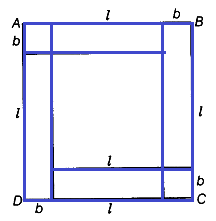
Perimeter of the rectangle = 16 inches
2(l + b) = 16
l + b = 8
Side length of the square = l + b
Area of square = (l + b)2
= 82
= 64
Problem 7 :
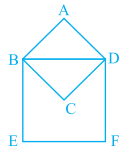
ABCD is a square with AB = 15 cm. Find the area of the square BDFE.
Solution :
ABCD is a square, here BD is the diagonal of the square.
BD2 = AB2 + AD2
BD2 = 152 + 152
BD2 = 450
BD = 15√2
Area of square BDEF = BD2
= (15√2)2
= 225(2)
= 450
Problem 8 :
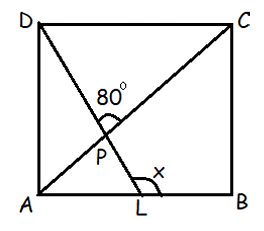
In the figure, ABCD is a square. If ∠DPC = 80°, then find the value of x.
Solution :
Given that ∠DPC = 80°, then ∠APL = 80°
Since AC is the diagonal, then ∠CAL = 45°(angle bisector)
In triangle APL, ∠PLB = x (exterior angle)
x = ∠PAL + ∠APL
x = 45 + 80
= 125
Problem 9 :
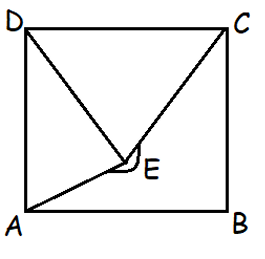
In the figure ABCD is a square and CDE is an equilateral triangle. find
(i) ∠AED ii) ∠EAB iii) Reflex of ∠AEC
Solution :
(i) ∠AED
Triangle CDE is an equilateral triangle, ∠CDE = 60
∠EDA = 90 - 60 ==> 30
DA = DE, then 180 - 30 ==> 150
∠DEA = 150/2 ==> 75
ii)
∠EAB = 90 - 75 ==> 15
∠BCE = 90 - 60 ==> 30
iii)
In a quadrilateral, the sum of interior angles is 360 degree.
∠EAB + ∠AEC + ∠ECB + ∠CBA = 360
15 + ∠AEC + 30 + 90 = 360
∠AEC + 135 = 360
∠AEC = 360 - 135
= 225
Problem 10 :
ABCD is a square, diagonal AC is joined. Then the measurement of ∠CAB is
(a) 35° (b) 40° (c) 45° (d) 50°
Solution :
Diagonals will be angle bisectors. Then, ∠CAB = 45°
Problem 11 :
Choose the most appropriate alternative for the given statement:
A square’s diagonals are _________ to each other.
a) Equal b) Unequal c) Parallel d) None of the above
Solution :
Diagonals will be equal in square and in rectangle.

Recent Articles


-
Digital SAT Math Practice Test with Answers (Part - 18)
Oct 22, 26 07:55 PM
 Digital SAT Math Practice Test with Answers (Part - 18)
 -
AP Calculus BC Problems with Solutions
Sep 30, 26 01:08 PM
 AP Calculus BC Problems with Solutions
 -
Digital SAT Math Practice Test with Answers (Part - 17)
Sep 30, 26 01:00 PM
 Digital SAT Math Practice Test with Answers (Part - 17)