PROBLEMS ON ISOSCELES TRAPEZOID WITH DIAGONALS
Subscribe to our ▶️ YouTube channel 🔴 for the latest videos, updates, and tips.
What is Trapezium ?
A trapezium is a convex quadrilateral with exactly one pair of opposite sides parallel to each other. The trapezium is a two-dimensional are called legs. It is also called a trapezoid. Sometimes the parallelogram is also called a trapezoid with two parallel sides.
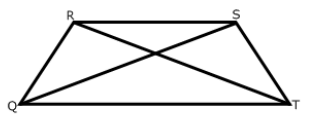
Diagonals are congruent.
Find the length of the diagonal indicated for each trapezoid.
Problem 1 :
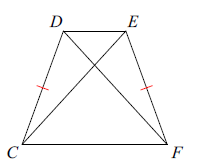
DF = 9.1, Find CE
Solution :
CE and DF are diagonals.
DF = 9.1, so CE = 9.1
Solve for x. Each figure is a trapezoid.
Problem 2 :
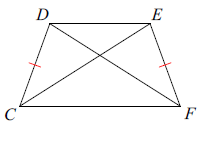
DF = 6 and CE = 2x - 10
Solution :
DF and CE are diagonals. So, they are equal.
6 = 2x - 10
2x = 6 +10
2x = 16
x = 16/2
x = 8
Problem 3 :
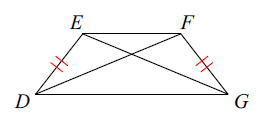
DF = 12 and EG = -2x + 36
Solution :
DF and EG are diagonals, so they are equal.
DF = EG
12 = -2x + 36
12 - 36 = -2x
-24 = -2x
x = 24/2
x = 12
Find the length of the diagonal indicated for each trapezoid.
Problem 4 :
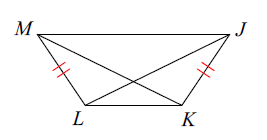
JL = 2x + 4, KM = 4x - 8. Find JL
Solution :
JL and KM are diagonals.
JL = MK
2x + 4 = 4x - 8
2x - 4x = -8 - 4
-2x = -12
dividing by -2 on both sides.
x = 12/2
x = 6
Problem 5 :
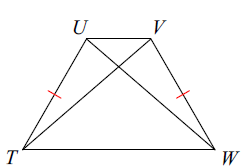
UW = 3x + 11, TV = 8x - 9 and Find UW
Solution :
UW and TV are diagonals.
UW = TV
3x + 11 = 8x - 9
Subtracting 8x and 11, we get
3x - 8x = -9 - 11
-5x = -20
x = 20/5
x = 4
Problem 6 :
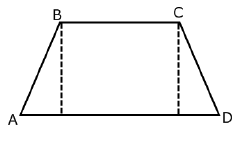
The bases of an isosceles trapezoid ABCD measure 10 cm and 20 cm. The height (altitude) is 12 cm. How long are the legs AB and CD?
Solution :
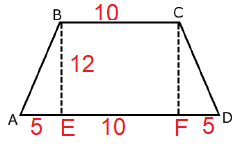
In triangle ABE,
AB2 = AE2 + BE2
AB2 = 52 + 122
AB2 = 25 + 144
AB2 = 169
AB = 13
Since is it isosceles trapezoid, CD is 13.
Problem 7 :
In isosceles trapezoid KIME, ∠K and ∠E are the base angles. If IK = 11 and ME = 3x - 1, what is the value of x?
Solution :
In KIME, KI and ME are non parallel sides.
IM and KE are parallel sides.
Non parallel sides will be equal in length.
IK = ME
11 = 3x - 1
Add 1 on both sides.
11 + 1 = 3x
3x = 12
x = 12/3
x = 4
Problem 8 :
𝐴𝐵𝐶𝐷 is an isosceles trapezoid with bases 𝐴𝐵 and 𝐷𝐶. If 𝐴𝐷 = 3x + 4 and 𝐵𝐶 = x + 12. Find the value of x and the length of 𝐴𝐷.
Solution :
AD = BC
3x + 4 = x + 12
3x - x = 12 - 4
2x = 8
x = 8/2
x = 4
Problem 9 :
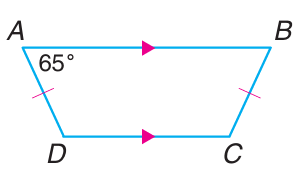
Trapezoid 𝐴𝐵𝐶𝐷 is an isosceles. Find the missing angle measures.
Solution :
DA = BC (given)
∠A = ∠B
∠B = 65
Since AB and DC are parallel, then co-interior angles will be supplementary.
∠A + ∠D = 180
65 + ∠D = 180
∠D = 180 - 65
= 115
∠C = 115
Problem 10 :
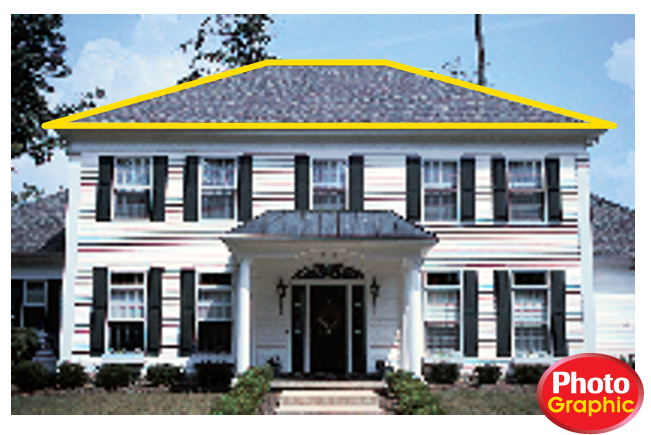
A hip roof slopes at the ends of the buildings as well as the front and back. The front of this hip roof is in the shape of an isosceles trapezoid. If one angle measures 30 degree, find the measures of the other three angles.
Solution :
acute angle = 30
Since it is isosceles trapezoid, the other angle is also 30 degree.
Obtuse angle = 180 - 30
= 150
So, the required angles are 30, 30, 150 and 150.
Problem 11 :
Find the length of the shorter base of a trapezoid if the length of the median is 34 meters and the length of the longer base is 49 meters.
Solution :
Length of longer base = 49 meters
Length of shorter base = x
Median = 34 meter
M = (1/2) (longer base + shorter base)
34 = (1/2) (49 + x)
34(2) = 49 + x
49 + x = 68
x = 68 - 49
x = 19
So, the length of the shorter base is 19 meters.
Problem 12 :
One base angle of an isosceles trapezoid is 45 degree. Find the measures of the other three angles.
Solution :
Acute angle = 45 degree
Obtuse angle = 180 - 45
= 135
Since it is isosceles trapezoid, the required angles are 45, 45, 135 and 135.
Problem 13 :
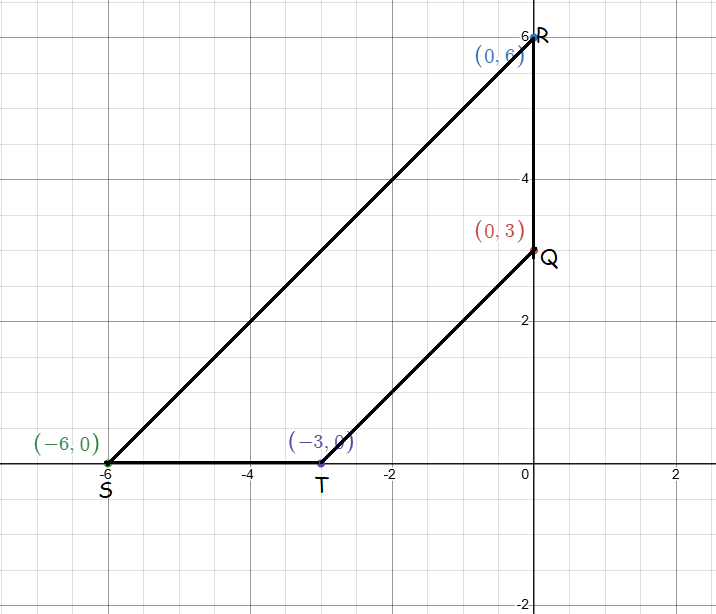
Show that the quadrilateral with vertices at Q(0, 3), R(0, 6), S(-6, 0) and T(-3, 0) is a trapezoid. Decide whether the trapezoid is isosceles. Then find the length of the midsegment of the trapezoid.
Solution :
Length of ST = √(-6 + 3)2 + (0 - 0)2
= √(-3)2+ (0 - 0)2
= 3
Length of TQ = √(-3 + 0)2 + (0 - 3)2
= √9 + 9
= √18
= √(2 x 3 x 3)
= 3√2
Length of QR = √(0 - 0)2 + (3 - 6)2
= √02+ (-3)2
= 3
Length of RS = √(0 + 6)2 + (6 - 0)2
= √(36 + 36)
= √72
= √(2 x 6 x 6)
= 6√2
It is not isosceles trapezium. Since it is not isosceles trapezium, we cannot use midsegment theorem.

Recent Articles


-
Digital SAT Math Practice Test with Answers (Part - 18)
Oct 22, 26 07:55 PM
 Digital SAT Math Practice Test with Answers (Part - 18)
 -
AP Calculus BC Problems with Solutions
Sep 30, 26 01:08 PM
 AP Calculus BC Problems with Solutions
 -
Digital SAT Math Practice Test with Answers (Part - 17)
Sep 30, 26 01:00 PM
 Digital SAT Math Practice Test with Answers (Part - 17)