HOW TO PROVE THE GIVEN FOUR POINTS FORM A PARALLELOGRAM USING SLOPE
Subscribe to our ▶️ YouTube channel 🔴 for the latest videos, updates, and tips.
Example 1 :
Using the concept of slope, show that the vertices (1 , 2), (-2 , 2), (-4 , -3) and (-1, -3) taken in order form a parallelogram.
Solution :
Let the given points be A(1 , 2) B(-2 , 2) C (-4 , -3) and D (-1, -3)
Slope of AB = (y2 - y1)/(x2 - x1)
A(1 , 2) B(-2 , 2)
= (2 - 2) / (-4 - 1)
= 0/(-5) = 0 ---(1)
Slope of BC = (y2 - y1)/(x2 - x1)
B(-2 , 2) and C (-4 , -3)
= (-3 - 2) / (-4 + 2)
= -5/(-2) = 5/2 ---(2)
Slope of CD = (y2 - y1)/(x2 - x1)
C (-4 , -3) and D (-1, -3)
= (-3 + 3) / (-1 + 4)
= 0/5 = 0 ---(3)
D (-1, -3) and A(1, 2)
= (2 + 3) / (1 + 1)
= 5/2---(4)
(1) = (3) and (2) = (4)
Hence the given points form a parallelogram.
Example 2 :
Show that the opposite sides of a quadrilateral with vertices A(-2 ,-4), B(5 , -1), C(6 , 4) and D(-1, 1) taken in order are parallel.
Solution :
Slope of AB = (y2 - y1) / (x2 - x1)
A(-2 ,-4), B(5 , -1)
= (-1 + 4) / (5 + 2)
= 3/7 ----(1)
Slope of BC = (y2 - y1) / (x2 - x1)
B(5 , -1) and C(6 , 4)
= (4 + 1) / (6 - 5)
= 5/1
= 5 ----(2)
Slope of CD = (y2 - y1) / (x2 - x1)
C(6 , 4) and D(-1, 1)
= (1 - 4) / (-1 - 6)
= -3/(-7)
= 3/7 ----(3)
D(-1, 1) and A(-2, -4)
= (-4 - 1) / (-2 + 1)
= -5/(-1)
= 5 ----(4)
(1) = (3)
(2) = (4)
Hence the opposite sides in a quadrilateral are parallel.
Example 3 :
A quadrilateral has vertices A(-4, -2), B(5, -1), C(6, 5) and D(-7, 6). Show that the mid-points of its sides form a parallelogram.
Solution :
A(-4, -2), B(5, -1), C(6, 5) and D(-7, 6)
Lep P, Q, R and S be the mid-points of the sides AB, BC, CD and DA respectively.
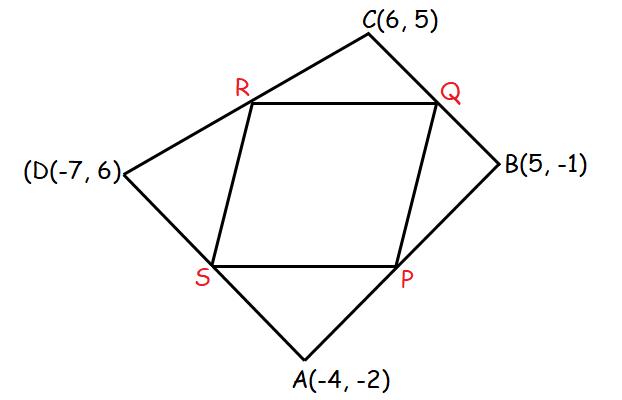
Midpoint of the side AB :
= P(⁽⁻⁴ ⁺ ⁵⁾⁄₂, ⁽⁻² ⁻ ¹⁾⁄₂)
= P (½, -³⁄₂)
Midpoint of the side BC :
= Q(⁽⁵ ⁺ ⁶⁾⁄₂, ⁽⁻¹ ⁺ ⁵⁾⁄₂)
= Q(¹¹⁄₂, ⁴⁄₂)
= Q(¹¹⁄₂, 2)
Midpoint of the side CD :
= R(⁽⁻⁷ ⁺ ⁶⁾⁄₂, ⁽⁶ ⁺ ⁵⁾⁄₂)
= R(-¹⁄₂, ¹¹⁄₂)
Midpoint of the side DA :
= S(⁽⁻⁷ ⁻ ⁴⁾⁄₂, ⁽⁻² ⁺ ⁶⁾⁄₂)
= S(-¹¹⁄₂, ⁴⁄₂)
= S(-¹¹⁄₂, 2)
Slope of SR :
Slope of PQ :
Slope of PQ = Slope of SR
Slope of SP :
Slope of RQ :
Example 4 :
PQRS is a rhombus. Its diagonals PR and QS intersect at the point M and satisfy QS = 2PR. If the coordinates of S and M are (1, 1) and (2, -1) respectively, find the coordinates of P.
Solution :
Let (a, b) be the coordinates of P.
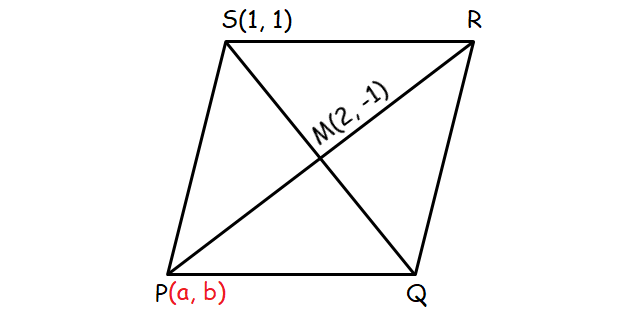
Slope of SP = Slope of RQ
Slope of SQ (use the coordinates of S and M) :
= ⁽⁻¹ ⁻ ¹⁾⁄₍₂ ₋ ₁₎
= ⁻²⁄₁
= -2
Slope of PR (use the coordinates of P and M) :
= ⁽⁻¹ ⁻ ᵇ⁾⁄₍₂ ₋ ₐ₎
In a rhombus, always diagonals are perpendicular.
So, the product of the slopes of the disgonals SQ and PS is equal to -1.
-2 ⋅ ⁽⁻¹ ⁻ ᵇ⁾⁄₍₂ ₋ ₐ₎ = -1
⁽² ⁺ ²ᵇ⁾⁄₍₂ ₋ ₐ₎ = -1
2 + 2b = -1(2 - a)
2 + 2b = -2 + a
2b + 4 = a
a = 2b + 4 ----(1)
Distance between S(1, 1) and M(2, -1) :
SM = √[(x2 - x1)2 + (y2 - y1)2]
SM = √[(2 - 1)2 + (-1 - 1)2]
SM = √[12 + (-2)2]
SM = √(1 + 4)
SM = √5
In a rhombus, always diagonals bisect each other. So, M is the midpoint of QS and PR.
QS = 2(SM)
QS = 2√5
Given : QS = 2PR.
2PR = 2√5
PR = √5
2(PM) = √5
Squaring both sides,
Substitute a = 2b + 4.
4(4b2 + 8b + 4 + 1 + 2b + b2) = 5
4(5b2 + 10b + 5) = 5
4 ⋅ 5(b2 + 2b + 1) = 5
Divide both sides by 5.
4(b2 + 2b + 1) = 1
4(b + 1)2 = 1
(b + 1)2 = ¼
b + 1 = ±√¼
b + 1 = ±√¼
|
b + 1 = ½ b = ½ - 1 b = -½ Substitute b = -½ in (1). a = 2(-½) + 4 a = -1 + 4 a = 3 |
b + 1 = -½ b = -½ - 1 b = -³⁄₂ Substitute b = -³⁄₂ in (1). a = 2(-³⁄₂) + 4 a = -3 + 4 a = 1 |
(a, b) = (3, -½) or (1, -³⁄₂)
The coordinates of P are (3, -½) or (1, -³⁄₂).
Subscribe to our ▶️ YouTube channel 🔴 for the latest videos, updates, and tips.
Kindly mail your feedback to v4formath@gmail.com
We always appreciate your feedback.
About Us | Contact Us | Privacy Policy
©All rights reserved. onlinemath4all.com

Recent Articles


-
Digital SAT Math Practice Test with Answers (Part - 18)
Nov 06, 26 05:32 PM
 Digital SAT Math Practice Test with Answers (Part - 18)
-
AP Calculus BC Problems with Solutions
Sep 30, 26 01:08 PM
 AP Calculus BC Problems with Solutions
-
Digital SAT Math Practice Test with Answers (Part - 17)
Sep 30, 26 01:00 PM
 Digital SAT Math Practice Test with Answers (Part - 17)