Subscribe to our ▶️ YouTube channel 🔴 for the latest videos, updates, and tips.
HOW TO FIND THE POSITION OF A TERM IN AN ARITHMETIC SEQUENCE
For the given algebraic rule, we have to apply natural numbers to find the specific terms.
For example,
an = 2n + 5 is the rule
an is the general term, n is the position. By applying n as 1, we will get the first term, by applying n as 2, we will get the second term and so on.
Problem 1 :
1) For each question use the rule to find the first five terms of the sequence.
2) Can you find the 10th term of the sequence ?
3) Can you find the 100th term of the sequence ?
Rule :
2n - 1
Solution :
Given rule = 2n - 1
|
If n = 1 = 2(1) - 1 = 2 - 1 = 1 |
If n = 2 = 2(2) - 1 = 4 - 1 = 3 |
If n = 3 = 2(3) - 1 = 6 - 1 = 5 |
|
If n = 4 = 2(4) - 1 = 8 - 1 = 7 |
If n = 5 = 2(5) - 1 = 10 - 1 = 9 |
1st term = 1, 2nd term = 3, 3rd term = 5, 4th term = 7 and 5th term = 9
10th term :
= 2(10) - 1
= 20 - 1
= 19
100th term :
= 2(100) - 1
= 200 - 1
= 199
Problem 2 :
Write the term to term rule for the sequence given below, then work out the next two terms.
4, 9, 14, 19, 24, .......
a) Is the number 37 in the sequence.
Solution :
4, 9, 14, 19, 24, .......
Every term is added with 5, by creating the rule
an = 5n - 1
Finding next two terms :
|
5th term : a5 = 5(5) - 1 a5 = 25 - 1 a5 = 24 |
6th term : a6 = 5(6) - 1 a6 = 30 - 1 a6 = 29 |
The next two terms are 24 and 29.
a) Is 34 in the sequence :
Since we don't know whether 34 is in the sequence or not, we can consider an = 34
34 = 5n - 1
5n = 34 + 1
5n = 35
n = 35/5
n = 7
From this, it is clear 7th term of the sequence is 34.
Problem 3 :
Calculate the difference between the 10th term and 50th term of the sequence
9, 14, 19, 24, ... ...
Solution :
9, 14, 19, 24, ... ...
In every term 5 is added. Creating the general term, we get
an = 5n + 4
|
10th term : an = 5n + 4 a10 = 5(10) + 4 a10 = 50 + 4 a10 = 54 |
50th term : an = 5n + 4 a50 = 5(50) + 4 a50 = 250 + 4 a50 = 254 |
Problem 4 :
Find the nth term for each of the following sequences
1/2, 3/4, 5/6, 7/8, .............
Solution :
By observing each values in the numerator and denominator, numerators are odd values and denominators are even numbers.
Odd values = 2n - 1
Even values = 2n
So, nth term of the sequence is (2n - 1)/2n
Problem 5 :
Write the next three terms of the arithmetic sequence.
a) First term: 2 Common difference: 13
b) First term: 18 Common difference: −6
Solution :
a) a = 2, d = 13
2, 2 + 13, 15 + 13, ......
2, 15, 28, ...............
b) a = 18, d = -6
18, 18 - 6, 12 - 6,...........
18, 12, 6, .............
Problem 6 :
write an equation for the nth term of the arithmetic sequence. Then find a10.
−5, −4, −3, −2, . . .
Solution :
a = -5, d = -4 - (-5)
= -4 + 5
d = 1
a10 = a + 9d
= -5 + 9(1)
= -5 + 9
= 4
So, the 10th term is 4.
Problem 7 :
Describe and correct the error in finding the common difference of the arithmetic sequence.
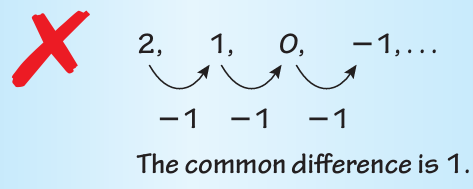
Solution :
Common difference = 1 - 2 ==> -1
0 - 1 ==> -1
-1 - 0 ==> -1
Bu the given common difference is 1 and that is the error.
Problem 8 :
Describe and correct the error in writing an equation for the nth term of the arithmetic sequence.
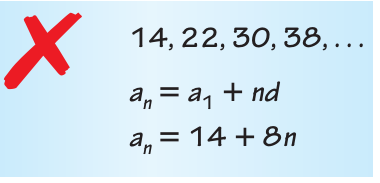
Solution :
a = 14, d = 22 - 14
= 8
nth term :
an = a + (n- 1) d
= 14 + (n - 1)8
= 14 + 8n - 8
= 6 + 8n
By the given nth term is different and that is the error.
Problem 9 :
The first term of an arithmetic sequence is 3. The common difference of the sequence is 1.5 times the first term. Write the next three terms of the sequence. Then graph the sequence
Solution :
a = 3
d = 1.5(8)
= 12
3, 3 + 12, 15 + 12, ...........
3, 15, 27, ...............

Recent Articles


-
SAT Math Practice Problems with Answers
May 21, 26 01:17 AM
 SAT Math Practice Problems with Answers
 -
Digital SAT Math Questions and Answers (Part - 13)
May 17, 26 09:03 AM
 Digital SAT Math Questions and Answers (Part - 13)
 -
Problems on Solving Logarithmic Equations
Apr 24, 26 09:30 PM
Problems on Solving Logarithmic Equations