HOW TO FIND THE LENGTH OF DIAGONAL OF A PARALLELOGRAM
Subscribe to our ▶️ YouTube channel 🔴 for the latest videos, updates, and tips.
Definition of parallelogram :
A parallelogram is a quadrilateral which has opposite sides parallel.
Properties of parallelogram :
- Opposite sides are equal in length
- Opposite angles are equal in size.
- Diagonals bisect each other.
- Consecutive interior angles add upto 180.
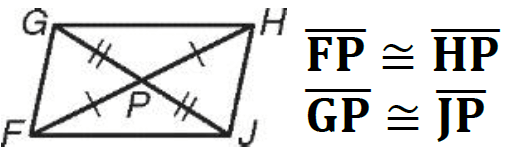
Problem 1 :
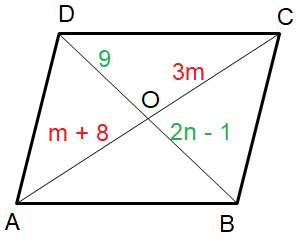
For the parallelogram given below, solve for m and n.
Solution :
Since the given shape is a parallelogram, the diagonals will bisect each other.
|
AO = OC m + 8 = 3m ---(1) 8 = 3m - m 2m = 8 m = 4 |
BO = OD 9 = 2n - 1 2n = 9 + 1 2n = 10 n = 5 |
Problem 2 :
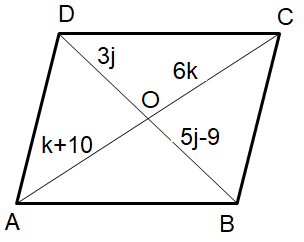
For the parallelogram given below, solve for j and k.
Solution :
|
AO = CO k + 10 = 6k 6k - k = 10 5k = 10 k = 2 |
BO = OD 5j - 9 = 3j 5j - 3j = 9 2j = 9 j = 4.5 |
Problem 3 :
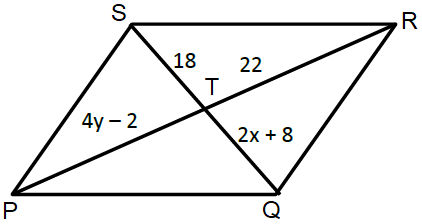
In parallelogram PQRS, solve for x and y.
Solution :
|
QT = ST 2x + 8 = 18 2x = 18 - 8 2x = 10 x = 10/2 x = 5 |
PT = TR 4y - 2 = 22 4y = 22 + 2 4y = 24 y = 24/4 y = 6 |
Problem 4 :
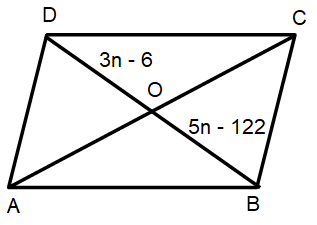
Solve the n in the following parallelogram ABCD. Find length of the diagonal BD.
Solution :
Diagonals will bisect each other.
3n - 6 = 5n - 122
3n - 5n = -122 + 6
-2n = -116
Dividing by 2 on both sides.
n = 116/2
n = 58
Length of BD = 3n - 6 + 5n - 122
= 8n - 128
= 8(58) - 128
= 464 - 128
= 336
So, length of the diagonal BD is 336.
Problem 5 :
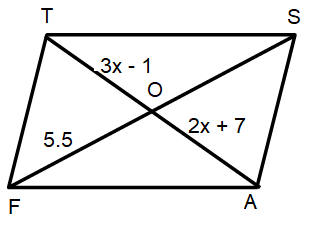
Length of the longer diagonal in the parallelogram FAST.
Solution :
FO = 5.5, then FS = 5.5(2) ==> 11
TO = 3x - 1, OA = 2x + 7
3x - 1 = 2x + 7
3x - 2x = 7 + 1
x = 8
Length of diagonal TA = 3x - 1 + 2x + 7
= 5x + 6
= 5(8) + 6
= 40 + 6
= 46
So, length of the longer diagonal is 46.
Problem 6 :
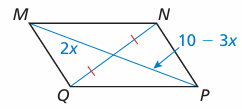
For what value of x is quadrilateral MNPQ a parallelogram? Explain your reasoning
Solution :
In parallelogram, the diagonals will bisect each other. From the parallelogram above,
10 - 3x = 2x
10 = 2x + 3x
10 = 5x
x = 10/5
x = 2
So, the value of x is 2.
Problem 7 :
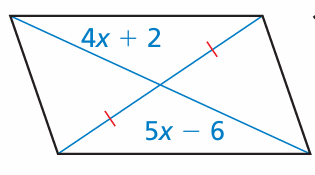
find the value of x that makes the quadrilateral a parallelogram.
Solution :
4x + 2 = 5x - 6
4x - 5x = -6 - 2
-1x = -8
x = 8
So, the value of x is 8.
Problem 8 :
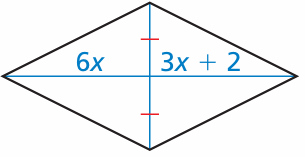
Solution :
6x = 3x + 2
6x - 3x = 2
3x = 2
x = 2/3
So, the value of x is 2/3.
Problem 9 :
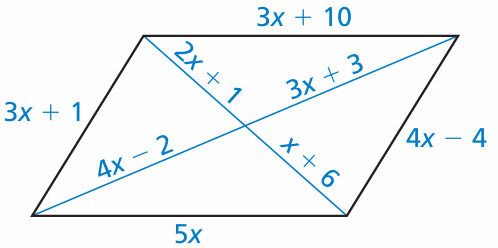
What value of x makes the quadrilateral a parallelogram? Explain how you found your answer.
Solution :
In parallelogram opposite sides will be equal, diagonals will bisect each other.
Equating the opposite sides :
|
4x - 4 = 3x + 1 4x - 3x = 1 + 4 x = 5 |
3x + 10 = 5x 3x - 5x = -10 -2x = -10 x = 10/2 x = 5 |
Equating the diagonals :
|
4x - 2 = 3x + 3 4x - 3x = 3 + 2 x = 5 |
2x + 1 = x + 6 2x - x = 6 - 1 x = 5 |
In all of the ways, we receive the same answer.
Problem 10 :
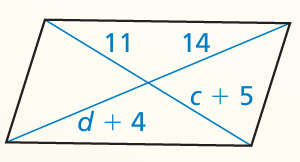
Find the value of each variable in the parallelogram.
Solution :
|
c + 5 = 11 c = 11 - 5 c = 6 |
d + 4 = 14 d = 14 - 4 d = 10 |
Problem 11 :
Find the coordinates of the intersection of the diagonals of ▱QRST with vertices Q(−8, 1), R(2, 1), S(4, −3), and T(−6, −3).
Solution :
In the parallelogram QRST, QS and TR are diagonals.
Since the diagonals bisect each other, the point where both diagonals are intersecting each other is the mid point of the diagonals.
Midpoint = (x1 + x2)/2, (y1 + y2)/2
Midpoint of QS = (-8 + 4)/2, (1 - 3)/2
= (-4/2, -2/2)
= (-2, -1)
Midpoint of TR = (2 - 6)/2, (1 - 3)/2
= (-4/2, -2/2)
= (-2, -1)
Problem 12 :
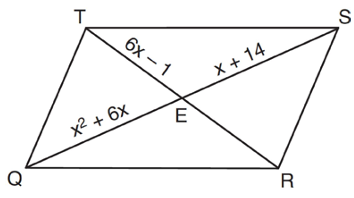
As shown in the diagram below, the diagonals of parallelogram QRST intersect at E. If QE = x2 + 6x, SE = x + 14, and TE = 6x − 1, determine TE algebraically
Solution :
x2 + 6x = x + 14
x2 + 6x - x - 14 = 0
x2 + 5x - 14 = 0
x2 + 7x - 2x - 14 = 0
x(x + 7) - 2(x + 7) = 0
(x - 2)(x + 7) = 0
x - 2 = 0 and x + 7 = 0
x = 2 and x = -7
So, the value of x is 2.
TE = 6(2) - 1
= 12 - 1
= 11
So, the length TE is 11.

Recent Articles


-
Digital SAT Math Practice Test with Answers (Part - 18)
Oct 22, 26 07:55 PM
 Digital SAT Math Practice Test with Answers (Part - 18)
 -
AP Calculus BC Problems with Solutions
Sep 30, 26 01:08 PM
 AP Calculus BC Problems with Solutions
 -
Digital SAT Math Practice Test with Answers (Part - 17)
Sep 30, 26 01:00 PM
 Digital SAT Math Practice Test with Answers (Part - 17)