SOLVING ABSOLUTE VALUE EQUATIONS AND INEQUALITIES
Subscribe to our ▶️ YouTube channel 🔴 for the latest videos, updates, and tips.
Solving Absolute Value Equations
For any real number a, the equation |x| = a has
i) two solutions x = a and x = -a, if a > 0
ii) one solution x = 0, if a = 0 and
iii) no solution, if a < 0
The general form of an absolute value equation is
|ax + b| = k
In the above absolute value equation, we can notice that there is only absolute part on the left side.
(Here "a" and "k" are real numbers)
Let us consider the absolute value equation |2x + 3| = 5.
We can solve the absolute value equation |2x + 3| = 5 as shown below.
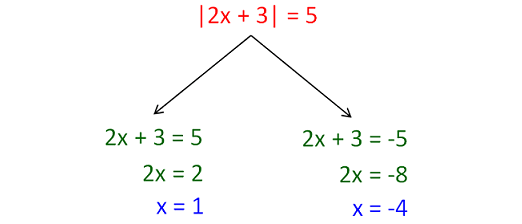
The following steps will be useful to solve absolute value equations.
Step 1 :
Get rid of absolute sign and divide it into two branches.
Step 2 :
For the first branch, take the sign as it is on the right side.
Step 3 :
For the second branch, change the sign on the right side.
Step 4 :
Then solve both the branches.
Solving Absolute Value Inequalities
For any real number a > 0
i) the solution of the inequality |x| < a is -a < x < a
ii) the solution of the inequality |x| ≤ a is -a ≤ x ≤ a
The general form of an absolute value inequality is
|ax + b| ≤ k
or
|ax + b| ≥ k
Method 1 : (Less Than or Equal to)
Solve the absolute value inequality given below
|x + 2| ≤ 3
Solution :
We can solve the absolute value inequality |x + 2| ≤ 3 as shown below.
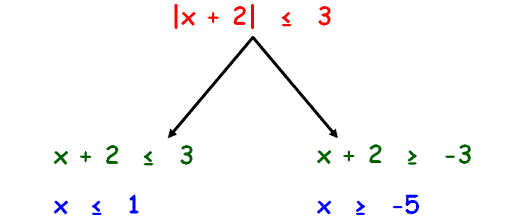
Let us graph the solution of the first branch x ≤ 1.

Let us graph the solution of the second branch x ≥ -5.

If we combine the above two graphs, we will get a graph as shown below below.

From the above graph, the solution for |x + 2| ≤ 3 is
-5 ≤ x ≤ 1
Method 2 : (Greater Than or Equal to)
Solve the absolute value inequality given below
|x - 3| ≥ 1
Solution :
We can solve the absolute value inequality |x - 3| ≥ 1 as shown below.
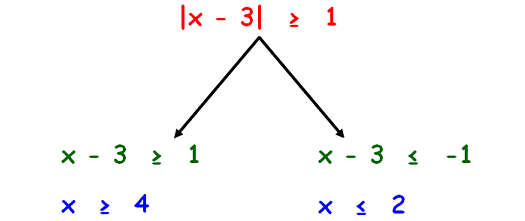
Let us graph the solution of the first branch x ≥ 4.

Let us graph the solution of the second branch x ≤ 2.

If we combine the above two graphs, we will get a graph as shown below below.

From the above graph, the solution for |x - 3| ≥ 1 is
(-∞, 2] U [3, +∞)
Example 1 :
Solve |3x + 5| = 2
Solution :
|3x + 5| = 2
Decomposing into two branches, we get
|
3x + 5 = 2 3x = 2 - 5 3x = -3 x = -1 |
3x + 5 = -2 3x = -2 - 5 3x = -7 x = -7/3 |
So, the solutions are -7/3 and -1.
Example 2 :
Solve |2x/3 + 1| = 0
Solution :
|2x/3 + 1| = 0
Since we have 0, it cannot be decomposed into two branches.
2x/3 + 1 = 0
2x/3 = -1
2x = -3
x = -3/2
Example 3 :
Solve |2x - 1| = -3
Solution :
For no value of x, the value of absolute value function will give negative value as result. Then, there is no solution.
Example 4 :
Solve |2x - 5| < 3
Solution :
|2x - 5| < 3
|
2x - 5 < 3 2x < 3 + 5 2x < 8 x < 8/2 x < 4 |
2x - 5 > -3 2x > -3 + 5 2x > 2 x > 1 |
The solution is
- as inequality, 1 < x < 4
- as interval notation (1, 4).
Example 5 :
Solve |3 - 5x| ≤ 1
Solution :
|3 - 5x| ≤ 1
|
3 - 5x ≥ -1 -5x ≥ -1 - 3 -5x ≥ -4 x ≤ 4/5 |
3 - 5x ≤ 1 -5x ≤ 1 - 3 -5x ≤ -2 x ≥ 2/5 |
So, the solution set is, 2/5 ≤ x ≤ 4/5
Example 6 :
Solve |5 + 2x| > 6
Solution :
|5 + 2x| > 6
|
5 + 2x < -6 2x < -6 -5 2x < -11 x < -11/2 |
5 + 2x > 6 2x > 6 - 5 2x > 1 x > 1/2 |
So, the solution are (-∞, -11/2) U (1/2, ∞).
Example 7 :
Solve |3/5 - 2x| ≥ 1
Solution :
|3/5 - 2x| ≥ 1
|
3/5 - 2x ≤ -1 -2x ≤ -1 - 3/5 -2x ≤ -8/5 Dividing by 2, we get x ≥ 4/5 |
3/5 - 2x ≥ 1 -2x ≥ 1 - 3/5 -2x ≥ 2/5 x ≤ -1/5 |
So, the solutions are (-∞, -1/5] U [4/5, ∞).
Example 8 :
Solve |3 - x| > -2
Solution :
|3 - x| > -2
By definition |3 - x| = |x - 3| ≥ 0. So, |3 - x| > -2 is true for all real numbers x. So, the solution is R.
Subscribe to our ▶️ YouTube channel 🔴 for the latest videos, updates, and tips.
Kindly mail your feedback to v4formath@gmail.com
We always appreciate your feedback.
About Us | Contact Us | Privacy Policy
©All rights reserved. onlinemath4all.com

Recent Articles


-
Digital SAT Math Practice Test with Answers (Part - 18)
Oct 22, 26 07:55 PM
 Digital SAT Math Practice Test with Answers (Part - 18)
 -
AP Calculus BC Problems with Solutions
Sep 30, 26 01:08 PM
 AP Calculus BC Problems with Solutions
 -
Digital SAT Math Practice Test with Answers (Part - 17)
Sep 30, 26 01:00 PM
 Digital SAT Math Practice Test with Answers (Part - 17)