VOLUME OF COMPOSITE SOLIDS WORKSHEET
Subscribe to our ▶️ YouTube channel 🔴 for the latest videos, updates, and tips.
Problem 1 :
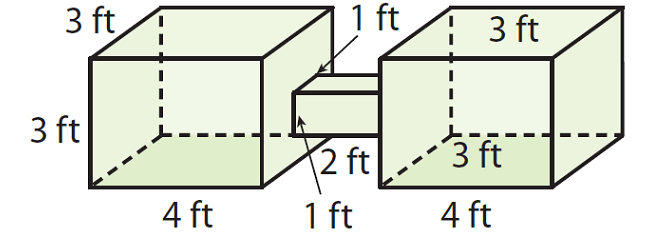
Allie has two aquariums connected by a small square prism. Find the volume of the double aquarium.
Solution :
Step 1 :
Find the volume of each of the larger aquariums.
Volume = Base area x Height
Volume = (4 x 3) x 3
Volume = 12 x 3
Volume = 36 cubic ft.
Step 2 :
Find the volume of the connecting prism.
Volume = Base area x Height
Volume = (2 x 1) x 1
Volume = 2 x 1
Volume = 2 cubic ft.
Step 3 :
Add the volumes of the three parts of the aquarium.
V = 36 + 36 + 2
V = 74 cubic ft.
The volume of the aquarium is 74 cubic ft.
Problem 2 :
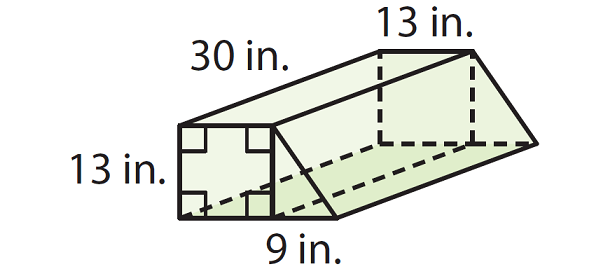
The figure is composed of a rectangular prism and a triangular prism. Find the volume of the figure.
Solution :
Step 1 :
Find the volume of each of the larger aquariums.
Volume = Base area x Height
Volume = (30 x 13) x 13
Volume = 5070 cubic in.
Step 2 :
Find the volume of the triangular prism.
Volume = (1/2) x Base area x Height
Volume = (1/2) x (30 x 9) x 13
Volume = 1755 cubic in.
Step 3 :
Add the volumes of the two parts of the aquarium.
V = 5070 + 1755
V = 6825 cubic in.
The volume of the given figure is 6825 cubic in.
Problem 3 :
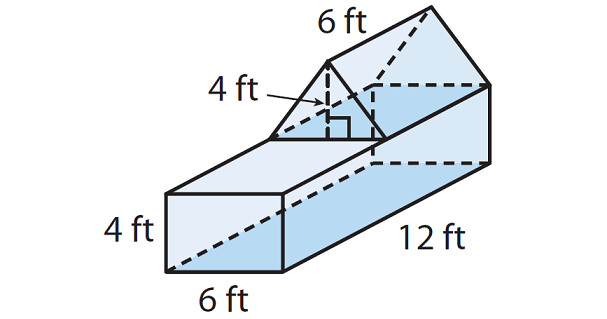
The figure is composed of a rectangular prism and a triangular prism. Find the volume of the figure.
Solution :
Step 1 :
Find the volume of each of the larger aquariums.
Volume = Base area x Height
Volume = (12 x 6) x 4
Volume = 288 cubic ft.
Step 2 :
Find the volume of the triangular prism.
Volume = (1/2) x Base area x Height
Volume = (1/2) x (6 x 6) x 4
Volume = 72 cubic ft.
Step 3 :
Add the volumes of the two parts of the aquarium.
V = 288 + 72
V = 360 cubic ft.
The volume of the given figure is 360 cubic ft.
Problem 4 :
A snack stand serves a small order of popcorn in a cone-shaped container and a large order of popcorn in a cylindrical container.
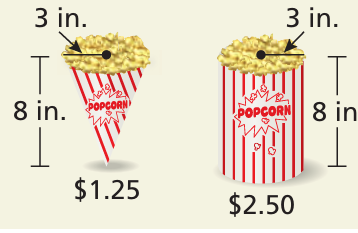
a. How many small containers of popcorn do you have to buy to equal the amount of popcorn in a large container? Explain.
b. Which container gives you more popcorn for your money? Explain.
Solution :
Capacity of popcorn = (1/3)πr2h
r = 1.3 inches and height = 8 inches
= (1/3) x 3.14 x 1.32 x 8
= 14.15 cubic inches
Capacity of pop corn = πr2h
r = 1.3 inches and height = 8 inches
= 3.14 x 1.32 x 8
= 42.45 cubic inches
Amount of pop corn in the cylindrical container is greater than the amount of popcorn in the conical container is lesser.
a) Number of smaller containers needed
= 42.45/14.15
= 3
So, 3 small containers are needed.
b) The cylindrical container will have more quantity of popcorn.
Problem 5 :
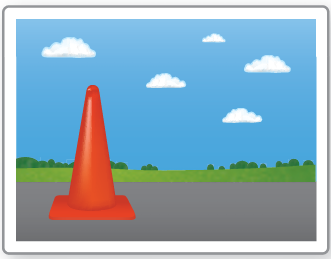
The traffic cone is approximately a right cone with a radius of 2 1/2 inches and a height of 12 inches. Find the volume of the traffic cone to the nearest cubic inch.
Solution :
Radius = 2 1/2 inches
= 5/2 inches
height = 12 inches
Volume of traffic cone = (1/3)πr2h
= (1/3) x 3.14 x 2.52 x 12
= 3.14 x 2.5 x 2.5 x 4
= 78.5 cubic inches
Problem 6 :
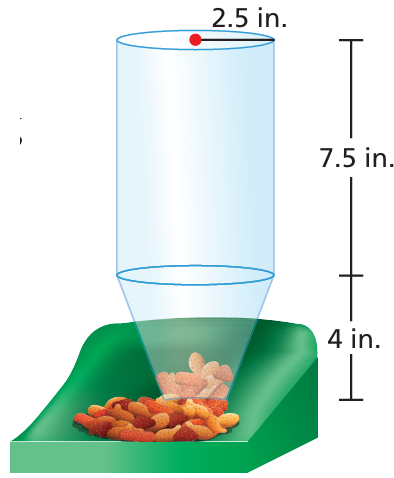
A cat eats half a cup of food, twice per day. Will the automatic pet feeder hold enough food for 10 days? Explain your reasoning. (1 cup ≈ 14.4 in.3)
Solution :
Capacity of food hold by the automatic pet feeder
= πr2h + (1/3) πr2h
Height of cylinder = 7.5 inches
height of cone = 4 inches
Radius of cylinder = cone = 2.5 inches
= π[2.52 x 7.5 + (1/3) 2.52 x 4]
= 3.14 [46.875 + 8.33]
= 3.14 x 55.2
= 173.28 cubic inches
1 cup of food = 14.4 cubic inches
Half cup twice per day, which means one cup each day.
10 cups of food = 14.4 x 10
= 144 cups of food
Since the automatic feeder has the capacity of 173.28 cubic inches. This food will be enough.
Problem 7 :
During a chemistry lab, you use a funnel to pour a solvent into a flask. The radius of the funnel is 5 centimeters and its height is 10 centimeters. You pour the solvent into the funnel at a rate of 80 milliliters per second and the solvent flows out of the funnel at a rate of 65 milliliters per second. How long will it be before the funnel overflows? (1 mL = 1 cm3)
Solution :
V = 1/3(π x r²h)
where r is the radius and h is the height of the cone.
Given a funnel is getting filled with the solvent at a rate of 80ml per sec and the solvent is coming out of the funnel at a rate of 65ml per sec.
rate at which the funnel is getting filled is 80-65 = 15 ml per sec.
So, this means that the funnel is getting filled at a rate of 15ml per sec.
For the funnel to overflow it need to be filled completely.
The time before the funnel gets overflowed is
= volume of funnel/ rate
A funnel is in the shape of an inverted cone.
The volume of the funnel V = 1/3(π x r²h)
V = 1/3 (3.14 * 5² * 10)
V = 1/3 (785.7)
V = 261.8ml³
Time before the funnel gets overflowed is 261.8/15
= 17.45 Sec
Subscribe to our ▶️ YouTube channel 🔴 for the latest videos, updates, and tips.
Kindly mail your feedback to v4formath@gmail.com
We always appreciate your feedback.
About Us | Contact Us | Privacy Policy
©All rights reserved. onlinemath4all.com

Recent Articles


-
Digital SAT Math Practice Test with Answers (Part - 17)
Sep 24, 26 12:05 PM
 Digital SAT Math Practice Test with Answers (Part - 17)
 -
Digital SAT Math Practice Test with Answers (Part - 16)
Sep 07, 26 11:23 AM
Digital SAT Math Practice Test with Answers (Part - 16) -
Digital SAT Math Practice Test with Answers (Part - 15)
Aug 23, 26 12:24 PM
 Digital SAT Math Practice Test with Answers (Part - 15)