SOLVING QUADRATIC EQUATIONS BY FACTORING METHOD
Subscribe to our ▶️ YouTube channel 🔴 for the latest videos, updates, and tips.
(i) In a quadratic equation in the form ax2 + bx + c = 0, if the leading coefficient is 1, we have to decompose the constant term "c" into two factors.
(ii) The product of the two factors must be equal to the constant term "c" and the addition of two factors must be equal to the coefficient of x, that is "b".
(iii) If p and q are the two factors of the constant term c, then we have to factor the quadratic equation using p and q as shown below.
(x + p)(x + q) = 0
(iv) Solving the above equation, we get
x = -p and x = -q
How to assign signs for the two factors ?
|
Quadratic Equation |
Signs of Factors |
|
ax2 + bx + c = 0 |
Positive sign for both the factors. |
|
ax2 - bx + c = 0 |
Negative sign for both the factors. |
|
ax2 + bx - c = 0 |
Negative sign for smaller factor and positive sign for larger factor. |
|
ax2 - bx - c = 0 |
Positive sign for smaller factor and negative sign for larger factor. |
Solved Questions
Question 1 :
Solve the following quadratic equations by factorization method.
4x2 - 7x - 2 = 0
Solution :
Product of coefficient of x2 and constant is -8
Now, we have to decompose -8 as product of two term, such that the product of those numbers must be -8 and simplified value must be equal to -7.
Since the middle and last terms are negative, we have to put negative sign for large factor.
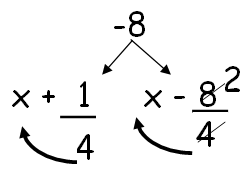
(4x + 1) (x - 2) = 0
4x + 1 = 0 (or) x - 2 = 0
4x = -1 (or) x = 2
x = -1/4 (or) x = 2
Hence the solutions are -1/4 and 2.
Question 2 :
Solve the following quadratic equations by factorization method.
3(p2 - 6) = p(p + 5)
Solution :
3p2 - 18 = p2 + 5p
3p2 - p2 - 5p - 18 = 0
2p2 - 5p - 18 = 0
Since the middle and last terms are negative, we have to put negative sign for large factor.
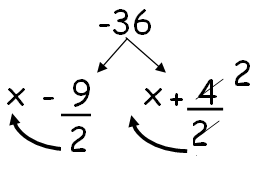
(2x + 9) (x - 2) = 0
2x + 9 = 0 (or) x - 2 = 0
2x = -9 (or) x = 2
x = -9/2
Hence the solutions are -9/2 and 2.
Question 3 :
Solve the following quadratic equations by factorization method.
√[a(a -7)] = 3√2
Solution :
√[a(a - 7)] = 3√2
Taking squares on both sides,
[√(a(a - 7))]2 = (3√2)2
a (a - 7) = 9(2)
a2 - 7a = 18
a2 - 7a - 18 = 0
Since the middle and last terms are negative, we have to put negative sign for large factor.
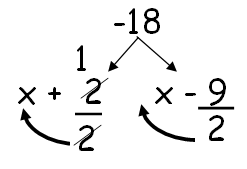
(x + 1) (2x - 9) = 0
x + 1 = 0 (or) 2x - 9 = 0
x = -1 (or) 2x = 9
x = 9/2
Hence the solutions are -1 and 9/2.
Subscribe to our ▶️ YouTube channel 🔴 for the latest videos, updates, and tips.
Kindly mail your feedback to v4formath@gmail.com
We always appreciate your feedback.
About Us | Contact Us | Privacy Policy
©All rights reserved. onlinemath4all.com

Recent Articles


-
Digital SAT Math Practice Test with Answers (Part - 18)
Oct 16, 26 11:02 AM
 Digital SAT Math Practice Test with Answers (Part - 18)
 -
AP Calculus BC Problems with Solutions
Sep 30, 26 01:08 PM
 AP Calculus BC Problems with Solutions
 -
Digital SAT Math Practice Test with Answers (Part - 17)
Sep 30, 26 01:00 PM
 Digital SAT Math Practice Test with Answers (Part - 17)