SIMPLIFYING RADICAL EXPRESSIONS INVOLVING FRACTIONS WORKSHEET
Subscribe to our ▶️ YouTube channel 🔴 for the latest videos, updates, and tips.
Use the quotient property to write the following radical expression in simplified form.
|
(1) |
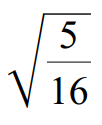 | |
|
(2) |
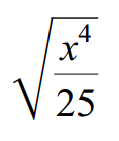 | |
|
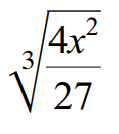
(3) |
 | |
|
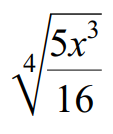
(4) |
 | |
|
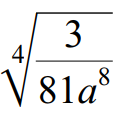
(5) |
 | |
|
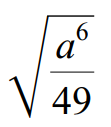
(6) |
 | |
|
(7) |
 | |
|
(8) |
 |

Detailed Answer Key
Problem 1 :
Use the quotient property to write the following radical expression in simplified form.
Solution :
√(5/16) = √5 / √16
√(5/16) = √5 / √(4 ⋅ 4)
Index of the given radical is 2.
Because its index is 2, we can take one term out of radical for every two same terms multiplied inside the radical sign.
√(5/16) = √5 / 4
Problem 2 :
Use the quotient property to write the following radical expression in simplified form.
Solution :
√(x4/25) = √x4 / √25
√(x4/25) = √(x2 ⋅ x2) / √(5 ⋅ 5)
Index of the given radical is 2.
Because its index is 2, we can take one term out of radical for every two same terms multiplied inside the radical sign.
√(x4/25) = x2 / 5
Problem 3 :
Use the quotient property to write the following radical expression in simplified form.
Solution :
3√(4x2/27) = 3√4x2 / 3√27
3√(4x2/27) = 3√(4x2) / 3√(3 ⋅ 3 ⋅ 3)
Index of the given radical is 3.
Because its index is 3, we can take one term out of radical for every three same terms multiplied inside the radical sign.
3√(4x2/27) = 3√(4x2) / 3
Problem 4 :
Use the quotient property to write the following radical expression in simplified form.
Solution :
4√(5x3/16) = 4√(5x3) / 4√16
4√(5x3/16) = 4√5x3 / 4√(2 ⋅ 2 ⋅ 2 ⋅ 2)
Index of the given radical is 4.
Because its index is 4, we can take one term out of the radical for every four same terms multiplied inside the radical sign.
4√(5x3/16) = 4√5x3 / 2
Problem 5 :
Use the quotient property to write the following radical expression in simplified form.
Solution :
4√(3/81a8) = 4√3 / 4√(81a8)
4√(3/81a8) = 4√3 / 4√(3a2 ⋅ 3a2 ⋅ 3a2 ⋅ 3a2)
Index of the given radical is 4.
Because its index is 4, we can take one term out of the radical for every four same terms multiplied inside the radical sign.
4√(3/81a8) = 4√3 / 3a2
Problem 6 :
Use the quotient property to write the following radical expression in simplified form.
Solution :
√(a6/49) = √a6/√49
√(a6/49) = √(a3 ⋅ a3)/(7 ⋅ 7)
Index of the given radical is 2.
Because its index is 2, we can take one term out of the radical for every two same terms multiplied inside the radical sign.
√(a6/49) = a3/7
Problem 7 :
Use the quotient property to write the following radical expression in simplified form.
Solution :
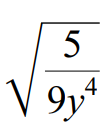
√(5/9y4) = √5 / √9y4
√(5/9y4) = √5 / (3y2 ⋅ 3y2)
Index of the given radical is 2.
Because its index is 2, we can take one term out of the radical for every two same terms multiplied inside the radical sign.
√(5/9y4) = √5 / 3y2
Problem 8 :
Use the quotient property to write the following radical expression in simplified form.
Solution :
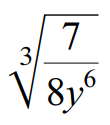
3√(7/8y6) = 3√7 / 3√(8y6)
3√(7/8y6) = 3√7 / 3√(2y2 ⋅ 2y2 ⋅ 2y2)
Index of the given radical is 3.
Because its index is 3, we can take one term out of the radical for every three same terms multiplied inside the radical sign.
3√(7/8y6) = 3√7 / 2y2
Subscribe to our ▶️ YouTube channel 🔴 for the latest videos, updates, and tips.
Kindly mail your feedback to v4formath@gmail.com
We always appreciate your feedback.
About Us | Contact Us | Privacy Policy
©All rights reserved. onlinemath4all.com

Recent Articles


-
Digital SAT Math Practice Test with Answers (Part - 18)
Oct 10, 26 06:38 PM
Digital SAT Math Practice Test with Answers (Part - 18) -
AP Calculus BC Problems with Solutions
Sep 30, 26 01:08 PM
 AP Calculus BC Problems with Solutions
 -
Digital SAT Math Practice Test with Answers (Part - 17)
Sep 30, 26 01:00 PM
 Digital SAT Math Practice Test with Answers (Part - 17)