PROPERTIES OF STANDARD DEVIATION
Subscribe to our ▶️ YouTube channel 🔴 for the latest videos, updates, and tips.
The best measure of dispersion is, usually, standard- deviation which does not possess the demerits of range and mean deviation.
SD for a given set of observations is defined as the root mean square deviation when the deviations are taken from the AM of the observations.
Let the variable "x" assume "n" values as given below

Then, the formula for SD is given by
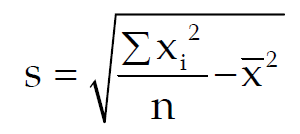
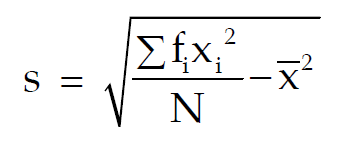
For a grouped frequency distribution, the SD is given by
Properties of Standard Deviation
1) If all the observations assumed by a variable are constant i.e. equal, then the SD is zero. This means that if all the values taken by a variable x is k, say , then s = 0. This result applies to range as well as mean deviation.
2) SD remains unaffected due to a change of origin but is affected in the same ratio due to a change of scale i.e., if there are two variables x and y related as y = a+bx for any two constants a and b, then SD of y is given by
SD of 'y' = |b| x SD of 'x'
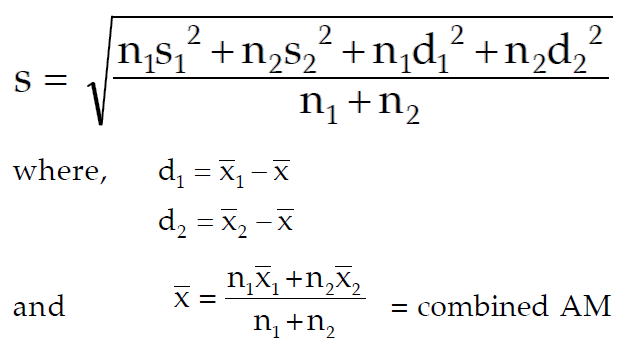
3) If there are two groups containing n₁ and n₂ observations, x̄₁ and x̄₂ as respective arithmetic means, S₁ and S₂ as respective standard deviations, then combined SD is given by
Question 1 :
The standard deviation of 20 observations is √5. If each observation is multiplied by 2, find the standard deviation and variance of the resulting observations.
Solution :
Here √5 is the standard deviation of 20 observations. Now we need to find the standard deviation and variance if each observation is multiplied by 2.
Standard deviation (σ) = 2√5
Question 2 :
Calculate the standard deviation of the first 13 natural numbers.
Solution :
= √(n² -1)/12
= √(13² -1)/12
= √(169 -1)/12
= √168/12
= √14
= 3.7416
= 3.74
So, standard deviation for first 13 numbers is 3.74.
Question 3 :
Calculate the standard deviation of the following data
10, 20, 15, 8, 3, 4
Solution :
First, we have to write the given data in the ascending order.
3, 4, 8, 10, 15, 20
Since the given numbers are small we can use direct method to find standard deviation.
|
x 3 4 8 10 15 20 |
x2 9 16 64 100 225 400 |
Σx = 60, Σx2 = 814
σ = √(Σx2/n) - (Σ x/n)2
= √(814/6) - (60/6)2
= √(135.67 - 102)
= √(135.67-100)
= √35.67
= 5.97
So, the standard deviation is 5.97.
Subscribe to our ▶️ YouTube channel 🔴 for the latest videos, updates, and tips.
Kindly mail your feedback to v4formath@gmail.com
We always appreciate your feedback.
About Us | Contact Us | Privacy Policy
©All rights reserved. onlinemath4all.com

Recent Articles


-
Digital SAT Math Practice Test with Answers (Part - 18)
Oct 22, 26 07:55 PM
 Digital SAT Math Practice Test with Answers (Part - 18)
 -
AP Calculus BC Problems with Solutions
Sep 30, 26 01:08 PM
 AP Calculus BC Problems with Solutions
 -
Digital SAT Math Practice Test with Answers (Part - 17)
Sep 30, 26 01:00 PM
 Digital SAT Math Practice Test with Answers (Part - 17)