PROPERTIES OF ADDITION OF RATIONAL NUMBERS
Subscribe to our ▶️ YouTube channel 🔴 for the latest videos, updates, and tips.
There are some properties of adding rational numbers.
They are closure, commutative, associative, identity, inverse and distributive.
Closure Property
The sum of any two rational numbers is always a rational number. This is called ‘Closure property of addition’ of rational numbers. Thus, Q is closed under addition
If a/b and c/d are any two rational numbers, then (a/b) + (c/d) is also a rational number.
Example :
2/9 + 4/9 = 6/9 = 2/3 is a rational number.
Commutative Property
Addition of two rational numbers is commutative.
If a/b and c/d are any two rational numbers,
then (a/b) + (c/d) = (c/d) + (a/b)
Example :
2/9 + 4/9 = 6/9 = 2/3
4/9 + 2/9 = 6/9 = 2/3
Hence, 2/9 + 4/9 = 4/9 + 2/9
Associative Property
Addition of rational numbers is associative.
If a/b, c/d and e/f are any three rational numbers,
then a/b + (c/d + e/f) = (a/b + c/d) + e/f
Example :
2/9 + (4/9 + 1/9) = 2/9 + 5/9 = 7/9
(2/9 + 4/9) + 1/9 = 6/9 + 1/9 = 7/9
Hence, 2/9 + (4/9 + 1/9) = (2/9 + 4/9) + 1/9
Additive Identity
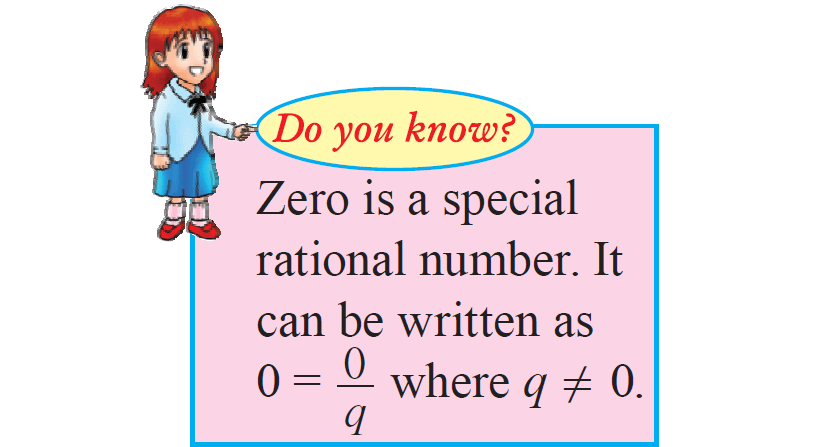
The sum of any rational number and zero is the rational number itself.
If a/b is any rational number,
then a/b + 0 = 0 + a/b = a/b
Zero is the additive identity for rational numbers.
Example :
2/7 + 0 = 0 + 2/7 = 27
Additive Inverse
(- a/b) is the negative or additive inverse of (a/b)
If a/b is a rational number,then there exists a rational number (-a/b) such that
a/b + (-a/b) = (-a/b) + a/b = 0
Example :
Additive inverse of 3/5 is (-3/5)
Additive inverse of (-3/5) is 3/5
Additive inverse of 0 is 0 itself.
Distributive Property
Distributive Property of Multiplication over Addition :
Multiplication of rational numbers is distributive over addition.
If a/b, c/d and e/f are any three rational numbers,
then a/b x (c/d + e/f) = a/b x c/d + a/b x e/f
Example :
1/3 x (2/5 + 1/5) = 1/3 x 3/5 = 1/5
1/3 x (2/5 + 1/5) = 1/3 x 2/5 + 1/3 x 1/5 = (2 + 1) / 15 = 1/5
Hence, 1/3 x (2/5 + 1/5) = 1/3 x 2/5 + 1/3 x 1/5
Therefore, Multiplication is distributive over addition.
Subscribe to our ▶️ YouTube channel 🔴 for the latest videos, updates, and tips.
Kindly mail your feedback to v4formath@gmail.com
We always appreciate your feedback.
About Us | Contact Us | Privacy Policy
©All rights reserved. onlinemath4all.com

Recent Articles


-
Digital SAT Math Practice Test with Answers (Part - 18)
Oct 22, 26 07:55 PM
 Digital SAT Math Practice Test with Answers (Part - 18)
 -
AP Calculus BC Problems with Solutions
Sep 30, 26 01:08 PM
 AP Calculus BC Problems with Solutions
 -
Digital SAT Math Practice Test with Answers (Part - 17)
Sep 30, 26 01:00 PM
 Digital SAT Math Practice Test with Answers (Part - 17)