PRIME AND COMPOSITE NUMBERS
Subscribe to our ▶️ YouTube channel 🔴 for the latest videos, updates, and tips.
Think about the situation :
The teacher gave 5 buttons to David and 6 buttons to Lily and asked them to arrange the buttons in all possible rows in such a way that the number of buttons in each row is equal. They did it, in different ways as shown below :
David's Ways
By arranging 5 buttons in a row, he gets 1 row.

1 x 5 = 5
By arranging 1 button in each row, he gets 5 rows.

5 x 1 = 5
He realizes that 5 buttons can be arranged in only 2 rectangular ways. Hence, the only factors of 5 are 1 and 5 (number of rows).
Lily's Ways
By arranging 6 buttons in a row, she gets 1 row.

1 x 6 = 6
By arranging 3 buttons in each row, she gets 2 rows.

2 x 3 = 6
By arranging 2 buttons in each row, she gets 3 rows.

3 x 2 = 6
By arranging 1 button in each row, she gets 6 rows.

6 x 1 = 6
She realizes that 6 buttons can be arranged in 4 rectangular ways. Hence, the factors of 6 are 1, 2, 3 and 6 (number of rows).
●Make different rectangular arrangements using 1 button, 2 buttons, 3 buttons, 4 buttons,…, 10 buttons and complete the following table :
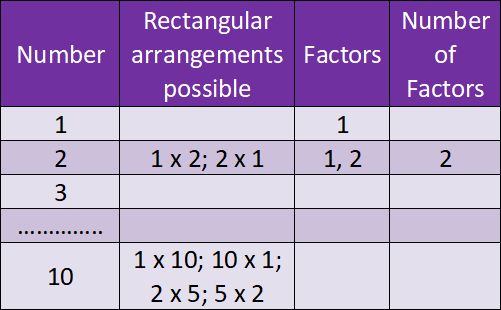
From the table, we conclude that
● A natural number greater than 1, having only two factors namely 1 and the number itself, is called a prime number.
For example, 2 (1 x 2) is a prime number as is 13 (1 x 13).
● A natural number having more than 2 factors is called composite number.
For example, 15 is a composite number (15 = 1 x 3 x 5) as is 70 (1 x 2 x 5 x 7).

Perfect Number
A number is a perfect number if the sum of its factors other than the given number gives the same number.
For example, 6 is a perfect number, since adding the factors of 6 (other than 6), namely 1, 2 and 3 gives the given number 6.
That is, 1 + 2 + 3 = 6 is the given number.
Check whether 28, 54 and 496 are perfect numbers or not.
Co-Primes or Relatively Prime
If the greatest common factor (GCF) of two numbers is 1, then the numbers are said to be co-primes or relatively prime or mutually prime.
Here, the two numbers can both be primes as (3, 11) or both can be composites as (16, 35) or one can be a prime and other a composite as (7, 14).
Activity
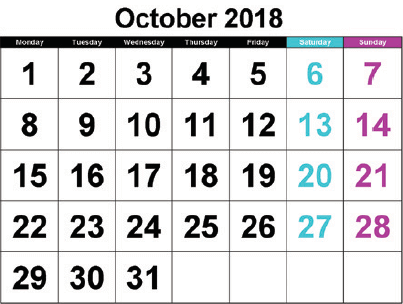
(i) List out the prime and composite numbers represented by the dates in the month of October.
(ii) Generate a few composite numbers by product of two or more natural numbers.
(iii) Classify the numbers 34, 57, 71, 93, 101, 111 and 291 as prime or composite.
Subscribe to our ▶️ YouTube channel 🔴 for the latest videos, updates, and tips.
Kindly mail your feedback to v4formath@gmail.com
We always appreciate your feedback.
About Us | Contact Us | Privacy Policy
©All rights reserved. onlinemath4all.com

Recent Articles


-
AP Calculus BC Problems with Solutions
Sep 30, 26 01:08 PM
 AP Calculus BC Problems with Solutions
 -
Digital SAT Math Practice Test with Answers (Part - 17)
Sep 30, 26 01:00 PM
 Digital SAT Math Practice Test with Answers (Part - 17)
 -
Digital SAT Math Practice Test with Answers (Part - 16)
Sep 07, 26 11:23 AM
Digital SAT Math Practice Test with Answers (Part - 16)