PRACTICE QUESTIONS ON RELATION FOR GRADE 11
Subscribe to our ▶️ YouTube channel 🔴 for the latest videos, updates, and tips.
Question 1 :
Suppose that 120 students are studying in 4 sections of eleventh standard in a school. Let A denote the set of students and B denote the set of the sections. Define a relation from A to B as “x related to y if the student x belongs to the section y”. Is this relation a function? What can you say about the inverse relation? Explain your answer.
Solution :
A be the set of students and B be the set of sections.

Every student in set A will be belonging at least any one of the classes of set B. Hence the above relation is a function.
Now let us consider about inverse relation. During the inverse relation, each section will have more than 1 students, which are given one to many relation.
That is, the section C1 will have more than 1 students. So we have to draw arrow mark from C1 to more than one student in set A. Hence it is not a function.
Question 2 :
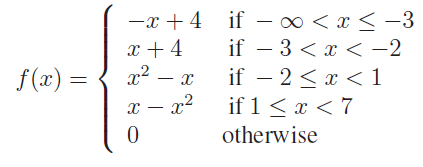
Write the values of f at −4, 1,−2, 7, 0 if
Solution :
(i) x = -4,
-4 lies in the interval (-∞, -3]
f(x) = -x + 4
x = -4
f(-4) = - (-4) + 4 = 8
(ii) x = 1,
1 lies in the interval [1, 7)
f(x) = x - x2
f(1) = 1 - 12 = 0
(iii) x = -2,
-2 lies in the interval [-2, 1)
f(x) = x2 - x
f(-2) = (-2)2 - (-2)
= 4 + 2
= 6
(iv) x = 7,
Do not lie in the given intervals. Hence f(7) is 0.
(v) x = 0,
0 lies in the interval [-2, 1)
f(x) = x2 - x
f(0) = 02 - 0 = 0
Question 3 :
Write the values of f at −3, 5, 2,−1, 0 if
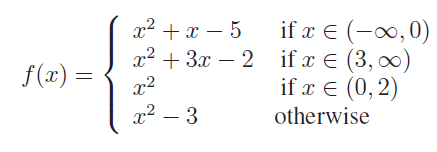
Solution :
(i) x = -3,
-3 lies in the interval (-∞, 0)
f(x) = x2 + x - 5
f(-3) = (-3)2 + (-3) - 5
= 9 - 3 - 5
f(-3) = 1
(ii) x = 5
5 lies in the interval (3, ∞)
f(x) = x2 + 3x - 2
f(5) = 52 + 3(5) - 2
= 25 + 15 - 2
= 38
(iii) x = 2
Do not lie in the given intervals. Hence f(2) is 0.
(iv) x = -1
-1 lies in the interval (-∞, 0)
f(x) = x2 + x - 5
f(-1) = (-1)2 + (-1) - 5
= 1 - 1 - 5
= 1 - 6
= -5
(v) x = 0
Do not lie in the given intervals. Hence f(0) is 0.
Question 4 :
If
A = {1, 2, 3}
and let
R = {(1, 1) , (2, 2) , (3, 3) , (1, 2) , (2, 1) , (2, 3) , (3, 2)}
then R is:
(a) Reflexive, symmetric but not transitive
(b) symmetric, transitive but not reflexive
(c) Reflexive and transitive but not symmetric
(d) an equivalence relation
Solution :
If a R a, the it is reflexive.
In the relation given, 1 R 1, 2 R 2, 3 R 3. So, it is reflexive.
If a R b and b R a, the given relation is symmetric.
(1, 2) and (2, 1)
(2, 3) and (3, 2)
So, it is symmetric.
To be a transistive, if a R b and b R to c, then a R c.
(1, 2) (2, 1) then (1, 1)
(1, 2) (2, 3) then there should 1 R 3. But there is no element (1, 3). So, it is not transistive.
So, the given relation is reflexive, symmetric but not transistive.
Question 5 :
Let R be a relation defined on Z by a R b <=> a ≥ b, then R is:
(a) symmetric, transitive but not reflexive
(b) Reflexive, symmetric but not transitive
(c) Reflexive and transitive but not symmetric
(d) an equivalence relation
Solution :
From the given condition it is clear that a and b may be equal. So, the given relation must be reflexive.
To be symmetric, it should satisfy the condition a R b then b R a
The relation will contain all whole numbers,
(1, 2) <==> (2, 1)
But according to the condition a should be greater than b. So, (1, 2) is not possible.
Mathematically :
a ≥ b and b ≥ c then a a ≥ c.
So, it is reflexive, transitive but not symmetric. Option c is correct.
Question 6 :
Let R be a relation defined on Z as follows: (a, b) ∈ R <=> a2 + b2 = 25, then domain of R is:
(a) {3, 4, 5} (b) {0, 3, 4, 5} (c) {0, ± 3, ±4, ±5}
(d) none of these
Solution :
a2 + b2 = 25
Option c satisfies this condition.
Subscribe to our ▶️ YouTube channel 🔴 for the latest videos, updates, and tips.
Kindly mail your feedback to v4formath@gmail.com
We always appreciate your feedback.
About Us | Contact Us | Privacy Policy
©All rights reserved. onlinemath4all.com

Recent Articles


-
Digital SAT Math Practice Test with Answers (Part - 18)
Oct 22, 26 07:55 PM
 Digital SAT Math Practice Test with Answers (Part - 18)
 -
AP Calculus BC Problems with Solutions
Sep 30, 26 01:08 PM
 AP Calculus BC Problems with Solutions
 -
Digital SAT Math Practice Test with Answers (Part - 17)
Sep 30, 26 01:00 PM
 Digital SAT Math Practice Test with Answers (Part - 17)