LEADING COEFFICIENT TEST
Subscribe to our ▶️ YouTube channel 🔴 for the latest videos, updates, and tips.
Whether the graph of a polynomial rises or falls can be determined by the Leading Coefficient Tests.
P(x) = anxn + an-1xn-1 +............. a1x + a0
In the above polynomial, n is the degree and an is the leading coefficient.
|
Case |
End Behavior of Graph |
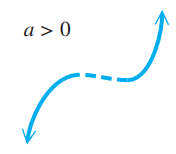
When n is odd and an is positive
Graph falls to the left and rises to the right
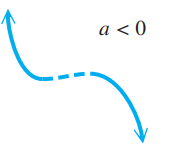
When n is odd and an is negative
Graph rises to the left and falls to the right
When n is even and an is positive
Graph rises to the left and right
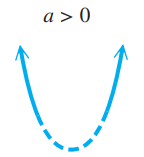
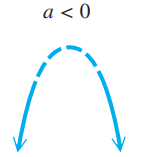
When n is even and an is negative
Graph falls to the left and right
Example 1 :
Find the right-hand and left-hand behaviors of the graph of
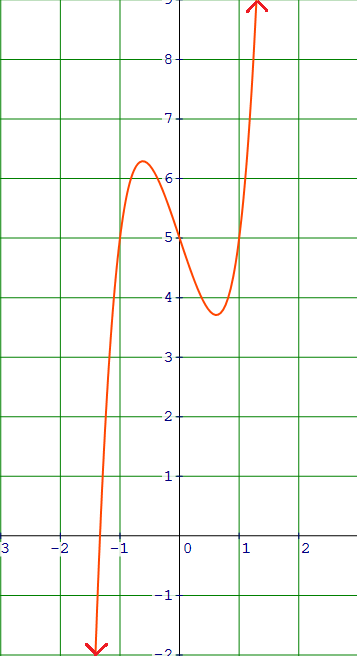
f(x) = x5 + 2x3 - 3x + 5
Solution :
Because the degree is odd and the leading coefficient is positive, the graph falls to the left and rises to the right as shown in the figure.
Example 2 :
Determine the end behavior of the graph of the polynomial function below using Leading Coefficient Test.
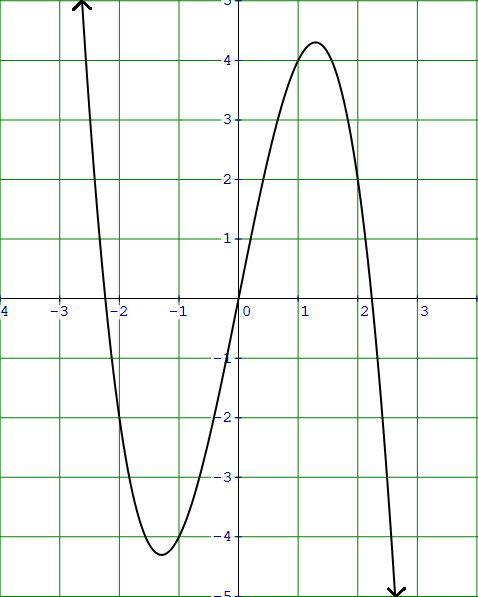
P(x) = -x3 + 5x
Solution :
Because the degree is odd and the leading coefficient is negative, the graph rises to the left and falls to the right as shown in the figure.
Example 3 :
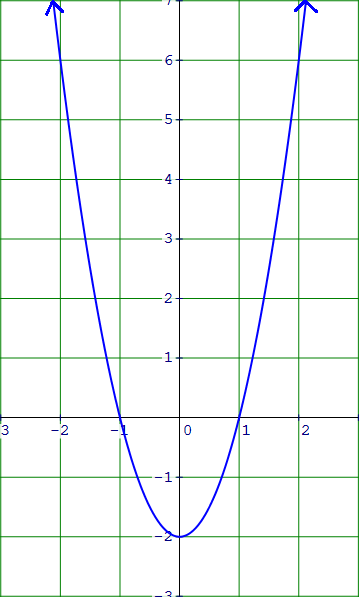
Determine the end behavior of the graph of the polynomial function below using Leading Coefficient Test.
P(x) = 2x2 - 2
Solution :
Because the degree is even and the leading coefficient is positive, the graph rises to the left and right as shown in the figure.
Example 4 :
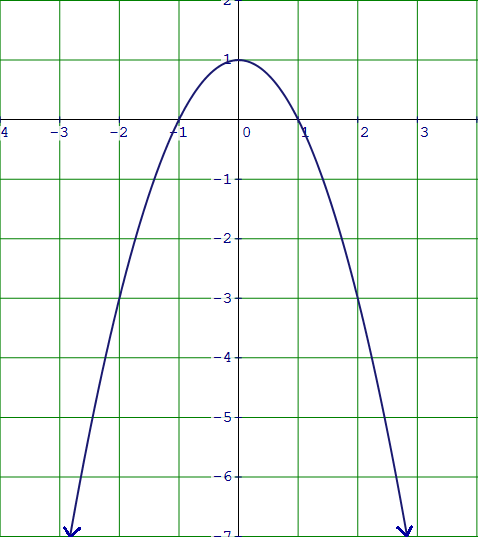
Determine the end behavior of the graph of the polynomial function below using Leading Coefficient Test.
P(x) = -x2 + 1
Solution :
Because the degree is even and the leading coefficient is negative, the graph falls to the left and right as shown in the figure.
Example 5 :
Describe the right hand and left hand behavior of the graph of each function.
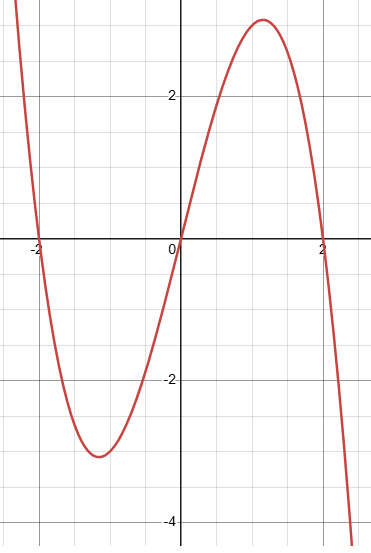
a) f(x) = -x3 + 4x
b) f(x) = x4 - 5x2 + 4
c) f(x) = x5 - x
Solution :
a) f(x) = -x3 + 4x
Degree = 3 (odd)
sign of leading coefficient = negative
Then the end behavior will be the graph will rise in left and falls in right.
b) f(x) = x4 - 5x2 + 4
Degree = 4 (even)
sign of leading coefficient = positive
Then the end behavior will be, the graph will rise in both left and right.
c) f(x) = x5 - x
Degree = 5 (odd)
sign of leading coefficient = positive
Then the end behavior will be, the graph will rise in right and will fall in left.
Example 6 :
Sketch the graph of the function by
a) applying the leading coefficient test
b) Finding the zeroes of the polynomial
c) plotting sufficient solution points
d) drawing continuous curve through the points
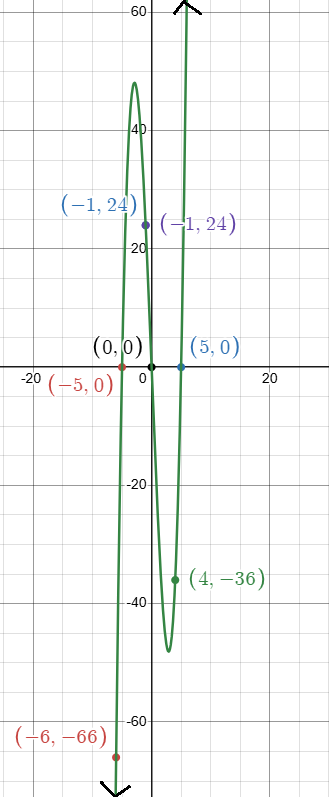
i) f(x) = x3 - 25x
ii) g(x) = x4 - 9x2
Solution :
a)
Degree = 3
Sign of leading coefficient = positive
End behavior :
The graph will rise right and will fall in left.
b) Finding zeroes :
x3 - 25x = 0
x(x2 - 25) = 0
x (x + 5)(x - 5) = 0
x = 0, x = -5 and x = 5
Zeroes are -5, 0 and 5 and x-intercepts are (0, 0) (-5, 0) and (5, 0).
c) Plotting additional points :
(-∞, -5) (-5, 0) (0, 5) and (5, ∞)
f(x) = x (x + 5)(x - 5)
|
x = -6 ∈ (-∞, 0) |
f(-6) = -6(-6 + 5)(-6 - 5) = -6(-1)(-11) = -66 negative plot the point (-6, -66) |
|
x = -1 ∈ (-5, 0) |
f(-1) = -1(-1 + 5)(-1 - 5) = -1(4)(-6) = 24 Positive plot the point (-1, 24) |
|
x = 4 ∈ (0, 5) |
f(4) = 4(4 + 5)(4 - 5) = 4(9)(-1) = -36 negative plot the point (4, -36) |
|
x = 6 ∈ (5, ∞) |
f(6) = 6(6 + 5)(6 - 5) = 6(11)(1) = 66 Positive plot the point (-1, 24) |
The polynomial has three distinct real roots, the graph will rise right and will fall in left.
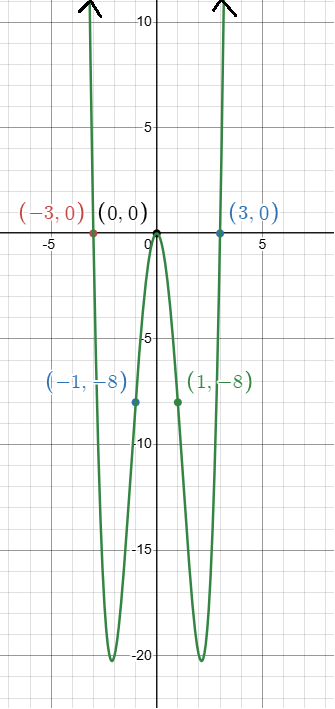
ii) g(x) = x4 - 9x2
a)
Degree = 4 (even)
Sign of leading coefficient = positive
End behavior :
The graph will rise both right and left.
b) Finding zeroes :
x4 - 9x2 = 0
x2(x2 - 9) = 0
x2 (x + 3)(x - 3) = 0
x = 0, x = -3 and x = 3
Zeroes are -3, 0 and 3 and x-intercepts are (0, 0) (-3, 0) and (3, 0). 0 is the multiplicity of 2.
c) Plotting additional points :
(-∞, -3) (-3, 0)(0, 3) and (3, ∞)
f(x) = x2 (x + 3)(x - 3)
|
x = -4 ∈ (-∞, -3) |
f(x) = (-4)2 (-4 + 3)(-4 - 3) = 16(-1)(-7) = 112 positive plot the point (-4, 112) |
|
x = -1 ∈ (-3, 0) |
f(-1) = (-1)2 (-1 + 3)(-1 - 3) = 1(2)(-4) = -8 negative plot the point (-1, -8) |
|
x = 1 ∈ (0, 3) |
f(1) = (1)2 (1 + 3)(1 - 3) = 1(4)(-2) = -8 negative plot the point (1, -8) |
|
x = 4 ∈ (3, ∞) |
f(4) = (4)2 (4 + 3)(4 - 3) = 16(7)(1) = 112 positive plot the point (4, 112) |
0 has multiplicity of 2 and the other roots are -3 and 3.
Plotting the points,
(-4, 112), (-1, -8), (1, -8) and (4, 112)
Subscribe to our ▶️ YouTube channel 🔴 for the latest videos, updates, and tips.
Kindly mail your feedback to v4formath@gmail.com
We always appreciate your feedback.
About Us | Contact Us | Privacy Policy
©All rights reserved. onlinemath4all.com

Recent Articles


-
Digital SAT Math Practice Test with Answers (Part - 18)
Oct 10, 26 06:38 PM
Digital SAT Math Practice Test with Answers (Part - 18) -
AP Calculus BC Problems with Solutions
Sep 30, 26 01:08 PM
 AP Calculus BC Problems with Solutions
 -
Digital SAT Math Practice Test with Answers (Part - 17)
Sep 30, 26 01:00 PM
 Digital SAT Math Practice Test with Answers (Part - 17)