KITES IN GEOMETRY
Subscribe to our ▶️ YouTube channel 🔴 for the latest videos, updates, and tips.
A kite is a quadrilateral that has two pairs of consecutive congruent sides, but opposite sides are not congruent.
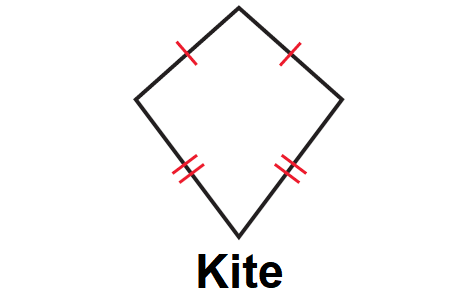
Theorems on Kites
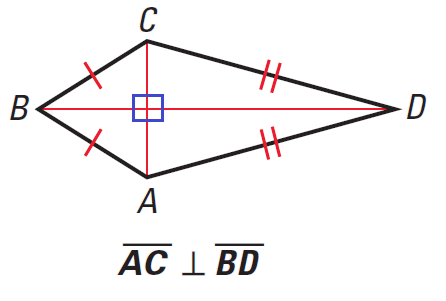
Theorem 1 :
If a quadrilateral is a kite, then its diagonals are perpendicular.
It has been illustrated in the diagram shown below.
Theorem 2 :
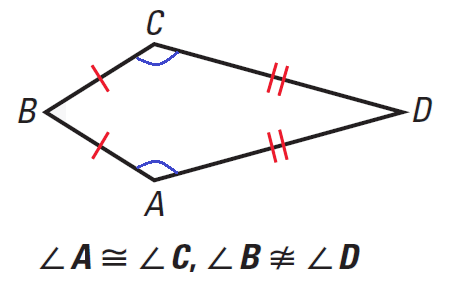
If a quadrilateral is a kite, then exactly one pair of opposite angles are congruent.
It has been illustrated in the diagram shown below.
Kites in Geometry - Practice Problems
Problem 1 :
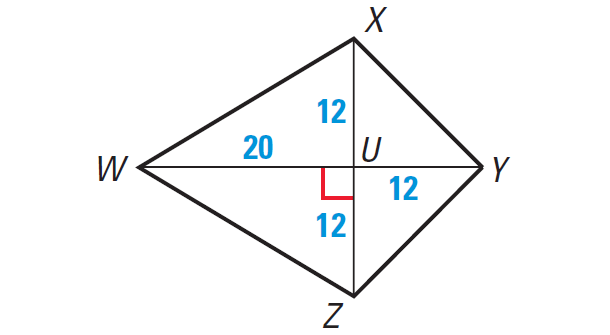
In the kite WXYZ shown below, find the length of each side.
Solution :
Because WXYZ is a kite, the diagonals are perpendicular. We can use Pythagorean theorem to find the side lengths.
In the kite WXYZ shown above, let us consider the triangle part WUZ.
Because the diagonals WY and XZ are perpendicular and they intersect at U, angle U is a right angle.
So, WUZ is a right triangle.
By Pythagoren theorem, we have
WZ2 = WU2 + UZ2
Take radical on both sides.
√WZ2 = √(WU2 + UZ2)
WZ = √(202 + 122)
WZ = √(400 + 144)
WZ = √544
WZ ≈ 23.32
Similarly, in the right triangle triangle YUZ, we have
YZ2 = YU2 + UZ2
Take radical on both sides.
√YZ2 = √(YU2 + UZ2)
YZ = √(122 + 122)
YZ = √(144 + 144)
YZ = √288
YZ ≈ 16.97
We know that a kite is a quadrilateral that has two pairs of consecutive congruent sides, but opposite sides are not congruent.
So, in the kite WXYZ shown above, we have
WX ≅ WZ
YX ≅ YZ
Hence, we have
WX = WZ ≈ 23.32
YX = YZ ≈ 16.97
Problem 2 :
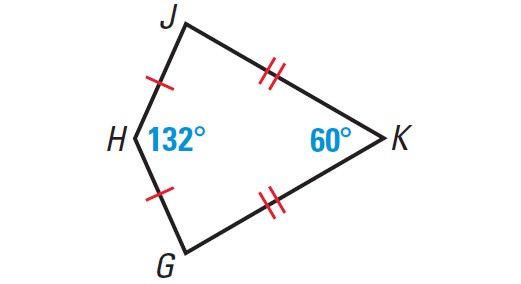
Find m∠G and m∠J in the diagram shown below.
Solution :
The quadrilateral GHJK shown above has two pairs of consecutive congruent sides, but opposite sides are not congruent.
So, the quadrilateral GHJK is a kite.
By theorem 2 above, exactly one pair of opposite angles of a kite are congruent.
But, in the diagram shown above, the pair of m∠H and m∠K are not congruent.
Then, the pair of m∠G and m∠J must be congruent.
That is,
m∠G ≅ m∠J
Let , m∠G = m∠J = x°
We know that the four angles of a quadrilateral add up to 360°.
So, we have
m∠G + m∠H + m∠J + m∠K = 360°
x° + 132° + x° + 60° = 360°
Simplify.
2x° + 192° = 360°
Subtract 192° from both sides.
2x° + 192° = 360°
2x° = 168°
Divide both sides by 2.
x° = 84°
Hence, we have
m∠G = m∠J = 84°
Problem 3 :
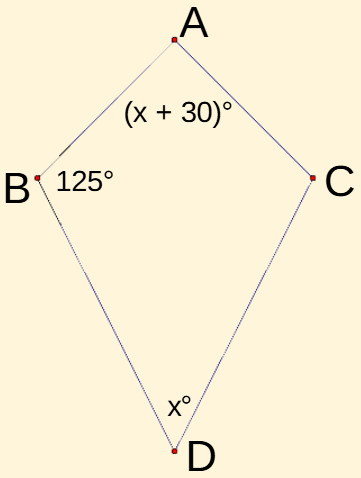
ABCD is a kite. Find ∠A, ∠C and ∠D.
Solution :
∠A = x + 30, ∠C = 125, ∠B = 125 and ∠D = x
∠A + ∠B + ∠C + ∠D = 360
x + 30 + 125 + 125 + x = 360
2x + 280 = 360
2x = 360 - 280
2x = 80
x = 80/2
x = 40
Applying the value of x, we get
∠A = 40 + 30 ==> 70
∠C = 125
∠D = 40
Problem 4 :
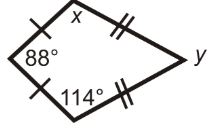
Find the value of the missing variable(s). Figure is a kite
Solution :
x = 114
x + 88 + 114 + y = 360
114 + 88 + 114 + y = 360
316 + y = 360
y = 360 - 316
y = 44
Problem 5 :
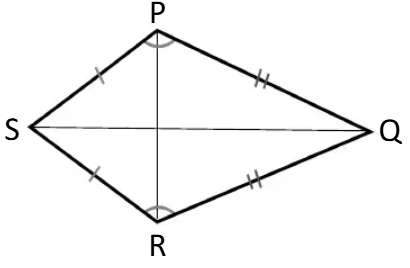
In kite PQRS, SQ is perpendicular to PR and PO = OR. IF PQ = 5x - 10 and QR = 4x + 5. Find x, PO and QR.
Solution :
PQ = QR
5x - 10 = 4x + 5
5x - 4x = 5 + 10
x = 15
PQ = 5(15) - 10
= 75 - 10
= 65
QR = 65
Problem 6 :
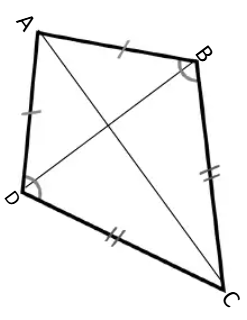
In kite ABCD, DB is perpendicular to AC, if AC = 10 and BD = 7. Find the area of the kite ABCD.
Solution :
Area of kite = 1/2 x diagonal 1 x diagonal 2
= (1/2) x 10 x 7
= 70/2
= 35 square units.
Problem 7 :
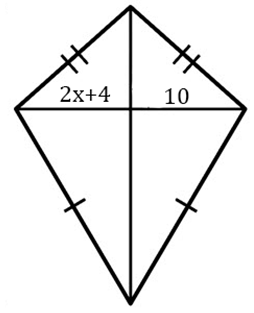
Solve for x.
Solution :
2x + 4 = 10
2x = 10 - 4
2x = 6
x = 6/2
x = 3
So, the value of x is 3.
Problem 8 :
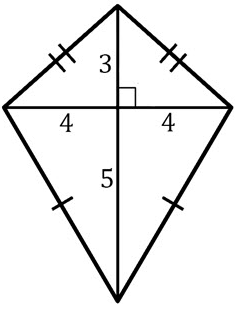
Find the perimeter of the kite.
Solution :
In the right triangle at the top left and right,
let x be the unknown side which is hypotenuse.
x2 = 32 + 42
x2 = 9 + 16
x2 = 25
x = 5
Let y be the length of the longer leg.
y2 = 42 + 52
= 16 + 25
= 41
y = √41
Perimeter of the kite = 2(5) + 2√41
= 10 + 2(6.4)
= 10 + 12.8
= 22.8
So, the required perimeter of the kite is 22.8 units.
Problem 9 :
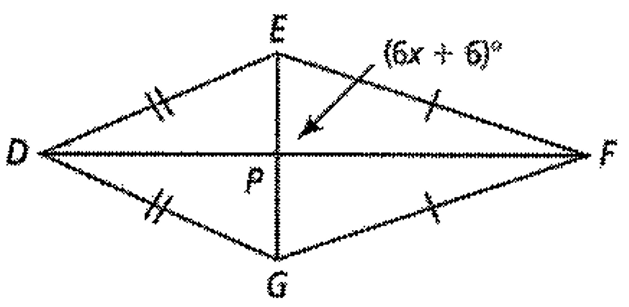
Find the value of x.
Solution :
In the kite, the diagonals will be perpendicular to each other.
6x + 6 = 90
6x = 90 - 6
6x = 84
x = 84/6
= 14
So, the value of x is 14.
Subscribe to our ▶️ YouTube channel 🔴 for the latest videos, updates, and tips.
Kindly mail your feedback to v4formath@gmail.com
We always appreciate your feedback.
About Us | Contact Us | Privacy Policy
©All rights reserved. onlinemath4all.com

Recent Articles


-
Digital SAT Math Practice Test with Answers (Part - 18)
Oct 22, 26 07:55 PM
 Digital SAT Math Practice Test with Answers (Part - 18)
 -
AP Calculus BC Problems with Solutions
Sep 30, 26 01:08 PM
 AP Calculus BC Problems with Solutions
 -
Digital SAT Math Practice Test with Answers (Part - 17)
Sep 30, 26 01:00 PM
 Digital SAT Math Practice Test with Answers (Part - 17)