JUSTIFYING ANGLE RELATIONSHIPS
Subscribe to our ▶️ YouTube channel 🔴 for the latest videos, updates, and tips.
A transversal is a line that intersects two lines in the same plane at two different points. Transversal and the two lines form eight angles.
In this section, you will learn how to justify the relationships between the eight angles.
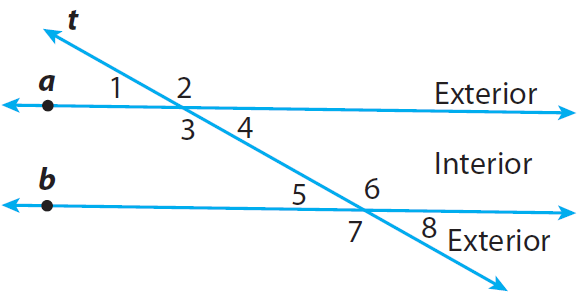
Corresponding Angles :
Angles lie on the same side of the transversal t, on the same side of lines a and b.
Example : ∠ 1 and ∠ 5
Alternate Interior Angles :
Angles are nonadjacent angles that lie on opposite sides of the transversal t, between lines a and b.
Example : ∠ 3 and ∠ 6
Alternate Exterior Angles :
Angles lie on opposite sides of the transversal t, outside lines a and b.
Example : ∠ 1 and ∠ 8
Same-Side Interior Angles :
Angles lie on the same side of the transversal t, between lines a and b.
Example : ∠ 3 and ∠ 5
Solved Problems
Problem 1 :
A transversal cuts the two parallel lines and forms eight angles. Describe the relationships between the angles in the diagram given below.
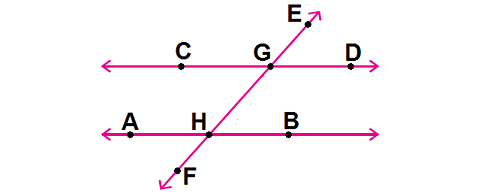
Solution :
Corresponding Angles :
∠CGE and ∠AHG, ∠DGE and ∠BHG, ∠CGH and ∠AHF, ∠DGH and ∠BHF ; congruent.
Alternate Interior Angles :
∠CGH and ∠BHG, ∠DGH and ∠AHG ; congruent.
Alternate Exterior Angles :
∠CGE and ∠BHF, ∠DGE and ∠AHF ; congruent.
Same-Side Interior Angles :
∠CGH and ∠AHG, ∠DGH and ∠BHG ; supplementary.
Problem 2 :
In the figure given below, let the lines l1 and l2 be parallel and m is transversal. If ∠F = 65°, using the angle relationships, find the measure of each of the remaining angles.
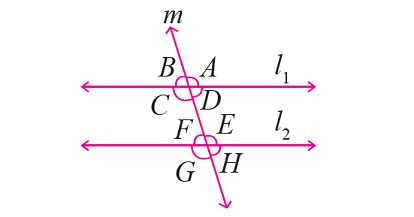
Solution :
From the given figure,
∠F and ∠H are vertically opposite angles and they are equal.
Then, ∠H = ∠F -------> ∠H = 65°
∠H and ∠D are corresponding angles and they are equal.
Then, ∠D = ∠H -------> ∠D = 65°
∠D and ∠B are vertically opposite angles and they are equal.
Then, ∠B = ∠D -------> ∠B = 65°
∠F and ∠E are together form a straight angle.
Then, we have
∠F + ∠E = 180°
Plug ∠F = 65°
∠F + ∠E = 180°
65° + ∠E = 180°
∠E = 115°
∠E and ∠G are vertically opposite angles and they are equal.
Then, ∠G = ∠E -------> ∠G = 115°
∠G and ∠C are corresponding angles and they are equal.
Then, ∠C = ∠G -------> ∠C = 115°
∠C and ∠A are vertically opposite angles and they are equal.
Then, ∠A = ∠C -------> ∠A = 115°
Therefore,
∠A = ∠C = ∠E = ∠G = 115°
∠B = ∠D = ∠F = ∠H = 65°
Problem 3 :
In the figure given below, let the lines l1 and l2 be parallel and t is transversal. Using angle relationships, find the value of x.
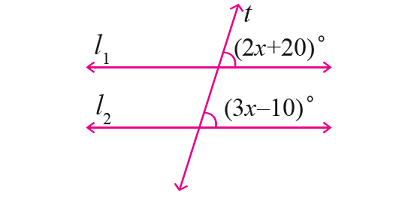
Solution :
From the given figure,
∠(2x + 20)° and ∠(3x - 10)° are corresponding angles.
So, they are equal.
Then, we have
(2x + 20)° = (3x - 10)°
2x + 20 = 3x - 10
30 = x
Problem 4 :
In the figure given below, let the lines l1 and l2 be parallel and t is transversal. Using angle relationships, find the value of x.
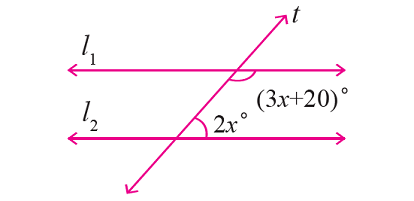
Solution :
From the given figure,
∠(3x + 20)° and ∠2x° are consecutive interior angles.
So, they are supplementary.
Then, we have
(3x + 20)° + 2x° = 180°
3x + 20 + 2x = 180
5x + 20 = 180
5x = 160
x = 32
Subscribe to our ▶️ YouTube channel 🔴 for the latest videos, updates, and tips.
Kindly mail your feedback to v4formath@gmail.com
We always appreciate your feedback.
About Us | Contact Us | Privacy Policy
©All rights reserved. onlinemath4all.com

Recent Articles


-
Digital SAT Math Practice Test with Answers (Part - 18)
Oct 22, 26 07:55 PM
 Digital SAT Math Practice Test with Answers (Part - 18)
 -
AP Calculus BC Problems with Solutions
Sep 30, 26 01:08 PM
 AP Calculus BC Problems with Solutions
 -
Digital SAT Math Practice Test with Answers (Part - 17)
Sep 30, 26 01:00 PM
 Digital SAT Math Practice Test with Answers (Part - 17)