JOINT RELATIVE FREQUENCY WORKSHEET
Subscribe to our ▶️ YouTube channel 🔴 for the latest videos, updates, and tips.
Problem 1 :
A survey is made among 100 students in a middle school. They are asked, how they travel to school. The table given below shows the results of the survey.
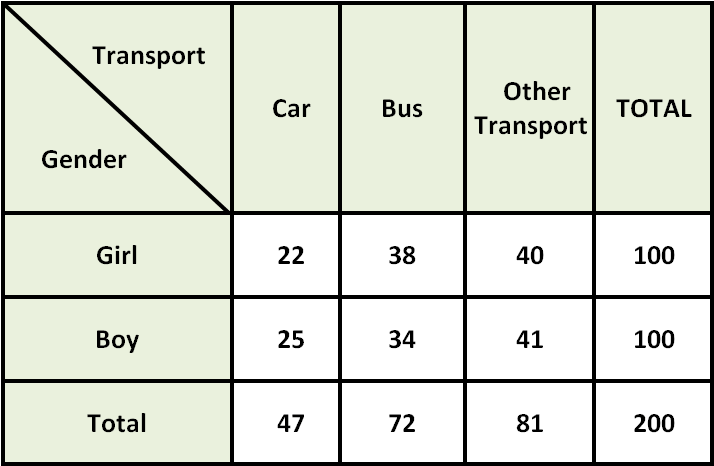
Use the above table to find each joint relative frequency.
(i) Find the joint relative frequency that a student surveyed prefers car, given that the student is a boy.
(ii) Find the joint relative frequency that a student surveyed is a boy, given that the student prefers bus.
Solution :
Part (i) :
Divide the number of boys who prefer car by the number of boys. Express your answer as a decimal and as a percent.
25/100 = 0.25 = 25%
Part (ii) :
Divide the number of boys who prefer bus by the number of students who prefer bus. Express your answer as a decimal and as a percent.
34/72 ≈ 0.47 = 47%
Problem 2 :
A survey is conducted among school students. 50 students are randomly selected and they are asked, whether they prefer dogs, cats or other pets. The table given below shows the results of the survey.
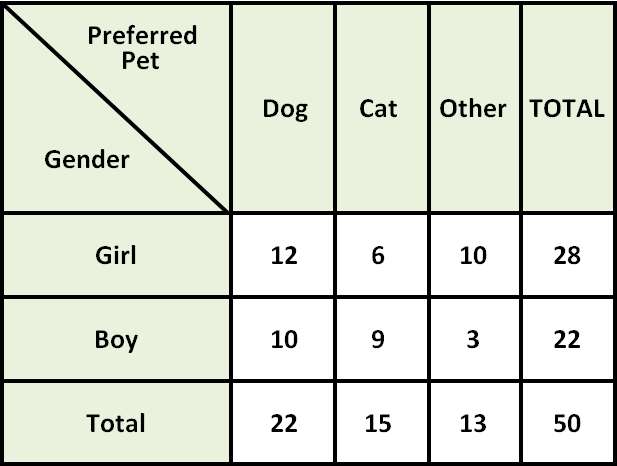
Use the above table to find each joint relative frequency.
(i) Find the joint relative frequency that a student surveyed prefers cats as pets, given that the student is a girl.
(ii) Find the joint relative frequency that a student surveyed is a girl, given that the student prefers dog as pets.
Solution :
Part (i) :
Divide the number of girls who prefer cats by the number of girls. Express your answer as a decimal and as a percent.
6/28 ≈ 0.21 = 21%
Part (ii) :
Divide the number of girls who prefer dogs by the number of students who prefer dogs. Express your answer as a decimal and as a percent.
12/22 ≈ 0.55 = 55%
Problem 3 :
Write an equation of variation to represent the situation and solve for the indicated information.
The number of centimeters y in a linear measurement varies directly with the number of inches x in the measurement. Pablo’s height is 152.4 centimeters or 60 inches. What is Maria’s height in centimeters if she is 64 inches tall?
Solution :
y ∝ x
y = kx
When y = 152.4, x = 60
152.4 = k(60)
k = 152.4/60
k = 2.54
Applying the value of k, we get
y = 2.54x
When x = 64, y = ?
y = 2.54(64)
= 162.56
Problem 4 :
The time needed to paint a fence varies directly with the length of the fence and indirectly with the number of painters. If it takes five hours to paint 200 feet of fence with three painters, how long will it take five painters to paint 500 feet of fence?
Solution :
Let T be the time, L be the length of fence and N be the number of painters.
Time directly varies with length and length indirectly varies with number of painters.
T ∝ L/N
Let k be the constant of proportionality.
T = k(L/N)
T = 3, L = 200
3 = k(200/N)
3N/200 = k
k = 3N/200
N = 5, L = 500, T = ?
k = 3(5) / 200
Applying the value of k in T = k(L/N)
T = (15/200)(500/5)
T = 7.5 hours
Problem 5 :
The time to prepare a field for planting is inversely proportional to number of people who are working. A large field can be prepared by five workers in 24 days. In order to finish the field sooner, the farmer plans to hire additional workers. How many workers are needed to finish the field in 15 days?
Solution :
Let T be the time, N be the number of people who are working.
T = k/N
Here k is the constant of proportionality.
24 = k/5
k = 24(5)
k = 120
T = 120/N
When T = 15, N = ?
15 = 120/N
N = 120/15
= 8
So, the number of workers is 8.
Problem 6 :
An egg is dropped from the roof of a building. The distance it falls varies directly with the square of the time it falls. If it takes 1/2 second for the egg to fall eight feet, how long will it take the egg to fall 200 feet?
Solution :
Let D be the distance and T be the time.
D = kT2
Here k is the constant of proportionality.
8 = k(1/2)2
8 = k/4
k = 8(4)
k = 32
Applying the value of k, we get
D = 32T2
When D = 200, T = ?
200/32 = T2
T2 = 6.25
T = √6.25
T = 2.5 hours
So, the required time is 2.5 hours.
Problem 7 :
The cost of material used in making a Frisbee varies directly with the square of its diameter. If it costs of manufacturer $0.45 for the material of a Frisbee with a 9 inch diameter, then what is the cost for the material for Frisbee with a 12 inch diameter ?
Solution :
Let C be the cost and D be the diameter.
C = kD2
Here k is the constant of proportionality.
0.45 = k(9)2
0.45/81 = k
k = 0.005
Applying the value of k, we get
C = 0.005D2
When D = 12
C = 0.005(12)2
C = 0.72
So, the cost of material is $0.72.
Subscribe to our ▶️ YouTube channel 🔴 for the latest videos, updates, and tips.
Kindly mail your feedback to v4formath@gmail.com
We always appreciate your feedback.
About Us | Contact Us | Privacy Policy
©All rights reserved. onlinemath4all.com

Recent Articles


-
Digital SAT Math Questions and Answers (Part - 13)
May 10, 26 05:50 PM
 Digital SAT Math Questions and Answers (Part - 13)
 -
Problems on Solving Logarithmic Equations
Apr 24, 26 09:30 PM
Problems on Solving Logarithmic Equations -
Solving Logarithmic Equations Worksheet
Apr 24, 26 09:05 PM
 Solving Logarithmic Equations Worksheet