FINDING SLOPE OF THE LINE WHEN ANGLE OF INCLINATION IS GIVEN
Subscribe to our ▶️ YouTube channel 🔴 for the latest videos, updates, and tips.
Formula to find slope when angle of inclination is given :
m = tan θ
Problem 1 :
Find the angle of inclination of the straight line whose slope is
(i) 1 (ii) √3 (iii) 0
Solution :
|
(i) Slope = 1 m = tan θ tan θ = 1 θ = 45 |
(ii) √3 m = tan θ tan θ = √3 θ = 60 |
(iii) 0
m = tan θ
tan θ = 0
θ = 0
Problem 2 :
Find the slope of the straight line whose angle of inclination is
(i) 30° (ii) 60° (iii) 90°
Solution :
|
(i) θ = 30° m = tan θ m = tan 30 m = 1/√3 |
(ii) θ = 60° m = tan θ m = tan 60 m = √3 |
(iii) 90°
m = tan θ
m = tan 90
m = undefined
Problem 3 :
Find the slope of the straight line passing through the points
(i) (3 , -2) and (7 , 2)
(ii) (2 , -4) and origin
(iii) (1 + √3 , 2) and (3 + √3 , 4)
Solution :
(i) m = (y2 - y1)/(x2 - x1)
m = (2 + 2)/(7 - 3)
m = 4/4
m = 1
Hence the slope passing through the given points is 1.
(ii) m = (y2 - y1)/(x2 - x1)
(2 , -4) and (0, 0)
m = (0 + 4)/(0 - 2)
m = 4/(-2)
m = -2
(iii) (1 + √3 , 2) and (3 + √3 , 4)
m = (y2 - y1)/(x2 - x1)
m = (4 - 2)/[(3 + √3) - (1 + √3)]
m = 2/2
m = 1
Problem 4 :
Find the angle of inclination of the line passing through the points
(i) (1, 2) and (2 , 3)
(ii) (3 , 3) and (0 , 0)
(iii) (a , b) and (-a , -b)
Solution :
|
(i) (1, 2) and (2 , 3) m = (3 - 2)/(2 - 1) m = 1 tan θ = 1 θ = 45 |
(ii) (3 , 3) and (0 , 0) m = (0 - 3)/(0 - 3) m = 1 tan θ = 1 θ = 45 |
(iii) (a , b) and (-a , -b)
m = (-b - b)/(-a - a)
m = (-2b)/(-2a)
tan θ = b/a
θ = tan-1 (b/a)
Question 5 :
Show that the given vertices form a right angled triangle and check whether its satisfies Pythagoras theorem
(i) A(1, -4), B(2, -3) and C(4, -7)
(ii) L(0, 5), M(9, 12) and N(3, 14)
Solution :
Part (i) :
A(1, -4), B(2, -3) and C(4, -7)
Slope of AB = ⁽⁻³ ⁺ ⁴⁾⁄₍₂ ₋ ₁₎
= ¹⁄₁
= 1
Slope of BC = ⁽⁻⁷ ⁺ ³⁾⁄₍₄ ₋ ₂₎
= -⁴⁄₂
= -2
Slope of AC = ⁽⁻⁷ ⁺ ⁴⁾⁄₍₄ ₋ ₁₎
= -³⁄₃
= -1
Slope of AB x Slope of AC = (-1)(1)
= -1
AB is perpendicular to AC, ∠A = 90°.
Using the distance formula d = √[(x2 - x1)2 + (y2 - y1)2], find the length of each side of the triangle.
Then, Check Pythagorean Theorem for the lengths.
That is, square of the larger side has to be equal to sum of the squares of other two sides.
The vertices are A(1, -4), B(2, -3) and C(4,-7).
AB = √[(x2 - x1)2 + (y2 - y1)2]
Substitute (x1, y1) = (1, -4) and (x2, y2) = (2, -3).
AB = √[(2 - 1)2 + (-3 + 4)2]
= √[12 + 12]
= √[1 + 1]
= √2
AB2 = 2
BC = √[(4 - 2)2 + (-7 + 3)2] = √20
BC2 = 20
AC = √[(4 - 1)2 + (-7 + 4)2] = √18
AC2 = 18
20 = 2 + 18 ----> BC2 = AB2 + AC2
The points A, B and C satisfy Pythagorean theorem.
Therefore, the points A, B and C form a right triangle.
Part (ii) :
L(0, 5), M(9, 12) and N(3, 14).
Slope of LM = ⁽¹² ⁻ ⁵⁾⁄₍₉ ₋ ₀₎
= ⁷⁄₉
Slope of MN = ⁽¹⁴ ⁻ ¹²⁾⁄₍₃ ₋ ₉₎
= ²⁄₋₆
= -⅓
Slope of LN = ⁽¹⁴ ⁻ ⁵⁾⁄₍₃ ₋ ₀₎
= ⁹⁄₃
= 3
Slope of MN x Slope of LN = (-⅓)(3)
= -1
MN is perpendicular to LN, ∠N = 90°.
Using the distance formula d = √[(x2 - x1)2 + (y2 - y1)2], find the length of each side of the triangle.
Then, Check Pythagorean Theorem for the lengths.
That is, square of the larger side has to be equal to sum of the squares of other two sides.
LM = √[(x2 - x1)2 + (y2 - y1)2]
Substitute (x1, y1) = (0, 5) and (x2, y2) = (9, 12).
LM = √[(9 - 0)2 + (12 - 5)2]
= √[92 + 72]
= √[81 + 49]
= √130
LM2 = 130
MN = √[(3 - 9)2 + (14 - 12)2] = √40
MN2 = 40
LN = √[(3 - 0)2 + (14 - 5)2] = √90
LN2 = 90
130 = 40 + 90 ----> LM2 = MN2 + LN2
The points L, M and N satisfy Pythagorean theorem.
Therefore, the points L, M and N form a right triangle.
Question 6 :
Show that the given points form a parallelogram :
A(2.5, 3.5) , B(10,-4), C(2.5,-2.5) and D(-5,5)
Solution :
In a parallelogram, we can prove that the opposite sides are parallel by showing that the slopes of opposite sides are equal.
A(2.5, 3.5), B(10, -4), C(2.5, -2.5) and D(-5, 5)
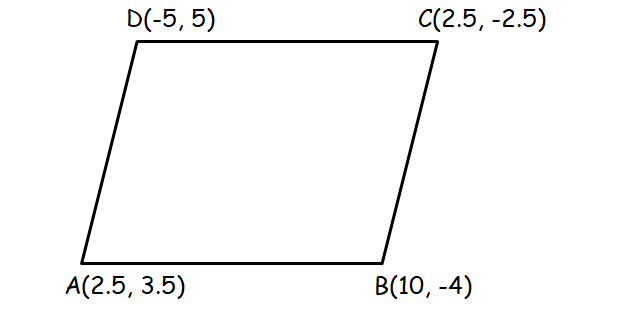
|
Slope of AB : = ⁽⁻⁴ ⁻ ³.⁵⁾⁄₍₁₀ ₋ ₂.₅₎ = -⁷.⁵⁄₇.₅ = -1 |
Slope of CD : = ⁽⁵ ⁺ ².⁵⁾⁄₍₋₅ ₋ ₂.₅₎ = -⁷.⁵⁄₇.₅ = -1 |
|
Slope of BC : = ⁽⁻².⁵ ⁺ ⁴⁾⁄₍₂.₅ ₋ ₁₀₎ = ¹.⁵⁄₋₇.₅ = -¹⁵⁄₇₅ = -⅕ |
Slope of DA : = ⁽⁵ ⁻ ³.⁵⁾⁄₍₋₅ ₋ ₂.₅₎ = ¹.⁵⁄₋₇.₅ = -¹⁵⁄₇₅ = -⅕ |
Slope of AB = Slope of CD
Slope of BC = Slope of DA
Therefore, the given points form a parallelogram.
Subscribe to our ▶️ YouTube channel 🔴 for the latest videos, updates, and tips.
Kindly mail your feedback to v4formath@gmail.com
We always appreciate your feedback.
About Us | Contact Us | Privacy Policy
©All rights reserved. onlinemath4all.com

Recent Articles


-
Digital SAT Math Practice Test with Answers (Part - 17)
Sep 24, 26 12:05 PM
 Digital SAT Math Practice Test with Answers (Part - 17)
 -
Digital SAT Math Practice Test with Answers (Part - 16)
Sep 07, 26 11:23 AM
Digital SAT Math Practice Test with Answers (Part - 16) -
Digital SAT Math Practice Test with Answers (Part - 15)
Aug 23, 26 12:24 PM
 Digital SAT Math Practice Test with Answers (Part - 15)