FINDING RATIOS FROM TABLES
Subscribe to our ▶️ YouTube channel 🔴 for the latest videos, updates, and tips.
Ratio is a comparison of two quantities with same kind. In this section, we are going to see, how to find ratios from the tables.
Example :
Students in Mr. Webster’s science classes are doing an experiment that requires 250 milliliters of distilled water for every 5 milliliters of ammonia. The table shows the amount of distilled water needed for various amounts of ammonia.
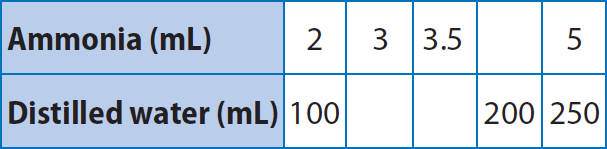
Question 1 :
Use the numbers in the first column of the table to write a ratio of distilled water to ammonia.
Solution :
100 ml distilled water / 2 ml ammonia (or) 100 : 2
Question 2 :
How much distilled water is used for 1 milliliter of ammonia?
Solution :
From the first column of the table, the ratio of distilled water to ammonia is
100 ml water / 2 ml ammonia
To find the quantity of distilled water used for 1 milliliter of ammonia, we have to make the second quantity (ammonia) as 1.
100 ml distilled water : 2 ml ammonia = (100 ÷ 2) / (2 ÷ 2)
100 ml distilled water : 2 ml ammonia = 50 / 1
That is,
50 ml distilled water / 1 ml ammonia
The quantity of distilled water used for 1 milliliter of ammonia is 50 ml.
Question 3 :
Use your answer from question 2, write another ratio of distilled water to ammonia.
Solution :
To write another ratio from the answer of question 2, we have find an equivalent ratio to 50 : 1.
To find equivalent ratio of the given ratio, we have to multiply both the terms of the ratio by the same non zero number, say "2".
Then, we have
(50x2) : (1x2) = 100 : 2
Therefore, another ratio of distilled water to ammonia is 100 : 2
Question 4 :
Check whether the two ratios from answers of question 1 and question 2 are equivalent or not equivalent.
Solution :
The two ratios from the answers of question 1 and 2 are
100 : 2 and 50 : 1
Let us check, whether two rations 100 : 2 and 50 : 1 are equivalent or not equivalent.
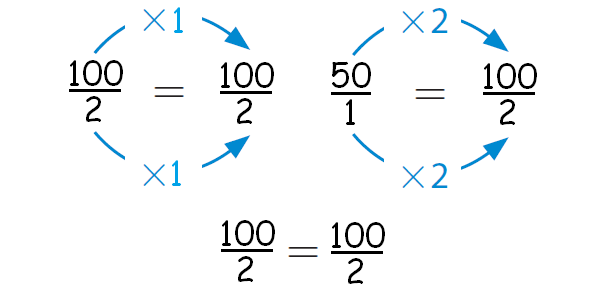
From the above working, it is clear that the two ratios 100 : 2 and 50 : 1 are equivalent.
Question 5 :
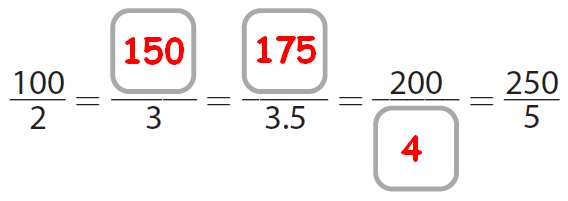
Complete the table. What are the equivalent ratios shown in the table ?
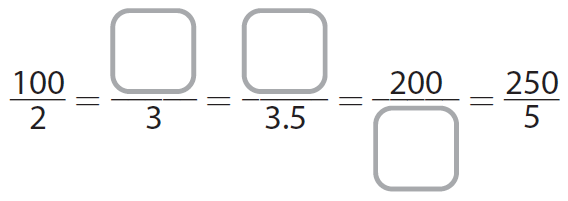
Solution :
For the first blank :
(100 ÷ 2) / (2 ÷ 2) = 50 / 1
(50 x 3) / (1 x 3) = 150 / 3
For the second blank :
(100 ÷ 2) / (2 ÷ 2) = 50 / 1
(50 ÷ 2) / (1 ÷ 2) = 25 / 0.5
(25 x 7) / (0.5 x 7) = 175 / 3.5
For the third blank :
(100 x 2) / (2 x 2) = 200 / 4
Then, we have
Question 6 :
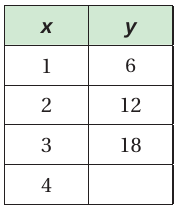
Using the numbers from the table, find and state the rule in words. Then find the missing value.
Solution :
Let x be the input and y be the output.
Ratio between input and output is 1 : 6
Let y be the missing output.
1 : 6 = 4 : y
1/6 = 4/y
y = 4(6)
y = 24
So, the missing output is 24.
Question 7 :
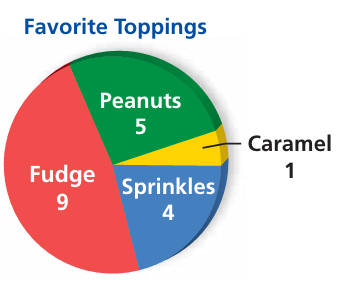
The circle graph shows the favorite ice-cream toppings of several students. Use ratio language to compare the number of students who favor peanuts to the total number of students.
Solution :
Total number of students = 5 + 1 + 4 + 9
= 19
Number of students who prefer peanuts = 5
Ratio between peanuts to total number of students.
= 5 : 19
Question 8 :
Lightning strikes Earth 1000 times in 10 seconds. How many times does lightning strike per second?
Solution :
Number of lightning strikes = 1000
Time taken = 10 seconds
Number of lightning strike per second = 1000/10
= 100 strikes
Question 9 :
You jog 2 kilometers in 12 minutes. At this rate, how long will it take you to complete a 5-kilometer race?
Solution :
Distance covered = 2 kilometers
Time taken = 12 minutes
Let x be the time taken to cover 5 kilometers.
2 : 12 = 5 : x
2/12 = 5/x
2x = 5(12)
x = 5(6)
x = 30
To jog 5 kilometers it takes 30 minutes.
Question 10 :
A printer prints 28 photos in 8 minutes.
a. How many minutes does it take to print 21 more photos?
b. How many minutes does it take to print 35 more photos?
Solution :
a) 28 photos in 8 minutes
Let x be the number of minutes for taking 21 photos.
28 : 8 = 21 : x
28/8 = 21/x
28x = 21(8)
x = 21(8)/28
x = 6 minutes
b) Let x be the number of minutes for taking 35 photos.
28 : 8 = 35 : x
28/8 = 35/x
28x = 35(8)
x = 35(8)/28
x = 10 minutes
Question 11 :
You mix 8 tablespoons of hot sauce and 3 cups of salsa in a green bowl. You mix 12 tablespoons of hot sauce and 4 cups of salsa in an orange bowl. Which mixture is hotter?
Solution :
Ratio between hot sauce to cups of salsa in a green bowl
= 8 : 3
Ratio between hot sauce to cups of salsa in a orange bowl
= 12 : 4
= 3 : 1
Multiplying both parts by 3, we get
= 9 : 3
Orange bowl mixture is hotter.
Subscribe to our ▶️ YouTube channel 🔴 for the latest videos, updates, and tips.
Kindly mail your feedback to v4formath@gmail.com
We always appreciate your feedback.
About Us | Contact Us | Privacy Policy
©All rights reserved. onlinemath4all.com

Recent Articles


-
Digital SAT Math Practice Test with Answers (Part - 17)
Sep 15, 26 12:10 PM
 Digital SAT Math Practice Test with Answers (Part - 17)
 -
Digital SAT Math Practice Test with Answers (Part - 16)
Sep 07, 26 11:23 AM
Digital SAT Math Practice Test with Answers (Part - 16) -
Digital SAT Math Practice Test with Answers (Part - 15)
Aug 23, 26 12:24 PM
 Digital SAT Math Practice Test with Answers (Part - 15)