FIND THE SUM OF N TERMS FROM THE GIVEN SUM OF SERIES
Subscribe to our ▶️ YouTube channel 🔴 for the latest videos, updates, and tips.
To find the sum of n terms of an arithmetic progression, we may use one of the formulas given below.
Sn = (n/2) [a + l] (or)
Sn = (n/2) [2a + (n - 1)d]
a = first term, d = common difference and n = number of terms.
Question 1 :
If the sum of 7 terms of an AP is 49 and that of 17 terms is 289, find the sum of first n terms.
Solution :
Given that :
S7 = 49
Sn = (n/2) [2a + (n - 1)d]
S7 = (7/2)[2a + (7-1)d]
(7/2)[2a + 6d] = 49
2a + 6d = 49⋅(2/7)
2a + 6d = 14
Dividing both sides by 2
a + 3d = 7 ------(1)
S17 = 289
S17 = (17/2)[2a + (17-1)d]
(17/2)[2a + 16d] = 289
2a + 16d = 289⋅(2/17)
2a + 16d = 34
Dividing both sides by 2
a + 8d = 17 ------(2)
(1) - (2)
a + 3d = 7
a + 8d = 17
(-) (-) (-)
------------------
-5d = -10
d = 2
By applying the value of d in (1), we get
a + 3(2) = 7
a + 6 = 7
a = 7 - 6 = 1
By applying the values of "a" and "d" in the formula for sum of n terms.
Sn = (n/2) [2a + (n - 1)d]
Sn = (n/2) [2(1) + (n - 1)2]
Sn = (n/2) [2 + 2n - 2]
Sn = n2
From the General Term Find the Sum of Series
Question 2 :
Show that a1, a2,............ an form an AP where an is defined as below
(i) an = 3 + 4n
(ii) an = 9 - 5n
Also find the sum of 15 terms in each case.
Solution :
(i) an = 3 + 4n
From the given general term, we may find the first term and common difference.
By applying n = 1, we get the first term.
|
n = 1 a1 = 3 + 4(1) = 7 |
n = 15 a2 = 3 + 4(15) = 63 |
First term (a) = 7, Last term (l) = 63
Number of terms = 15
Sn = (n/2) [a + l]
S15 = (15/2) [7 + 63]
= (15/2) (70)
= 15(35)
= 525
Hence the sum of 15 terms is 525.
(ii) an = 9 - 5n
From the given general term, we may find the first term and common difference.
By applying n = 1, we get the first term.
|
n = 1 a1 = 9 - 5(1) = 4 |
n = 15 a2 = 9 - 5(15) = = 9 - 75 = -66 |
First term (a) = 4,
Last term (l) = -66
Number of terms = 15
Sn = (n/2) [a + l]
S15 = (15/2) [4 - 66]
= (15/2) [-62]
= 15 (-31)
= -465
Hence the sum of 15 terms is -465.
Question 3 :
A partial sum of an arithmetic sequence is given. Find the sum
3 + 7 + 11 + ............. + 39
Solution :
a = 3, d = 7 - 3 ==> 4
Finding the number of terms :
l = 39 = an
a + (n - 1)d = 39
3 + (n - 1) (4) = 39
(n - 1)4 = 39 - 3
(n - 1)4 = 36
n - 1 = 9
n = 10
The series consists of 10 terms.
Finding the sum of 10 terms :
Sn = (n/2)[a + l]
S10 = (10/2)[3 + 39]
= 5(42)
= 210
So, the required sum of the series is 210.
Question 4 :
A partial sum of an arithmetic sequence is given. Find the sum
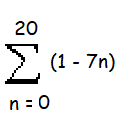
Solution :
|
When n = 0 = 1 - 7(0) = 1 |
When n = 1 = 1 - 7(1) = -6 |
When n = 2 = 1 - 7(2) = 1 - 14 = -13 |
1, -6, -13, ..........
First term = 1
Common difference = -6 - 1 ==> -7
By applying from 0 to 20, the series consists of 21 terms.
To find last term, we apply n = 20
= 1 - 7(20)
= 1 - 140
= -139
S21 = (21/2)[1 - 139]
= (21/2)[- 138]
= 21(-69)
= -1449
So, the required sum is -1449.
Question 5 :
A partial sum of an arithmetic sequence is given. Find the sum
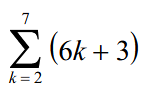
Solution :
|
When n = 2 = 6(2) + 3 = 12 + 3 = 15 |
When n = 3 = 6(3) + 3 = 18 + 3 = 21 |
When n = 4 = 6(4) + 3 = 24 + 3 = 27 |
15, 21, 27, ...........
a = 15, d = 21 - 15 ==> 6
The series consists of 6 terms.
By applying the n = 7, we get the last term.
Last term = 6(7) + 3
= 42 + 3
= 45
S6 = (n/2)[a + l]
= (6/2) [15 + 45]
= 3(60)
= 180
So, the required sum of the series is 180.
Subscribe to our ▶️ YouTube channel 🔴 for the latest videos, updates, and tips.
Kindly mail your feedback to v4formath@gmail.com
We always appreciate your feedback.
About Us | Contact Us | Privacy Policy
©All rights reserved. onlinemath4all.com

Recent Articles


-
Digital SAT Math Practice Test with Answers (Part - 18)
Nov 02, 26 05:29 PM
 Digital SAT Math Practice Test with Answers (Part - 18)
-
AP Calculus BC Problems with Solutions
Sep 30, 26 01:08 PM
 AP Calculus BC Problems with Solutions
-
Digital SAT Math Practice Test with Answers (Part - 17)
Sep 30, 26 01:00 PM
 Digital SAT Math Practice Test with Answers (Part - 17)