EVALUATE RADICAL EXPRESSIONS
Subscribe to our ▶️ YouTube channel 🔴 for the latest videos, updates, and tips.
To evaluate a radical expression, replace the variables in the expression by the given values of the variables and simplify order of operations.
After having replaced the variables by the given values, write the number inside the radical sign as a product of its factors.
Take one number out of the radical for every two same numbers multiplied inside the radical sign, if the radical is a square root.
Take one number out of the radical for every three same numbers multiplied inside the radical sign, if the radical is a cube root.
Examples :
√4 = √(2 ⋅ 2) = 2
√16 = √(2 ⋅ 2 ⋅ 2 ⋅ 2) = 2 ⋅ 2 = 2
3√27 = 3√(3 ⋅ 3 ⋅ 3) = 3
3√125 = 3√(5 ⋅ 5 ⋅ 5) = 5
Evaluate the following expressions using the given values of the variables.
Example 1 :
√x + √y for x = 4 and y = 9
Solution :
= √x + √y
Substitute x = 4 and y = 9.
= √4 + √9
= 2 + 3
= 5
Example 2 :
2√(185 - x) for x = 169
Solution :
= 2√(185 - x)
Substitute x = 169.
= 2√(185 - 169)
= 2√16
= 2√(4 ⋅ 4)
= 2(4)
= 8
Example 3 :
5√x3 for x = 3
Solution :
= 5√x3
Substitute x = 3.
= 5√33
= 5√(3 ⋅ 3 ⋅ 3)
= 5(3√(3)
= 15√3
Example 4 :
5√x + 1 for x = 1
Solution :
= 5√x + 1
Substitute x = 1.
= 5√1 + 1
= 5√1 + 1
= 5(1) + 1
= 5 + 1
= 6
Example 5 :
√(x/49) for x = 25
Solution :
= √(x/49)
Substitute x = 25.
= √(25/49)
= √25/√49
= √(5 ⋅ 5)/√(7 ⋅ 7)
= 5/7
Example 6 :
√(x2 + y2) for x = 3 and y = 4
Solution :
= √(x2 + y2)
Substitute x = 3 and y = 4.
= √(32 + 42)
= √(9 + 16)
= √25
= √(5 ⋅ 5)
= 5
Example 7 :
3√x - 3√y for x = 27 and y = 8
Solution :
3√x - 3√y
Substitute x = 27 and y = 8.
= 3√27 - 3√8
= 3 - 2
= 1
Example 8 :
√12w + √27w for w = 3
Solution :
= √(12w) + √(27w)
= √(2 ⋅ 2 ⋅ 3 ⋅ w) + √(3 ⋅ 3 ⋅ 3 ⋅ w)
= 2√3w + 3√3w
= 5√3w
Substitute w = 3.
= 5√(3 ⋅ 3)
= 5(3)
= 15
Example 9 :
3√8x3y6 + √9x2y4 for x = 1 and y = 2
Solution :
= 3√8x3y6 + √9x2y4
= 3√(2 ⋅ 2 ⋅ 2 ⋅ x ⋅ x ⋅ x ⋅ y2 ⋅ y2 ⋅ y2) + √(3 ⋅ 3 ⋅ x ⋅ x ⋅ y2 ⋅ y2)
= 2xy2 + 3xy2
= 5xy2
Substitute x = 1 and y = 2.
= 5(1)(22)
= 5(1)(4)
= 20
Example 10 :
√4p2q4 - 3√125p3q6 for p = -2 and q = -3
Solution :
= √4p2q4 - 3√125p3q6
= √(2 ⋅ 2 ⋅ p ⋅ p ⋅ q2 ⋅ q2) - √(5 ⋅ 5 ⋅ 5 ⋅ p ⋅ p ⋅ p ⋅ q2 ⋅ q2 ⋅ q2)
= 2pq2 - 5pq2
= -3pq2
Substitute p = -2 and q = -3.
= -3(-2)(-3)2
= -3(-2)(9)
= 54
Example 11 :
If the area A of a square is known, then the length of its sides s, can be computed by the formula s = A1/2
a) Compute the length of side of a square having an area of 100 square inches.
b) Compute the length of the side of a square having an area of 72 square inches. Round your answer to the nearest tenth.
Solution :
Given that, side length of the square
s = A1/2
a) Here area A = 100 square inches
s = 1001/2
s = (102)1/2
= 102 x (1/2)
= 10
So, the side length of the square is 10 inches.
b) Here area A = 72 square inches
s = 721/2
s = (72)1/2
= 8.48
Example 12 :
The time T(in seconds) for a pendulum to make one complete swing back and forth is approximated by
T(x) = 2π√(x/32)
where x is the length of the pendulum in feet. Determine the exact time required for one swing for a pendulum that is 1 ft long. Then approximate the time to the nearest hundredth of a second.
Solution :
T(x) = 2π√(x/32)
x is the length of pendulum, that is x = 1 ft
T(1) = 2π√(1/32)
= 2π (√1/√32)
= 2π [√1/√(2 x 2 x 2 x 2 x 2)]
= 2π (1/4√2)
= (π/2√2)
Example 13 :
An object is dropped off a building x meters tall. The time T(in seconds) required for the object to hit the ground is given by
T(x) = √(10x/49)
Find the exact time required for the object to hit the ground if it is dropped off the First National Plaza Building in Chicago, a height of 230 m. Then round the time to the nearest hundredth of a second.
Solution :
x is the height and that is h = 230 m
T(230) = √(10(230)/49))
= √46.93
= 6.85
So, the required time is 7 minutes
Example 14 :
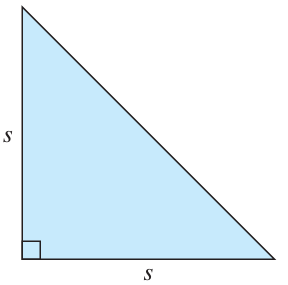
The length of the legs, s, of an isosceles right triangle is
s = √2A
where A is the area. If the lengths of the legs are 9 in., find the area.
Solution :
s = √2A
Length of legs = 9 inches
9 = √2A
Squaring on both sides, we get
92 = (√2A)2
81 = 2A
A = 81/2
A = 40.5 square inches.
So, the required area of the triangle is 40.5 square inches.
Example 15 :
Use the Pythagorean theorem to find a, b, or c.
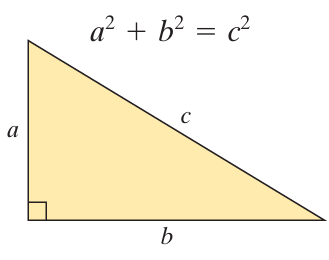
a) Find b, when a = 2 and c = y
b) find b when a = h and c = 5
c) find a, when b = x and c = 8
Solution :
a2 + b2 = c2
a) when a = 2 and c = y
22 + b2 = y2
b2 = y2 - 22
b2 = y2 - 4
b = √(y2 - 4)
b) when a = h and c = 5
h2 + b2 = 52
b2 = 52 - h2
b2 = 25 - h2
b = √(25 - h2)
c) when b = x and c = 8
a2 + x2 = 82
a2 = 64 - x2
a = √(64 - x2)
Subscribe to our ▶️ YouTube channel 🔴 for the latest videos, updates, and tips.
Kindly mail your feedback to v4formath@gmail.com
We always appreciate your feedback.
About Us | Contact Us | Privacy Policy
©All rights reserved. onlinemath4all.com

Recent Articles


-
Digital SAT Math Practice Test with Answers (Part - 2)
Apr 13, 26 06:21 PM
 Digital SAT Math Practice Test with Answers (Part - 2)
 -
Digital SAT Math Questions and Answers (Part - 13)
Apr 13, 26 12:18 PM
Digital SAT Math Questions and Answers (Part - 13) -
SAT Math Resources (Videos, Concepts, Worksheets and More)
Apr 09, 26 07:46 PM
SAT Math Resources (Videos, Concepts, Worksheets and More)