CUBE ROOTS AND RADICALS
Subscribe to our ▶️ YouTube channel 🔴 for the latest videos, updates, and tips.
Finding cube root of a number is the inverse operation of finding cube.
The radical of a number is the same as the root of a number. The root may be square root or cube root and so on.
So, cube root is also a radical with index 3.
Finding Cube Root a Number
To obtain cube root of a number, we can use the prime factorization method.
Step 1 :
Write the number inside the cube root as a product of prime numbers.
Step 2 :
We can take one number out of cube root for every three same numbers multiplied inside the cube root.
Radicals
Addition, subtraction, multiplication and division of radical terms can be performed by some laws. Let us see the rules one by one.
Rule 1 :
When we have two or more radicals are multiplied with same index, then we can take the radical in common.
Rule 2 :
When we have two radicals are in division with same index, then we can take radical in common.
Rule 3 :
nth root of 'a' can be written as 'a' to the power 1/n. When we have power to the power, we can multiply both powers.
Example 1 :
Find the cube root of 512.
Solution :
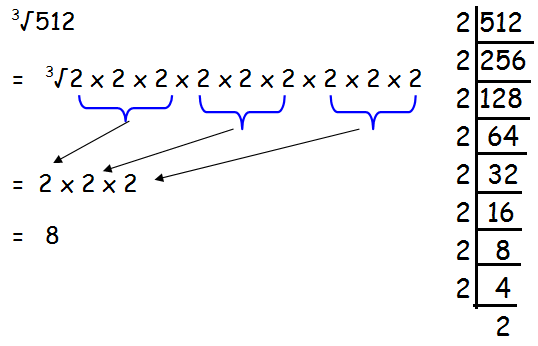
Hence cube-root of 512 is 8.
Example 2 :
Find the cube-root of 27 x 64
Solution :
= ∛27 x 64
We can write 27 as 3 x 3 x 3, like wise 64 as 4 x 4 x 4.
= ∛3 x 3 x 3 x 4 x 4 x 4
= 3 x 4
= 12
Hence the answer is 12.
Example 3 :
Find the cube-root of 125/216.
Solution :
Here we need to find the cube-root for a fraction. For that, split the numerator and denominator as much as possible.
= ∛125/216
125 = 5 x 5 x 5 and 64 = 4 x 4 x 4
= ∛(5 x 5 x 5) /(4 x 4 x 4)
Since we have cube-root, we need to take one for each three same terms.
= 5/4
Hence the cube root of 125/216 is 5/4.
Example 4 :
Find the cube-root of -512/1000.
Solution :
Here we need to find the cube-root for a fraction. In the cube-root we have negative sign.
Whenever we have negative sign inside the cube-root, the answer must have negative sign.
= ∛512/1000
512 = 8 x 8 x 8 and 1000 = 10 x 10 x 10
= - ∛(8 x 8 x 8)/(10 x 10 x 10)
Since we have cube-root, we need to take one for each three same terms.
= - 8/10
If it is possible, we may simplify
= - 4/5
Hence the cube-root of ∛-512/1000 is -4/5.
Example 5 :
Find the cube-root of 0.027.
Solution :
Here we need to find the cube-root for a decimal.
First let us convert the given decimal as fraction. For that, we have to multiply and divide by 1000.
0.027 x (1000/1000) = 27/1000
∛0.027 = ∛27/1000
= ∛(3 x 3 x 3)/(10 x 10 x 10)
= 3/10
Hence the cube-root of ∛0.027 is 3/10.
Example 6 :
Simplify the following radical terms
4√3, 18√2, -3√3, 15√2
Solution :
= 4√3 + 18√2 - 3√3 + 15√2
To simplify the above terms, we need to combine the like terms
= 4√3 - 3√3 + 18√2 + 15√2
= (4 - 3) √3 + (18 + 15) √2
= 1√3 + 33√2
= √3 + 33√2
Example 7 :
Simplify the following radical terms
2∛2, 24∛2, - 4∛2
Solution :
= 2∛2 + 24∛2 - 4∛2
= (2 + 24 - 4) ∛2
= 22 ∛2
Example 8 :
Multiply ∛13 x ∛5
Solution :
= ∛13 x ∛5
Since the index of both root terms are same, we can write only one root sign and multiply the numbers.
= ∛(13 x 5)
= ∛65
Example 9 :
Multiply 15√54 ÷ 3√6
Solution :
= 15√54 ÷ 3√6
Since the index of both root terms are same, we can write only one root and divide the numbers.
= (15/3)√(54/6)
= 5√9 ==> 5√(3 x 3) ==> 5 x 3 ==> 15
Example 10 :
Multiply (48)1/4 ÷ (72)1/8
Solution :
= (48)1/4 ÷ (72)1/8
Since the index of the above root terms are not same, we need to convert the power 1/4 as 1/8.
= (48)(1/4) x (2/2) ÷ (72)1/8
= (48)(2/8) ÷ (72)1/8
= 482 (1/8) ÷ (72)1/8
= [(48 x 48) ÷ (72)]1/8
= [2304 ÷ 72]1/8
= (32)1/8
Example 11 :
Is 1188 a perfect cube? If not, by which smallest natural number should 1188 be divided so that the quotient is a perfect cube?
Solution :
Decomposing 1188,
= 2 x 2 x 3 x 3 x 3 x 11
1188 is not a perfect cube, to group them as three same values we need ignore one 2 and two 11's. So,
= 2 x 11 x 11
That is, 242 is to be divided to make 1188 as perfect cube.
Example 12 :
A cubical box has a volume of 512000 cubic cm. What is the length of the side of box?
Solution :
Volume of cubical box = 512000 cubic cm
Let a be the side length of cube
a3 = 512000
a = ∛512000
= ∛(8 x 8 x 8 x 10 x 10 x 10)
= 8 x 10
= 80 cm
So, the side length of the cube is 80 cm.
Subscribe to our ▶️ YouTube channel 🔴 for the latest videos, updates, and tips.
Kindly mail your feedback to v4formath@gmail.com
We always appreciate your feedback.
About Us | Contact Us | Privacy Policy
©All rights reserved. onlinemath4all.com

Recent Articles


-
Tricky SAT Math Problems Solved Easily
Feb 19, 26 09:11 AM
 Tricky SAT Math Problems Solved Easily
 -
Digital SAT Math Problems and Solutions
Feb 18, 26 03:01 AM
 Digital SAT Math Problems and Solutions
 -
Conquering the Hardest SAT Math Questions
Feb 18, 26 02:24 AM
 Conquering the Hardest SAT Math Questions