AREA OF COMPOSITE FIGURES 7TH GRADE
Subscribe to our ▶️ YouTube channel 🔴 for the latest videos, updates, and tips.
A composite figure is made up of several simple geometric figures such as triangles, rectangles, squares, circles, and semicircles.
To find the area of a composite figure, separate the figure into simpler shapes whose area can be found. Then add the areas together.
Be sure than none of the simpler figures have overlapping areas.
Example 1 :
Find the area of the figure shown below.
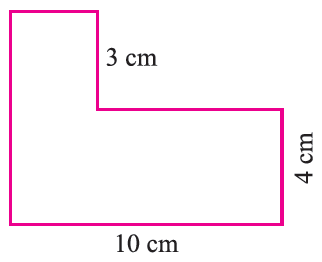
Solution :
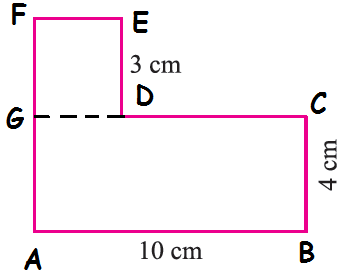
By drawing a line GD parallel to AB, we can split the given picture as two parts.
(i) GDEF is a square of side length 3 cm
(ii) ABCG is a rectangle of length 10 cm and width 4 cm
Area of square = a2
Area of rectangle = length ⋅ breadth
Area of square (GDEF) = 32 = 9 cm2
Area of rectangle = 10 ⋅ 4 = 40 cm2
Area of the given figure = 40 + 9 = 49 cm2
Example 2 :
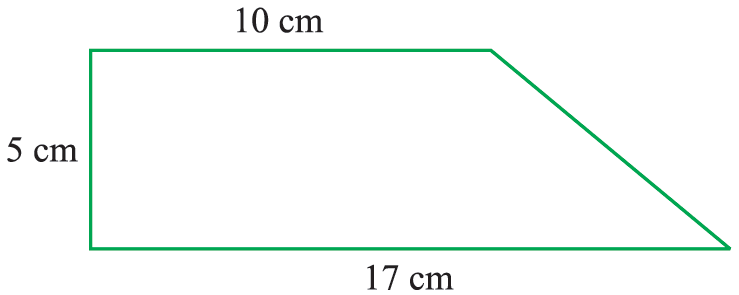
Find the area of the figure shown below.
Solution :
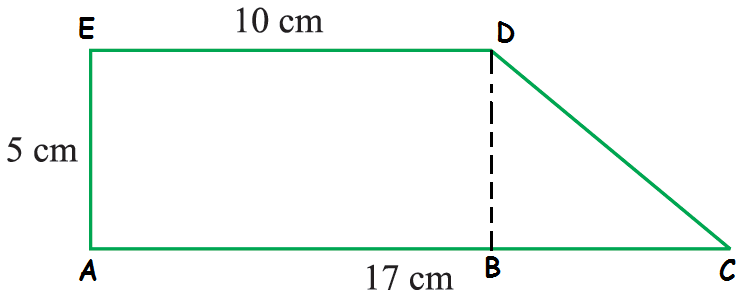
By drawing a line BD parallel to AE, we can split the given picture as two parts.
(i) BCD is a triangle
(ii) ABED is a rectangle
Area of triangle = (1/2) ⋅ b ⋅ h
Area of rectangle = length ⋅ breadth
length of AC = 17
AB + BC = 17 ==> 10 + BC = 17 ==> BC = 7 cm
Area of triangle = (1/2) ⋅ 7 ⋅ 5 = 35/2 ==> 17.5 cm2
Area of rectangle = 10 ⋅ 5 = 50 cm2
Area of given shape = 17.5 + 50 ==> 67.5 cm2
Example 3 :
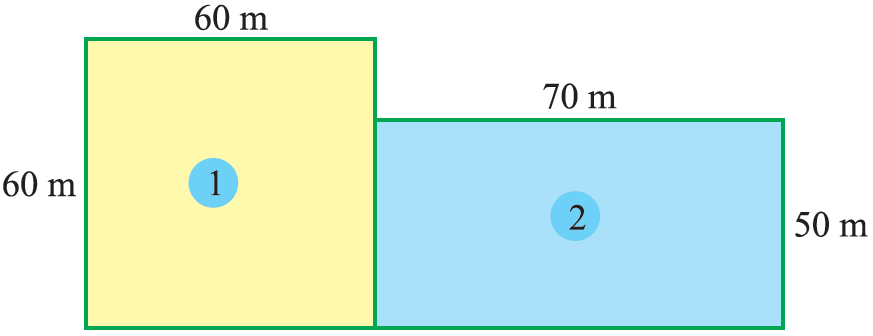
John bought a square plot of side 60 m. Adjacent to this David bought a rectangular plot of dimension 70 m x 50 m. Both paid the same amount. Who is benefited ?
Solution :
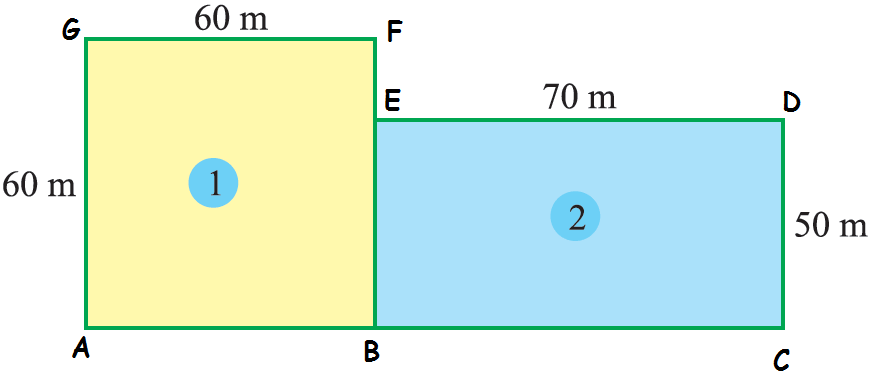
To find who is benefited, we have to find the area of above shapes separately.
(i) ABFG is a square of side length 60 m
(ii) BCDE is a rectangle of length 70 m and width 50 m.
Area of square = a2
Area of rectangle = length x breadth
Area of ABFG = 602 = 60 x 60 = 3600 m2
Area of rectangle = 70 x 50 = 3500 m2
From the above calculation, we come to know that John is having more area than David. So John is more benefited.
Example 4 :
Find the area of the figure shown below.
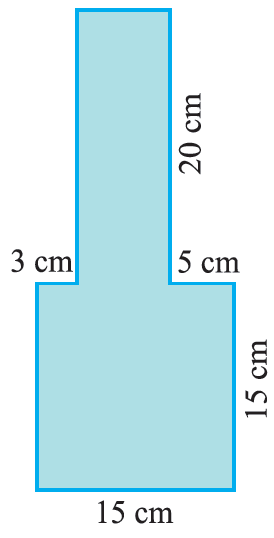
Solution :
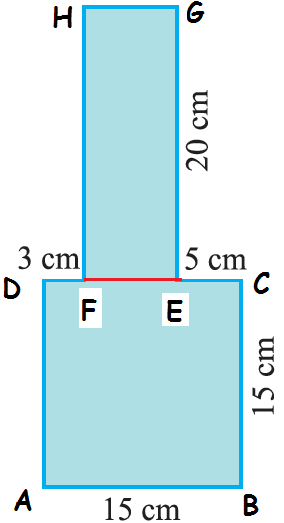
(i) ABCD is a square of side length 15 cm
(ii) Area of rectangle FEGH
Length of DC = 15
DF + FE + EC = 15 ==> 3 + FE + 5 = 15
FE = 15 - 8 ==> FE = 7 cm
Area of square (ABCD) = a2 ==> 152 ==> 225 cm2
Area of rectangle (FEGH) = length x width
= 20 x 7 = 140 cm2
Area of the given figure = 225 + 140 = 365 cm2
Example 5 :
Daniel bought a square plot of side 50 m. Adjacent to this Richard bought a rectangular plot of length 60 m and breadth 40 m for the same price. Find out who is benefited and how many sq. m. are more for him?
Solution :
Area of square plot = a2.
Side length of square = 50 m.
Area of land owned by Daniel = 502.
= 50 ⋅ 50
= 2500 m2
Area of land owned by Richard = length ⋅ width
= 60 ⋅ 40
= 2400 m2
Since Daniel is having more area than Richard, we can decide that Daniel is benefited.
Daniel is having 100 m2 more area than Richard.
Subscribe to our ▶️ YouTube channel 🔴 for the latest videos, updates, and tips.
Kindly mail your feedback to v4formath@gmail.com
We always appreciate your feedback.
About Us | Contact Us | Privacy Policy
©All rights reserved. onlinemath4all.com

Recent Articles


-
Digital SAT Math Practice Test with Answers (Part - 17)
Sep 15, 26 12:10 PM
 Digital SAT Math Practice Test with Answers (Part - 17)
 -
Digital SAT Math Practice Test with Answers (Part - 16)
Sep 07, 26 11:23 AM
Digital SAT Math Practice Test with Answers (Part - 16) -
Digital SAT Math Practice Test with Answers (Part - 15)
Aug 23, 26 12:24 PM
 Digital SAT Math Practice Test with Answers (Part - 15)